Hast Rekha Gyan — 5 Myths Everyone Repeats
Trikaal Sandesh — Direct Answer
Hast Rekha Shastra is the palmistry branch of Samudrika Shastra, the classical Indian science of reading the body. It maps five main lines — Jeevan, Mastishk, Hriday, Bhagya and Vivah — plus seven planetary mounts. It reads constitution, temperament and direction, not lifespan, disease or fixed dates, and needs no birth time.
Deep Dive Analysis
What is Hast Rekha and Samudrika Shastra?
Samudrika Shastra is the classical Indian science of reading the human body as a record. It has several branches: the face (Mukha Samudrika), the feet (Pada Lakshana), the forehead, and the hand. The branch that reads the hand is called Hast Rekha Shastra — palmistry.
The tradition holds that the hand is not decoration. It is a map. The lines, the mounts, the shape of the fingers and the texture of the skin together describe temperament, capacity, drive, and the pressure points of a life. Classical sources for this knowledge include the Samudrika Shastra corpus itself, the Hasta Sanjeevani, the Hast Rekha sections attributed to the Ravan Samhita, and the body-reading chapters of Varahamihira's Brihat Samhita.
Vedic astrology and palmistry are sister sciences, not rivals. Jyotish reads the sky at the moment you were born. Samudrika Shastra reads the imprint that moment left on your body. In classical practice a competent astrologer checked both — the chart for timing, the hand for constitution.
The mounts of the palm carry planetary names for exactly this reason. The mound below the index finger is the Guru Parvat (Jupiter). Below the middle finger sits Shani Parvat (Saturn). Below the ring finger, Surya Parvat (Sun). Below the little finger, Budh Parvat (Mercury). The base of the thumb is Shukra Parvat (Venus), the outer edge is Chandra Parvat (Moon), and the two Mangal zones (Mars) sit on the thumb side and the percussion side. The same nine planets, read on a different surface.
Why palm reading matters when you do not know your birth time
This is the practical reason Hast Rekha still matters in 2026.
Every serious Vedic calculation depends on birth time. Your Lagna (Ascendant) changes roughly every two hours. Move the birth time by twenty minutes and house positions shift; move it by an hour and the entire chart changes character. That is why every tool on our free calculators page asks for date, time and place of birth.
But an enormous number of Indians simply do not have an accurate birth time. Home births with no record. A time written from memory decades later. A hospital slip that recorded the time of registration, not the time of the first breath. A rounded 'about 6 in the morning' that could be anything from 5:15 to 6:45.
For these people a birth chart is a guess dressed as a calculation. And a guessed chart produces confident, precise, wrong predictions — which is worse than no prediction at all.
Your palm does not have this problem. It is present, physical and current. This is the one classical reading that needs nothing but your hand — which is why the AI Hast Rekha Calculator is where you should start when your birth time is unknown or unreliable.
The major lines of the palm
Jeevan Rekha (Life Line). Curves around the base of the thumb, enclosing the Shukra Parvat. It describes vitality, stamina and physical constitution — how much fuel you run on and how you recover from strain. A deep, clear, wide-arcing life line indicates strong reserves. A thin or fragmented one indicates a constitution that needs protecting.
It does not measure lifespan. This is the single most damaging myth in palmistry and we will state it plainly: a short life line does not mean a short life. No line on your hand predicts death. Anyone who tells you otherwise is either untrained or selling fear.
Mastishk Rekha (Head Line). Runs across the centre of the palm. It describes how you think — not how intelligent you are, but the shape of your intelligence. A straight, level head line indicates practical, analytical, sequential thinking. A head line sloping toward the Chandra Parvat indicates imaginative, associative, creative thinking. A long line means depth of engagement; a short one means directness and speed.
Hriday Rekha (Heart Line). The uppermost of the three main lines. It describes emotional temperament — how you attach, how you express affection, how you handle emotional injury. A heart line ending under the Guru Parvat suggests idealism in love and high expectations of a partner. Ending under Shani suggests a more self-directed, physically-driven emotional nature. A chained or broken heart line indicates emotional turbulence, not doom.
Bhagya Rekha (Fate Line). Rises vertically toward the middle finger. This is the career and life-direction line, and it is the one people ask about most. A strong, unbroken fate line indicates a clear, early-defined path. A broken fate line is not a curse — it typically marks career changes, restarts and redirections. A fate line rising from the Chandra Parvat indicates a career supported by other people, by the public, or by work done far from home.
Many people have no fate line at all. This does not mean no career. It usually means a self-constructed path rather than an inherited or institutionally defined one.
Surya Rekha (Sun Line). Runs toward the ring finger. It indicates recognition, reputation and public visibility — the difference between doing good work and being *known* for good work. A clear Sun line alongside a strong fate line is one of the most favourable career combinations in Samudrika Shastra.
Budh Rekha (Mercury Line). Communication, commerce and business acumen.
Vivah Rekha (Marriage Line). Short horizontal lines below the little finger, describing significant bonds — their depth, their relative timing and their disturbances.
Swasthya Rekha (Health Line). Read strictly as a constitutional and stress indicator. See the health section below for our firm position on this.
Each of these lines has its own full reading, and the detail matters more than the summary above: the life line measures vitality rather than lifespan, the fate line tracks the shape of a working life, the heart line and the head line together decide how feeling and judgement cooperate, while the marriage line and the sun line speak to bonds and recognition.
A gap in the heart line has its own deep-dive: broken heart line palmistry explains where the break sits, which hand it is in and what it does not mean.
To practise the order in which a reader moves from line to line, follow the step-by-step palm line reading guide.
The seven mounts (Parvat) and what they reveal
The mounts are the raised pads of the palm. Their relative elevation shows which planetary energy dominates your nature.
- Guru Parvat (Jupiter) — below the index finger. Leadership, ambition, ethics, teaching instinct, the desire to be respected. Well developed: natural authority. Flat: reluctance to lead.
- Shani Parvat (Saturn) — below the middle finger. Discipline, patience, endurance, solitude, the capacity for long unglamorous work. Over-developed: severity and isolation.
- Surya Parvat (Sun) — below the ring finger. Creativity, charisma, artistic ability, the pull toward recognition.
- Budh Parvat (Mercury) — below the little finger. Speech, negotiation, commerce, quick calculation. Strong here is the classic trader's and communicator's hand.
- Shukra Parvat (Venus) — the fleshy base of the thumb, enclosed by the life line. Vitality, sensuality, love of comfort, beauty and family warmth. A full Shukra Parvat indicates real physical and emotional energy.
- Chandra Parvat (Moon) — the outer heel of the palm. Imagination, intuition, emotional depth, attraction to travel and water. Strongly linked to creative and public-facing careers.
- Mangal (Mars) — two zones. Upper Mangal (courage under pressure, resilience) and Lower Mangal (aggression, physical drive), with the Mangal Kshetra (Plain of Mars) between them, which shows how you handle conflict.
A hand is read as a system. One raised mount means little on its own; what matters is which mounts dominate, which are flat, and whether the lines support or contradict them.
A mount is never read alone, and the full method for judging which one dominates a hand is set out in the guide to the seven mounts of the palm.
For a labelled tour of every zone, including fingers, thumb and mounts, see the palmistry hand map.
Signs and symbols on the palm: M, machli, trishul and more
Beyond the lines, Samudrika Shastra reads the small marks. These are the most-searched topics in Indian palmistry, and the most misrepresented.
- The M sign — formed when the head, heart, life and fate lines meet to trace the letter M. Traditionally read as a mark of self-made success and strong instincts. It is also far more common than social media suggests. A good sign, not a rare miracle.
- Machli / Fish sign (Matsya) — an auspicious mark, classically linked to prosperity and divine favour, especially on the Chandra Parvat or near the wrist.
- Trishul (Trident) — a strong sign wherever it appears, amplifying the quality of that mount. On the Guru Parvat it is one of the finest marks in the tradition.
- Star — intensity. On a benefic mount it means sudden elevation; on an afflicted line it means a sharp, disruptive event.
- Triangle — learning, skill and intelligence applied to the quality of that mount.
- Square — a mark of protection. It indicates preservation through a difficult phase.
- Cross — obstruction or a decisive turning point, depending on placement.
- Island — a period of division, drain or scattered energy on the line it sits on. An island on the fate line corresponds to a career phase of confusion or blocked progress.
- Grille — dispersed, wasted or blocked energy on that mount.
- Swastik, Kalash, Shankh, Chakra, Kamal (lotus), Mandir (temple) — the classical auspicious symbols, all considered marks of merit, and all considerably rarer than the internet claims.
An honest caution: a single symbol never decides a life. Its meaning depends entirely on which mount or line carries it, and on what the rest of the hand supports. Any reading that hangs your entire fortune on one mark is selling you something.
Every sign named here carries a longer classical reading: the M sign, the fish or machli, the trishul, the star, triangle and square, the cautionary island, cross and grille, and the genuinely rare auspicious marks that most hands simply do not have.
Stop guessing at your own hand
You are reading this because you looked at your palm and could not tell what you were looking at. That is not a failing — the marks are small, the light is never right, and you are the one person in the world who most wants a particular answer.
A palmist charges ₹500 to ₹2,000 to settle it, and in the offline market a great many of them will tell you what you want to hear, because the follow-up puja is where their margin sits.
The AI Hast Rekha Calculator settles it from one photograph — and it has one honest advantage over both a palmist and your own hopeful eye: it is not rooting for you.
- No birth time. No birth date. No birth place. Your palm is enough — which is the whole point if your birth time was never reliable.
- 6 lines, 7 mounts, 8 life scores — read against the full hand, not one mark in isolation
- Classical Samudrika rules, personalised remedies, downloadable PDF report
- Your palm image is never stored on our servers — it stays in your browser session and is removed after analysis
- ₹51. No subscription, no upsell, no follow-up ritual to buy
Which hand should be read — left or right?
The classical rule is about dominance, not superstition.
The non-dominant hand shows what you arrived with — inherited constitution, family conditioning, latent potential. The dominant hand shows what you have done with it — the life you have actually built.
Traditional Indian practice reads the right hand first for men and the left first for women, and this convention still appears widely in the texts. In real practice a complete reading looks at both and reads the *difference* between them — because that difference is the most revealing thing on your body. It tells you how far you have moved from where you started.
For an AI reading, upload your dominant hand. Adding the second hand deepens the analysis but the dominant hand is what carries the current, active picture.
The honest answer depends on age, dominance and what the gap between the two hands is telling you, worked through case by case in which hand to read.
Career, wealth and marriage in the hand
Career. Read primarily from the Bhagya Rekha (path), the Surya Rekha (recognition), the Mastishk Rekha (thinking style), and the elevation of Guru, Shani, Surya and Budh.
A strong, straight fate line reaching Shani with a well-formed Guru Parvat is the classical structure for institutional authority — government service, administration, senior corporate roles. A fate line rising from the Chandra Parvat with a strong Budh Parvat points toward business, trade, public-facing work, or a career built through other people rather than a hierarchy. A prominent Surya Rekha adds visibility and reputation — the entrepreneur, the performer, the person whose name travels.
Wealth is never read from one line. It is read from convergence: fate, sun and Mercury working together, supported by mounts that show the temperament to actually hold what is earned. A hand can show earning capacity and simultaneously show the leak that empties it.
Marriage. The Vivah Rekha lines indicate significant, committed bonds — depth, relative timing, and strain. The Hriday Rekha matters just as much: it describes what you are like *inside* a relationship.
The honest position: no line on your hand names a person, a caste, a date, or a decision. Palmistry describes emotional temperament and relational patterns. It does not deliver marriage dates. If compatibility is your real question, a proper Kundali Milan — Nakshatra, Gana, Nadi and Mangal Dosha — is the correct instrument. Palm reading tells you who you are in love. Kundali Milan tells you how two charts meet.
The health line — read this carefully
Trikaal Vaani applies a strict rule here, and it does not bend.
The Swasthya Rekha and the Jeevan Rekha are read as indicators of vitality, stress load, stamina and constitutional strength. Nothing more.
We do not diagnose disease from a palm. We do not predict lifespan. We do not claim that a mark on your hand causes, foretells or explains a medical condition. A broken life line is not cancer. An island on the health line is not a warning of surgery. A palm reading is not a medical opinion and can never replace one.
If a palm reading anywhere on the internet tells you that a line indicates an illness or a limited lifespan, close the page. That is fear used as a sales tool, and it is the exact practice this platform was built against.
For any health concern, consult a qualified doctor. What Samudrika Shastra can honestly tell you is whether your constitution runs hot or cold, whether you burn energy faster than you replace it, and where your resilience sits. That is genuinely useful — and it can be said without alarm.
Can palm lines change? Yes — and that changes everything
This is one of the most misunderstood facts in the field.
The three major lines (life, head, heart) are formed before birth and are broadly stable. But the secondary lines change measurably over a lifetime. Fate lines strengthen, break, restart and reroute. Sun lines appear. Marriage lines deepen or fade. Fine lines multiply under sustained stress and recede under sustained calm.
Which means the hand is not a sentence. It is a current reading of a moving system.
This single fact is why remedies exist in the classical tradition at all. If the hand were fixed, remedial action would be meaningless. It is not fixed — which is why a palm reading taken at 25 and again at 40 will genuinely differ, and why what you do between those readings matters.
AI palm reading vs a traditional palmist vs a Kundali reading
Versus a traditional palmist. A good human palmist reading your hand in person, in good light, with the ability to tilt and press, has a detection advantage. What an AI engine offers instead is consistency and reach — the same classical rules applied the same way every time, at 3 AM, from anywhere, without the practitioner's mood, memory or commercial incentive entering the reading. It also cannot pressure you into an expensive follow-up puja, which is a real problem in the offline market.
Versus astrology (Kundali). These answer different questions. Jyotish reads planetary positions and Dasha periods, and is the stronger instrument for timing — when a career shift lands, when a marriage window opens. Palmistry reads constitution and disposition, and is the stronger instrument when birth time is unknown. They complement each other; they do not compete. Read our AI palm reading explainer for how the two fit together.
Versus face reading. The same Samudrika parent tradition, a different surface. The hand carries far more granular data.
If you want to test that claim before paying for anything, read our own assessment of whether palm reading is accurate, try the AI palm reading itself, or see how an online reading compares with finding a palmist near you.
How to take a palm photo the AI can actually read
Detection quality is the single biggest factor in the accuracy of an AI reading. Five rules:
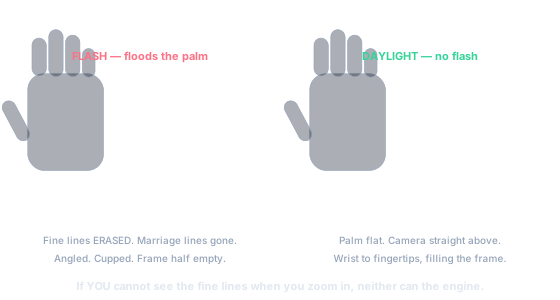
- Use daylight. No flash. Flash washes out the fine lines completely. Stand near a window.
- Open the palm flat — fingers slightly apart, not tensed, not cupped.
- Hold the camera directly above the palm, straight down. An angled shot distorts mount elevation.
- Fill the frame with the hand, wrist to fingertips.
- Check the photo before uploading. If you cannot see the fine lines yourself when you zoom in, neither can the engine.
Dominant hand. One clear photo. That is all that is required.
The engine reads what is visible in your photograph. It does not hallucinate lines that are not there, and it does not invent certainty it does not have. Give it a good photo and it gives you a good reading.
What an honest palm reading can and cannot tell you
A palm reading describes tendencies, temperament, capacity and pattern. It does not name people, dates, diseases or deaths.
Trikaal Vaani will not tell you that you will lose your job, that your marriage will fail, or that a line predicts illness — because those claims are unsupported by the classical texts and are used almost exclusively to sell fear.
Where Hast Rekha genuinely helps is in showing you the shape of your own constitution: where your energy runs, where it leaks, what kind of work fits your mind, and what kind of pressure your temperament handles badly. That is actionable. Doom is not.
For any remedial gemstone, always have a qualified astrologer analyse your precise birth chart before wearing it — check the gemstone suitability calculator first. And for questions of exact timing, a full Vedic chart reading remains the deeper instrument.
The rule set behind the Trikaal Vaani engine was built by Rohiit Gupta, Chief Vedic Architect, from 16+ years of practice in the Parashara (BPHS) tradition. Every rule it applies is traceable to a source text. Read your palm now for ₹51 — one photo, no birth time required.
Hand shapes and finger shapes: the layer most people skip
Before a single line is read, Samudrika Shastra reads the shape of the hand itself. Practitioners who jump straight to the lines are working with half the information.
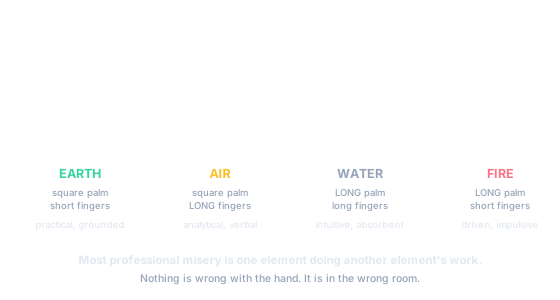
The classical division works from the proportion of the palm to the fingers, and it maps to the elements:
- Earth hand — square palm, short fingers, thick skin. Practical, grounded, physically capable, slow to change. Strong builders and operators.
- Air hand — square palm, long fingers, dry skin. Analytical, verbal, restless, quick to abstract. Communicators, strategists, teachers.
- Water hand — long palm, long flexible fingers, soft skin. Emotional, intuitive, absorbent, easily overwhelmed. Artists, healers, empaths.
- Fire hand — long palm, short fingers, firm skin. Driven, impulsive, magnetic, impatient. Founders, leaders, performers.
The fingers refine this further. Long fingers indicate attention to detail and patience with process; short fingers indicate speed, impatience and a preference for the outcome over the method. A long index finger (Guru) signals ambition and the need for authority. A long ring finger (Surya) signals creative risk appetite. A flexible thumb indicates adaptability, sometimes to the point of inconsistency; a stiff thumb indicates willpower, sometimes to the point of rigidity. The thumb, in classical Hast Rekha, is read as the seat of willpower itself — some texts hold that the thumb alone reveals more about a person's capacity to execute than any line on the palm.
Skin texture, palm flexibility, and the relative fullness of the hand complete the picture. A hand is read as a whole before it is read in parts.
Five myths about Hast Rekha that need to die
Myth 1: Your life line predicts how long you will live. It does not. It reflects vitality and constitution. This myth has caused more unnecessary fear than any other idea in palmistry, and it has no support in the classical texts.
Myth 2: No fate line means no career. Most self-made people have irregular or absent fate lines. An absent Bhagya Rekha usually indicates a path you build yourself rather than one handed to you.
Myth 3: The lines are fixed at birth and never change. The secondary lines change measurably across a lifetime. If they did not, no remedy in the tradition would make sense.
Myth 4: One auspicious sign guarantees wealth. A machli or trishul on the palm is a favourable indication, not a lottery ticket. Its meaning depends entirely on which mount carries it and whether the rest of the hand supports it. Any reader who builds your whole fortune on one mark is selling you something.
Myth 5: Palmistry can diagnose disease. It cannot, and no honest practitioner will claim otherwise. Vitality, stress load and constitutional strength — yes. Diagnosis — never. See a doctor.
Stripped of these five myths, Hast Rekha remains what it always was in the classical tradition: a disciplined reading of temperament, capacity and direction. That is a real and useful thing. It does not need to be inflated with fear to be worth your time.
Palmist, generic astrology app, or AI Hast Rekha — an honest comparison
Three ways to get your palm read in India today. Here is the honest version, including where we lose.
A traditional palmist in person. *Cost:* ₹500–₹2,000, often more. *Birth time:* not needed. *Strength:* a good human palmist, with your hand in front of them and the ability to tilt it to the light, will always have a detection advantage. We will not pretend otherwise — this is a genuine edge and it is real. *Weakness:* the reading varies with their mood, their memory and their commercial incentive. The follow-up puja, gemstone or ritual is frequently where the actual revenue lives, and that incentive shapes what you are told.
A generic astrology app or portal. *Cost:* free content, paid consultations. *Birth time:* usually required. *Strength:* volume and reach. *Weakness:* the free content is written to convert, not to inform — which is why the entire category tells you a fish sign means you will be rich, and why not one of them will tell you that most people are looking at an island.
Trikaal Vaani AI Hast Rekha. *Cost:* ₹51. *Birth time:* not required. *Strength:* the same classical rules applied the same way every time, at 3 AM, from anywhere — with no mood, no memory, no upsell, and no wish for you to have an auspicious mark. That last point is the one that matters. *Weakness:* it reads only what is visible in your photograph. A dark, blurred or angled photo produces weaker detection, and unlike a palmist it cannot tilt your hand to the light. Give it a bad photo and it gives you a weaker reading. That is a real limit and we would rather you knew it.
The honest summary: if you have access to a genuinely skilled, non-commercial palmist, use them. Most people do not. What we offer is a disciplined classical reading, at a price that does not require trust, from a system with no incentive to flatter you.
The Manibandh: the bracelet lines at the wrist
Below the palm, wrapping the wrist, sit two to four horizontal lines the shastra calls the Manibandh or Rascette. Classical Samudrika Shastra treats the first bracelet as the constitutional line: clear and unbroken suggests a steady base, chained or frayed suggests the body has been asked for more than it comfortably gives. The second and third are read for stability of circumstance, not for lifespan.
Most modern palmistry ignores the Manibandh entirely, which is why a reading that includes it immediately feels different. Read it alongside the life line and the Shukra mount — never on its own, and never as a count of decades.
Travel lines and foreign settlement in the hand
Short horizontal lines entering the palm from the percussion edge, below the Budh mount and across the Chandra mount, are read as travel lines. A deep line reaching toward the fate line is the classical marker for relocation that changes the working life, rather than a holiday. A well-developed Chandra mount strengthens the reading; Rahu placement in the chart is what actually times it.
Palmistry can suggest the inclination. It cannot give you a year. For that, the birth chart does the work — see which country suits your foreign settlement and the Rahu-Ketu axis in settlement astrology, or run the free foreign spouse calculator against your own birth data.
Moles on the palm and fingers — what Samudrika Shastra says about til
Til, the mole, is read in Samudrika Shastra by position, not by colour or size. A mole on the Guru mount is read for authority earned late; on Shukra, for intensity in relationships; on Budh, for money that arrives through speech or trade; in the centre of the palm, on the Rahu Kshetra, for a life with an unusual turn in it.
Two honest cautions. First, the right-hand and left-hand distinction people repeat online has no consistent classical basis — dominance matters more, as explained in which hand to read. Second, a mole is a minor modifier. It never overrides the major lines or the mount that carries it.
Nails, skin and hand colour — the layer beyond lines
Samudrika Shastra reads the whole hand, not only the lines. Nail shape is taken as a constitutional signal: long and narrow for a sensitive nervous system, short and broad for a blunt practical temperament, spoon-shaped or ridged as a prompt to check health rather than fate. Skin texture is read for refinement of temperament, and a warm pliant palm is read differently from a cold rigid one.
This layer is why a photograph has limits, and we say so plainly in how accurate palm reading really is. Colour and texture also shift with season and work, so they modify a reading — they never lead it.
The fingers: names, length and what each one governs
Each finger carries a planet and reports on the mount beneath it. The index is Tarjani, Guru — ambition and self-regard. The middle is Madhyama, Shani — discipline, restraint, the capacity to endure dull work. The ring finger is Anamika, Surya — expression and the appetite for recognition. The little finger is Kanishtha, Budh — speech, negotiation, commerce.
Length is read against the middle finger, never in absolute centimetres. A long Guru finger reads as a need to lead; a low-set Budh finger as a sense of being unheard early in life. Judge each against the mount below it, and the thumb separately, since the thumb decides whether any of it is acted on.
Timing and age on the palm lines — the honest method
Classical timing divides the life line along the arc of the Shukra mount and the fate line upward from the wrist, marking rough decades rather than dates. A break at roughly one-third along the life line points to a change in the twenties or early thirties; a fate line that restarts halfway up points to a mid-career turn.
The honest part: palm timing is approximate by nature, because the divisions are proportional to a hand, not to a calendar. Anyone offering you a specific year from a palm alone is guessing. Dasha periods in the birth chart are the instrument built for timing — check yours with the free dasha calculator and read it beside your fate line.
Is palm reading different for men and women?
The lines mean the same thing in every hand. What circulates as a gender rule — right hand for men, left for women — is a folk convention, not a shastra rule, and it collapses the moment you meet a left-handed person. The working rule is dominance: the dominant hand shows the life being lived, the other shows what was brought into it.
Where a genuine difference appears is in interpretation, not in the marks. A strong Guru mount in a hand whose owner was never allowed to lead reads as frustration rather than authority. That is context, not anatomy. The full method is in which hand to read.
Indian Samudrika Shastra vs Western palmistry
Western palmistry, shaped largely by Cheiro and the nineteenth-century revival, is built around character reading and the four elemental hand types. Indian Samudrika Shastra sits inside Jyotish: the mounts are planets, the marks are read as karmic residue, and the whole hand is treated as one limb of a body-reading tradition that includes the face and the feet.
The practical difference is remedy. Western palmistry describes; Samudrika Shastra expects the reading to connect to the birth chart and to an upay. That is also why we read the palm and the Kundali as two instruments pointed at one question, not as rivals.
Palm reading scanners and free apps — what they can and cannot do
Most free palm scanners do one of two things. Either they detect the four obvious lines and return pre-written paragraphs keyed to length and curve, or they return the same text to everyone and rely on the reader recognising themselves in it. Neither reads the mounts, and almost none read displacement, hand shape or the Manibandh.
The test is simple: upload two clearly different palms and see whether the output changes in substance. If it does not, you have a template, not a reading. Our own honest account of what an automated reading can and cannot claim is set out in is palm reading accurate, and you can run the Hast Rekha calculator yourself and apply that same test to us.
Can ChatGPT read your palm?
A general-purpose language model can describe your palm and produce fluent palmistry-flavoured prose. What it does not do is apply a fixed classical method — the same hand described twice can return different verdicts, because nothing anchors the reading to Samudrika Shastra rules about mount dominance, displacement and the amplifier signs.
That inconsistency is the real problem, not the technology. A reading is only worth something if the same hand produces the same judgement every time. That is the standard we hold our own AI palm reading to, and the same standard we apply to a Kundali reading — the method has to be fixed before the output can be trusted.
The rarest lines in palmistry — and why rare is oversold
The genuinely uncommon formations are the Simian line, where head and heart fuse into a single crease; a complete Girdle of Venus; a full unbroken Sun line running the height of the palm; and a clear Shankh on the fingertip. Together these appear in a small minority of hands.
Rarity is where the fear-and-flattery trade makes its money, because a rare mark is hard to verify and easy to sell. Two rules protect you. A rare mark on a weak mount delivers nothing, and a mark you cannot photograph clearly is a mark nobody can honestly read. The verification method is in rare auspicious signs on the palm.
Wealth in the hand: which marks actually indicate money
There is no dhan rekha, no single wealth line. What the shastra reads is a combination: a well-formed Budh mount for earning through trade and negotiation, a straight strong fate line for sustained income, a clean Sun line for recognition that converts into money, and a firm thumb for the discipline to keep it.
The triangle formed between head line, fate line and life line is read for accumulation — a closed clean triangle for retained wealth, an open one for money that arrives and leaves. Marks such as the fish sign or the star, triangle and square modify this picture; none of them creates it.
Children lines — what they show and what they cannot
The short vertical lines rising from the marriage line on the Budh mount are read classically as santan rekha. Traditional texts read deeper lines for sons and finer for daughters — a reading we state but do not endorse, because it has no reliable basis and has been used badly for a long time.
What these lines can honestly suggest is emotional investment in children, including children who are not biologically yours. They cannot give a number, a gender or a date. For anything close to a real answer on progeny, the fifth house and its dasha periods in the birth chart are the instrument, and the marriage line provides the surrounding context.
The palm surface in Brihat Samhita: hollow, raised and deep palms
Before any line is read, Varahamihira looks at the floor of the palm itself. Brihat Samhita says a deeply hollow palm marks people who lose or do not receive the wealth of their father, a palm that is deep but well closed marks the wealthy, and a raised, upturned palm marks generous givers.[3] In practice this means pressing the palm gently and watching how the centre behaves. A cupped, firm centre is the classical sign of a person who holds on to what comes in. A hollow centre is not a sentence of poverty. Trikaal Vaani reads it as a tendency to spend on others or to start without family capital, and the remedy is practical: put a fixed monthly saving aside before any spending, starting on a Thursday morning, for twelve months. Read the surface together with the seven mounts of the palm, because a strong Jupiter or Sun mount changes how a hollow centre plays out.
Yava marks on the thumb: the barley-grain sign
Brihat Samhita names a small mark shaped like a barley grain (yava) on the thumb as a sign of prosperity, and the same mark at the root of the thumb as a sign of sons, in the wording of the text. It adds that long finger joints point to good fortune and a long life.[4] On a real hand the yava usually sits on the middle joint of the thumb, formed where two curved creases meet and close. It is common, so do not treat it as rare luck. It is one positive marker, and it carries weight only when the fate line and the Jupiter mount agree with it. If you do not see a yava, nothing is missing, because the absence of a good sign is not a bad sign in the classical text.
Deep, smooth lines vs faint lines, and gaps between the fingers
The text gives a simple rule for line quality. Lines that are smooth and deep belong to the wealthy, and lines of the opposite kind belong to those without means. Fingers held with gaps between them are linked with poverty, and close-set fingers with people who save wealth.[5] Trikaal Vaani reads this as a statement about holding power, not about income. Faint lines and open fingers often show a person who earns well but lets money slip away, and the fix is behavioural: set an automatic transfer into a separate account on the day salary arrives, keep it for 90 days, and then review. Lines also deepen and fade over the years, as the section on changing palm lines explains, so a faint line today is not fixed for life. For the money lines in detail, read the sun line guide.
The classical list of auspicious figures on the palm
Brihat Samhita lists the shapes that count as fortunate when the lines form them. A thunderbolt (vajra) shape marks the wealthy, a fish-tail shape marks the learned, and a conch, umbrella, palanquin, elephant, horse or lotus shape marks a person of rule and authority.[6] Modern palmists talk mostly about the fish and the trident, but the classical list is wider and is about authority and learning, not about sudden lottery wealth. Two cautions apply. First, most of these figures are formed by chance crossings of minor lines, so a clear photo and a second look matter before anyone claims one on your hand. Second, a figure supports what the main lines already show and never overrides them. The rare auspicious signs guide and the fish sign page show how real examples look.
Lines reaching the index finger and the question of lifespan
One verse of Brihat Samhita is often quoted as a lifespan rule. Lines that reach the index finger (pradeshini) are read as a full life of a hundred years and shorter ones as proportionally less, broken lines as the risk of a fall, and a palm crowded with lines or almost without lines as a sign of want.[7] Trikaal Vaani does not read the age of death from any hand, and you should not accept anyone who does. The verse describes the classical estimate of vitality, and a short or broken line is read today as a call for care, not as a date. The practical step is plain: if a line looks broken, book a full health check once a year and keep that habit. Read the life line guide to see why a break is often covered by a sister line, and use the AI Hast Rekha reading for a full hand check.
The classical sources behind this guide
The one palmistry text in the Trikaal Library is Varahamihira's Brihat Samhita, Chapter 67 (Purusha Lakshana), so it is the only classical source this guide cites. Its general rule is that any limb that is dry, fleshless and bound with veins is inauspicious and the opposite wholly auspicious (Sl.83)[1] — a rule about the quality of what you see, not a date or a verdict. For the wrist, where the Manibandh lines begin, it says concealed, firm, well-fitted joints mark a person of standing and loose, noisy ones mark scarcity (Sl.38)[2]. Trikaal Vaani's reading: we use these as quality markers — clear, smooth, well-set lines read more favourably than faint, broken ones — and nothing in them gives lifespan, disease or dates.
Where the classical texts disagree with each other — and on the children lines and the gender rule they clearly do — this guide says so instead of picking the more saleable version. That standard is applied across every page in the palmistry cluster and every reading sold through the Hast Rekha calculator.
Apna Personalized Analysis Lein
Yeh article general framework hai. Aapke specific chart ke according detailed analysis ke liye:
शब्दावली · Glossary
- Hast Rekha
- The Indian system of reading the lines, mounts and signs of the palm to understand constitution and temperament.
- Samudrika Shastra
- The classical Indian science of reading the body's marks; Hast Rekha is its palm branch.
- Parvat (mount)
- A raised pad of the palm named after a graha — Guru, Shani, Surya, Budh, Shukra, Mangal or Chandra — which supplies the quality that the lines act on.
- Rekha
- A line of the palm; the main ones are the Jeevan, Mastishk, Hriday, Bhagya and Vivah Rekha.
- Manibandh
- The bracelet lines and joints at the wrist where the palm begins.
ग्रंथ सन्दर्भ · Classical Sources
The classical source behind every rule in this article — Granth, Adhyaya and Shlok number.
यद्यद् गात्रं रूक्षं मांसविहीनं शिरावनद्धं च । तत्तदनिष्टं प्रोक्तं विपरीतमतः शुभं सर्वम् ।
— Brihat Samhita, Adhyaya 67 — Purusha Lakshana Adhyaya · Shlok 83Whatever limb is dry, fleshless and bound with veins is called inauspicious; the opposite is wholly auspicious.
जो अंग रूखा, मांसहीन और नसों से जकड़ा हो वह अनिष्ट कहा गया है; इसके विपरीत सब कुछ शुभ है।
मणिबन्धनैः निगूढैः दृढैश्च सुश्लिष्टसन्धिभिः भूपाः । हीनैः हस्तच्छेदः श्लथैः सशब्दैश्च निर्द्रव्याः ।
— Brihat Samhita, Adhyaya 67 — Purusha Lakshana Adhyaya · Shlok 38Wrist joints that are concealed, firm and well-fitted mark persons of standing; deficient ones bring injury to the hand, and loose, noisy ones mark those without means.
मणिबंध की संधियाँ छिपी हुई, दृढ़ और भली-भाँति जुड़ी हों तो प्रतिष्ठित व्यक्ति का लक्षण; हीन हों तो हाथ को हानि, और ढीली तथा आवाज़ करने वाली हों तो निर्धनता।
पितृवित्तेन विहीना भवन्ति निम्नेन करतलेन नराः । संवृतनिम्नैः धनिनः प्रोत्तानकराश्च दातारः ।
— Brihat Samhita, Adhyaya 67 — Purusha Lakshana Adhyaya · Shlok 39A hollow palm marks those deprived of the wealth of their father, a deep but closed palm marks the wealthy, and a raised, upturned palm marks givers.
गहरी (नीची) हथेली वाले पिता के धन से वंचित, गहरी पर बंद हथेली वाले धनी, और उठी हुई हथेली वाले दानी होते हैं।
अंगुष्ठयवैः आढ्याः सुतवन्तो अंगुष्ठमूलजैश्च यवैः (मूलगैश्च यवः) । दीर्घांगुलिपर्वाणः सुभगा दीर्घायुषश्चैव ।
— Brihat Samhita, Adhyaya 67 — Purusha Lakshana Adhyaya · Shlok 42Barley-grain marks on the thumb mark the prosperous, such marks at the root of the thumb mark those with sons, and long finger joints mark the fortunate and long-lived.
अंगूठे पर यव के चिह्न से धनी, अंगूठे की जड़ में यव से पुत्रवान, और उंगलियों के लंबे पोरों से सौभाग्यशाली तथा दीर्घायु।
स्निग्धा निम्ना रेखा धनिनां तद्व्यत्ययेन निःस्वानाम् । विरलांगुलयो निःस्वा धनसंचयिनो घनांगुलयः ।
— Brihat Samhita, Adhyaya 67 — Purusha Lakshana Adhyaya · Shlok 43Smooth, deep lines belong to the wealthy and the opposite to those without means. Gapped fingers mark the poor and close-set fingers those who save wealth.
चिकनी और गहरी रेखाएँ धनी की, उल्टी हों तो निर्धन की। उंगलियों में फासला निर्धनता का, सटी हुई उंगलियाँ धन-संचय का लक्षण।
वज्राकारा धनिनां विद्याभाजां च मीनपुच्छनिभाः । शंख आतपत्रशिविकागजाश्वपद्मौपमा नृपतेः ।
— Brihat Samhita, Adhyaya 67 — Purusha Lakshana Adhyaya · Shlok 45Thunderbolt-shaped lines mark the wealthy, fish-tail shapes the learned, and conch, umbrella, palanquin, elephant, horse or lotus shapes a ruler.
वज्र आकार की रेखाएँ धनी की, मछली की पूँछ जैसी विद्वान की, और शंख, छत्र, पालकी, हाथी, घोड़ा या कमल जैसी राजा की।
रेखाः प्रदेशिनिगताः (गाः) शतायुषं कल्पनीयमूनाभिः । छिन्नाभिः द्रुमपतनं बहुरेखारेखिणो निःस्वाः ।
— Brihat Samhita, Adhyaya 67 — Purusha Lakshana Adhyaya · Shlok 50Lines reaching the index finger indicate a life of a hundred years, shorter ones less in proportion, broken ones a fall from a tree, and many lines or no lines poverty.
तर्जनी तक पहुँचने वाली रेखाएँ सौ वर्ष की आयु, छोटी हों तो उसी अनुपात में कम, टूटी हों तो पेड़ से गिरने का भय, और बहुत अधिक या बिल्कुल न होने वाली रेखाएँ निर्धनता बताती हैं।
Each reference checked against the Trikaal Vaani Granth library or a reputable open source · Interpretation: Rohiit Gupta, Chief Vedic Architect
Frequently Asked Questions
What is Samudrika Shastra?
Samudrika Shastra is the classical Indian science of reading the body — the palm (Hast Rekha), face, feet and forehead. Its palmistry branch maps the lines and the seven planetary mounts of the hand. It is a sister science to Jyotish: the chart reads the sky at your birth, the hand reads the imprint it left on your body.
Does a short life line mean a short life?
No. This is the most common fear in palmistry and it is wrong. The Jeevan Rekha reflects vitality, stamina and physical constitution — not lifespan. No line on your hand predicts death, and Trikaal Vaani will never make that claim. For any health concern, consult a doctor.
Do I need my birth time for a palm reading?
No. This is the one classical reading that needs no birth date, no birth time and no birth place. You only need one clear photo of your palm. That makes it the right starting point if your birth time is unknown or unreliable.
Which hand should be read — left or right?
The dominant hand shows what you have made of your life; the non-dominant hand shows what you were born with. Traditionally the right hand is read first for men and the left for women. For an AI reading, upload your dominant hand.
Can palm lines change over time?
Yes. The three major lines are broadly stable, but the secondary lines — fate, sun, marriage and the fine stress lines — change measurably over a lifetime. The hand is a current reading of a moving system, not a sentence. This is precisely why remedies exist in the tradition.
Is AI palm reading accurate?
The engine detects the lines and mounts from your photo and applies classical Samudrika Shastra rules to them. Accuracy depends heavily on photo quality — daylight, flat palm, camera straight above. It reads what is visible and does not invent lines that are not there.
Palm reading or Kundali — which is better?
They answer different questions. Palmistry reads constitution and temperament and needs no birth time. Jyotish reads planetary periods and is stronger for exact timing. Start with the palm if your birth time is unknown; go to the Kundali when you want the calendar.
What does the M sign on the palm mean?
The M is formed when the head, heart, life and fate lines meet to trace that letter. It is traditionally read as a mark of self-made success and strong instincts. It is also far more common than social media suggests — a good sign, not a rare miracle.
All pages in this hub
The major lines of the palm
- Broken Heart Line Palmistry: Not Doom
- Broken Fate Line? Why It Is Often Good News
- Head Line — Not How Smart, But Which Smart
- Heart Line — Why Relationships Keep Repeating
- Short Life Line? It Does Not Mean Early Death
- Overlapping Heart Line Palmistry: 4 Types
- Palm Line Reading: Easy 10-Step Guide
- Sun Line — Why the Best Worker Gets Passed Over
See also · यह भी देखें
AI Palm Reading — What the Machine Actually Sees
palmistryBroken Fate Line? Why It Is Often Good News
palmistryFish Sign on Palm? It's Probably an Island
compatibilityKundli Matching: 36 Gunas, 8 Kootas and Cancellations
palmistryShort Life Line? It Does Not Mean Early Death
palmistryM Sign on Palm — Not Rare, But Telling
Swapna ShastraSapne Ka Matlab: Swapna Shastra Dream Meanings A–Z
Vedic AstrologyWhat Is Rahu? The Planet of Obsession
Categories: palmistry · spirituality