Broken Fate Line? Why It Is Often Good News
Trikaal Sandesh — Direct Answer
The Bhagya Rekha (fate line) rises vertically through the palm toward the middle finger and indicates career direction, life purpose and how externally structured your path is. A broken fate line marks career change, not failure. A missing fate line does not mean no career — it usually means a self-built path rather than an inherited one.
Deep Dive Analysis
What the Bhagya Rekha actually measures
The Bhagya Rekha rises vertically through the centre of the palm toward the Shani Parvat (the mount below the middle finger). Most people call it the fate line or the career line.
Here is what it really measures, and it is subtler than most readings admit: the fate line indicates how externally structured your path is. A strong, straight, unbroken fate line means a life with a clear track — an institution, a family business, a profession entered early and never left. The path was visible and the person walked it.
A weak, broken or absent fate line does not mean the absence of a career. It means the absence of a *pre-built track*. The person had to construct the path themselves.
Which of these describes a more successful life? Neither. Both structures produce fortunes and both produce failures. What the line tells you is the shape of your working life, so you stop fighting your own nature.
The broken fate line: change, not collapse
This is the most common palmistry anxiety after the life line, and it is equally misunderstood.
A break in the Bhagya Rekha marks a change of direction — not a failure. Where the old line stops and a new line begins slightly offset, you are looking at a career pivot: a resignation, an industry change, a business that closed and another that opened, a move from job to enterprise.
When the new segment starts stronger and deeper than the old one, the change was an upgrade. When it starts finer, the transition cost something and took time to rebuild.
Overlapping breaks — where the new line begins before the old one ends — indicate a planned, cushioned transition. The person had the next thing lined up before letting go of the last. Clean gaps indicate an abrupt break with a fallow period between.
None of this is a curse. In an economy where nobody holds one job for forty years, a broken fate line is close to normal.
No fate line at all — the self-made hand
A substantial number of people have no visible Bhagya Rekha. They are usually alarmed to discover it.
They should not be. An absent fate line correlates with the self-constructed life: no inherited business, no institutional track, no obvious ladder. The person invented the path.
In these hands, direction is read elsewhere — from the Mastishk Rekha (head line), which shows how the person thinks, and from the Surya Rekha (sun line), which shows whether the work earns recognition. A hand with no fate line but a strong sun line and a decisive head line is a formidable hand. It belongs to a founder.
What an absent fate line does indicate honestly: a life with less external scaffolding. More freedom, more uncertainty, more dependence on self-generated momentum. Knowing this about yourself is worth more than a comforting lie.
Where the fate line begins — and what it reveals
The origin point of the Bhagya Rekha is more informative than its length.
From the wrist / base of the palm — an early, clear sense of direction. Often family-influenced, sometimes family-imposed. The path was set young.
From inside the Jeevan Rekha — the career grew out of family: a family business, a family profession, or heavy family involvement in the choice.
From the Chandra Parvat (the outer heel) — this is the significant one. A fate line rising from the Moon mount indicates a career powered by other people: the public, clients, an audience, a network. Sales, media, politics, performance, teaching, entrepreneurship, work done abroad or far from the birthplace. Fortune arrives through others rather than through a hierarchy.
Starting late, mid-palm — direction arrived late. The person drifted, experimented, or was blocked in early adulthood, and found the track in their thirties or later. This is extremely common and carries no stigma in the classical reading.
Islands, grilles and interruptions
An island on the Bhagya Rekha — a split that runs as two strands before rejoining — marks a career period of confusion, divided energy, or a role that pulled the person two ways. Two jobs. A business partnership that drained rather than fed. A stretch of blocked, going-nowhere effort. It resolves when the strands rejoin.
A grille across the line indicates dispersed effort and blocked progress in that phase.
A bar cutting across the line indicates an external obstruction — a decision made by someone else that stopped forward movement.
Read these as phases, not permanent conditions. The fate line is the most changeable of the major lines: it strengthens, reroutes and restarts across a lifetime. That is not a metaphor. Palmists observe it directly.
Stop guessing at your own hand
You are reading this because you looked at your palm and could not tell what you were looking at. That is not a failing — the marks are small, the light is never right, and you are the one person in the world who most wants a particular answer.
A palmist charges ₹500 to ₹2,000 to settle it, and in the offline market a great many of them will tell you what you want to hear, because the follow-up puja is where their margin sits.
The AI Hast Rekha Calculator settles it from one photograph — and it has one honest advantage over both a palmist and your own hopeful eye: it is not rooting for you.
- No birth time. No birth date. No birth place. Your palm is enough — which is the whole point if your birth time was never reliable.
- 6 lines, 7 mounts, 8 life scores — read against the full hand, not one mark in isolation
- Classical Samudrika rules, personalised remedies, downloadable PDF report
- Your palm image is never stored on our servers — it stays in your browser session and is removed after analysis
- ₹51. No subscription, no upsell, no follow-up ritual to buy
Career signals: government job, business, and foreign settlement
Classical Samudrika Shastra reads career from convergence, never one mark.
Institutional authority (government service, administration, senior corporate): a straight, deep fate line terminating cleanly on the Shani Parvat, supported by a well-formed Guru Parvat (ambition, the desire to be respected) and a straight, level head line.
Business and enterprise: a fate line rising from the Chandra Parvat, a strong Budh Parvat (commerce, negotiation, speech), and a Surya Rekha present. Add a firm, stiff thumb — the seat of willpower — and you have the classical trader hand.
Foreign settlement: a fate line or life-line branch reaching toward the Chandra Parvat, plus travel lines on the percussion edge.
No single one of these decides anything. It is the convergence that speaks. Any reading that promises you a government job from one mark is selling you a dream.
Fate line vs Kundali: which answers the career question?
They answer different halves of it.
The Bhagya Rekha tells you the shape — structured path or self-built, one track or many, early direction or late. It needs no birth time, which is why it works for the large number of people whose birth time is unreliable.
A Vedic chart tells you the calendar — which Mahadasha you are in, when the 10th house activates, when a transit opens a window. That is timing, and palmistry does not do timing with that precision.
Use the palm to understand your working nature. Use the chart to know when to move. If you have a reliable birth time, start with the free Kundali calculator.
Get your Bhagya Rekha read properly
A fate line means nothing without the mounts that support it. A break is read differently depending on whether the Surya Rekha holds through it. An absent fate line is read entirely from the head line and thumb.
The AI Hast Rekha Calculator detects the Bhagya Rekha from one palm photo, traces its origin, breaks, islands and termination, reads it against all seven mounts, and applies classical Samudrika rules — returning 8 life scores including career and wealth, personalised remedies, and a PDF report. ₹51. No birth time required.
Full theory in the Hast Rekha Gyan complete guide.
Fate line and Sun line: the two-line career picture
Reading a career from the Bhagya Rekha alone is like judging a company from its revenue and ignoring its profit. You need the second line.
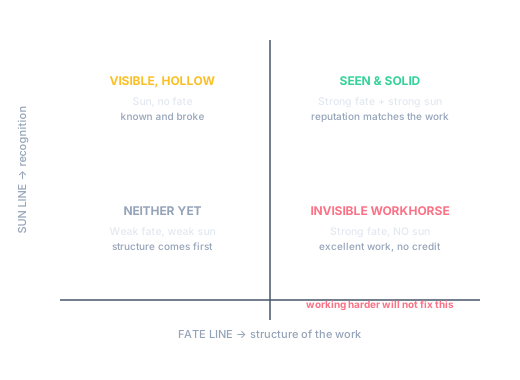
The Surya Rekha (Sun line) runs toward the ring finger and indicates recognition — reputation, visibility, the difference between doing good work and being *known* for it. Together with the fate line it produces four distinct career structures, and almost everyone falls into one:
Strong fate + strong sun. The classical success hand. A clear path *and* recognition for walking it. Authority that is publicly acknowledged.
Strong fate + weak sun. The invisible workhorse. The career is solid, the track is clear, the work is real — and the credit goes to someone else. This is one of the most common professional frustrations in existence, and it shows on the hand. The remedy is not more work. It is visibility.
Weak fate + strong sun. Talent and charisma without structure. Recognised, admired, magnetic — and financially erratic. Creatives, performers, founders between ventures. The fix is scaffolding, not more talent.
Weak fate + weak sun. Direction is read from the head line and thumb instead. Not a bad hand — an unwritten one. The person is building from scratch, and the head line tells you what tools they are building with.
The thumb: the line that decides whether the fate line delivers
A fate line describes a path. The thumb describes whether the person has the will to walk it.
In classical Hast Rekha the thumb is the seat of willpower and execution. Some texts hold that it reveals more about a person's capacity to *finish* than any line on the palm — and in career reading this is decisive.
A stiff thumb that resists bending backward: iron will, resistance to persuasion, the ability to grind through years of unrewarded work. Paired with a broken fate line, this is the person who restarts a business three times and succeeds on the fourth. The breaks are real; so is the refusal to stop.
A flexible thumb that bends easily backward: adaptable, generous, persuadable, quick to pivot. Paired with a strong fate line, this is a superb corporate operator. Paired with a weak fate line, it produces drift — many starts, few finishes.
A long first phalange (the top section, from the joint to the tip) indicates the will to decide. A long second phalange indicates the logic to decide *well*. When the first dominates, you get decisive people who act on bad reasoning. When the second dominates, you get excellent reasoning that never converts to action.
A career reading without the thumb is incomplete. This is why photographs matter: your thumb must be visible and flat in the image.
Timing a career change on the fate line — honestly
Traditional palmistry reads the fate line from the wrist upward, treating the point where it crosses the head line as roughly the middle years, and where it crosses the heart line as later maturity. A break below the head line is read as an early-career change; a break above the heart line as a late-career one.
Now the honest part.
Palmistry does not give you dates. Hands vary in proportion; a mark at the 'age 35' point on one palm sits at a different decade on another. Any reader who tells you your job change will happen in March 2027 because of a mark on your Bhagya Rekha is inventing precision the tradition does not support. That is fortune-telling theatre, and it is exactly what this platform was built against.
What the fate line *honestly* gives you is sequence and character: this change came early and cost something; that one came late and was an upgrade; this phase was blocked by someone else's decision; that phase was self-chosen.
If you want an actual window — which year, which quarter — that is a Dasha and transit question and it requires a birth chart. Palmistry tells you *what kind of career you have*. The chart tells you *when it moves*. If your birth time is reliable, start with the free Kundali calculator.
What to do with a broken or missing fate line
The useful response to a broken Bhagya Rekha is not anxiety. It is design.
If your fate line is broken repeatedly: you are not built for a single forty-year track, and pretending otherwise will make you miserable. Stop treating each change as a failure of stability and start treating it as your operating mode. Build transferable skills, keep an overlap before you leap (the overlapping break is the cushioned transition), and keep a financial buffer sized for the gap.
If you have no fate line at all: you have no inherited scaffolding, so you must build it. Structure that others get for free — routine, deadlines, hierarchy, accountability — you have to manufacture. Founders with no fate line who succeed almost always import structure deliberately: a co-founder, a board, a coach, a hard schedule.
If your fate line is strong but your sun line is absent: your problem is not work. It is visibility. Do less and publish more.
Classical support for a weak Bhagya Rekha works through Shani — the planet of the mount the line reaches. The traditional prescriptions are unglamorous and unfashionable: discipline, routine, service, patience, showing up when it is boring. That is Shani. It is also, inconveniently, what actually works.
Before wearing any gemstone for career, check suitability against your actual chart — see the gemstone suitability calculator. Never wear Neelam on someone else's advice.
Skeptic's corner: does the fate line really predict a career?
A fair question, and it deserves a straight answer rather than a defensive one.
No, the fate line does not predict your job. No line on your hand knows the name of your employer. Anyone claiming otherwise is selling something.
What the Bhagya Rekha reflects is structure — whether your working life runs on an externally provided track or a self-constructed one, whether it has changed direction, and how those changes were absorbed. Is that predictive? No. Is it *descriptive*, and useful? In our experience, unusually so — because most people have never had the shape of their own working life named for them, and naming it changes what they do next.
Samudrika Shastra is a structured observational tradition, not a laboratory science, and we will not pretend it is one. We do not claim proof of prediction. We claim a disciplined reading of constitution, temperament and direction, honestly delivered.
If that is not enough for you, that is a completely reasonable position. If it is, upload your palm.
Privacy: your palm image is not stored on our servers — it stays in your browser session and is removed after analysis. Price: ₹51 for the full reading with PDF. No subscription. Read your fate line now.
The fate line and Shani mount — the discipline behind the direction
The fate line runs toward the Shani mount, and its steadiness depends on how developed that mount is. A full Shani mount gives the line the patience to hold a straight course; a flat one leaves even a clear fate line prone to drifting.
See the seven mounts of the palm for the full map before reading direction alone.
Reading the fate line beside the life line
A strong life line beside a weak fate line usually means the energy exists but direction has not yet firmed up. Both strong together suggests a life with both stamina and a clear course, which is one of the more resilient combinations on the whole hand.
Reading the fate line beside the head line
A fate line that rises from a clearly analytical head line tends to reflect a deliberately planned career; one paired with a head line sloping toward the Chandra mount suggests a career shaped more by instinct and opportunity than by planning.
Neither path is weaker — they simply describe different decision styles.
Does the fate line ever run backwards or reverse direction
No — the fate line by definition runs upward toward the fingers; what looks like a 'reversed' fate line is usually a separate line being misread, often a strong Mercury or Sun line mistaken for it. A genuine fate line does not run the other way.
Misidentification here is one of the more common beginner errors, alongside confusing the sun line for a second fate line.
The fate line and Manglik dosha — unrelated systems
A broken or absent fate line has no bearing on Manglik dosha, which is determined solely by Mars's house placement in the birth chart. The two are frequently, and wrongly, connected online.
The real check is the free manglik dosh calculator.
Both hands compared on the fate line
The fate line typically shows the largest gap between hands of any line, because career is shaped almost entirely by lived choice rather than birth. A faint fate line on the non-dominant hand paired with a strong one on the dominant hand is the classic self-made pattern.
See which hand to read for the full comparison method.
Marks on the fate line — machli, trishul, star and island
A machli at the end of the fate line marks unexpected career fortune; a trishul there amplifies whatever the line already showed. A star marks a sudden turn; an island marks a temporary muddled period rather than a permanent block — the two are easy to confuse in a poor photo.
Check shape carefully before deciding which one you are actually looking at.
Classical sources behind the Bhagya Rekha
On classical support: the Trikaal Library holds one palmistry text, Varahamihira's Brihat Samhita (Ch.67, Purusha Lakshana), and it has no verse that reads the fate line, so this page cites none rather than stretch a verse over a career question it does not answer. Trikaal Vaani's reading: the Bhagya Rekha is read here as a description of how structured a working path is, never as a promise of success, a lifespan or a date, and career timing belongs to the Kundali.
The full framework is in the Hast Rekha guide.
Telling a genuine fate line from an incidental crease
A real fate line runs continuously toward the fingers with reasonably consistent depth; incidental hand creases tend to be shorter, more irregular, and inconsistent under a clear photo. An angled or dim photo makes this distinction significantly harder.
The full photo standard is set out in is palm reading accurate.
How AI reading measures the fate line
The engine checks starting point, direction, breaks and any marks against the mount it rises toward — the same checklist a careful human reader applies. Photo quality, not the underlying method, is what actually limits accuracy here.
See how AI palm reading works, or read your own fate line for ₹51.
Wealth claims built on the fate line — the honest limit
A strong fate line alone does not guarantee wealth. Financial outcomes read as convergence — a well-formed Budh mount, a clear sun line, and a disciplined thumb, all together, never one line by itself.
Anyone promising riches off a single unbroken fate line is selling a story, not a reading grounded in the Hast Rekha guide.
Common myths about the fate line, restated plainly
"No fate line means no career" — false; most self-made professionals show a faint or absent fate line early on. "A broken fate line means you will lose your job" — false; it marks a change, not a guaranteed loss. "A double fate line means two careers" — partly true at best; it more often means an additional source of support, not a literal second profession.
None of these claims survives a careful reading against the classical texts, or against is palm reading accurate.
Frequently asked questions about the fate line
Can the fate line tell me when I'll get promoted? No — it shows direction and change, not specific dates; dasha periods in the birth chart handle timing. Does a missing fate line mean failure? No, the opposite is often true for entrepreneurs. Can two people have identical fate lines? Extremely unlikely, since the line tracks lived choices rather than birth alone, as which hand to read explains in more depth.
Bringing the fate line into the whole system
The fate line never stands alone — it works with the life line, the head line, the sun line, and the Shani and Budh mounts that shape its course. Marks like machli or an M sign reinforce the same direction from a different angle.
Whether any of this holds up is addressed honestly in is palm reading accurate. The full method is in the Hast Rekha guide, and you can begin your own reading for ₹51.
Does hand dominance matter more for the fate line specifically
Yes, more than for almost any other line. Because the fate line tracks lived career choices so closely, the gap between dominant and non-dominant hand here is often the single most informative comparison on the entire palm.
Always check both hands before drawing a career conclusion from this line alone — cross-reference against the M sign, which is itself partly a fate-line story.
A quick honest summary of the fate line
The fate line describes direction and change, not destiny fixed at birth — its absence is not failure, and its presence is not a guarantee. Read against the mounts, the thumb, and the sun line, it becomes genuinely useful career context.
The full method sits in the Hast Rekha guide; start your own reading for ₹51.
Apna Personalized Analysis Lein
Yeh article general framework hai. Aapke specific chart ke according detailed analysis ke liye:
शब्दावली · Glossary
- Bhagya Rekha
- The fate line, which rises vertically through the palm toward the middle finger and describes how structured a working path is, not luck.
- Shani Parvat
- The mount below the middle finger, toward which the fate line runs.
- Jeevan Rekha
- The life line around the base of the thumb. A fate line that starts inside it is read as a career that grew out of family.
- Mastishk Rekha
- The head line, which shows how a person thinks. It is read for direction when the fate line is absent.
- Chandra Parvat
- The mount on the outer heel of the palm, one of the places a fate line can begin.
Frequently Asked Questions
What does a broken fate line mean?
A change of direction, not a failure. It marks a career pivot — a resignation, an industry change, a move from job to business. If the new segment is deeper than the old, the change was an upgrade.
I have no fate line. Does that mean no career?
No. An absent Bhagya Rekha correlates with the self-constructed life — no inherited business, no institutional ladder. Direction is then read from the head line and sun line. It is common in the hands of founders.
What does a fate line starting from the Moon mount mean?
A career powered by other people — the public, clients, an audience, a network. Sales, media, teaching, performance, entrepreneurship, or work done far from the birthplace. Fortune arrives through others rather than a hierarchy.
What does an island on the fate line mean?
A career period of confusion or divided energy — two roles pulling in different directions, a draining partnership, or a stretch of blocked effort. It resolves when the strands rejoin.
My fate line started late. Is that bad?
No. A fate line beginning mid-palm means direction arrived in the thirties or later, after a period of drift or experiment. It is extremely common and nothing to be ashamed of.
Which palm signs indicate a government job?
Classically, a straight deep fate line terminating on the Shani Parvat, supported by a well-formed Guru Parvat and a level head line. It is the convergence that matters — no single mark promises a government job.
Fate line or Kundali — which is better for career questions?
The fate line tells you the shape of your working life and needs no birth time. A Vedic chart tells you the timing — which Dasha, which transit window. Use the palm for nature, the chart for the calendar.
See also · यह भी देखें
Part of the hubHast Rekha Gyan — 5 Myths Everyone RepeatsGroup: The major lines of the palm
AI Palm Reading — What the Machine Actually Sees
palmistryHead Line — Not How Smart, But Which Smart
palmistryHeart Line — Why Relationships Keep Repeating
palmistryShort Life Line? It Does Not Mean Early Death
palmistryM Sign on Palm — Not Rare, But Telling
palmistryTwo Marriage Lines Does Not Mean Two Marriages
palmistrySun Line — Why the Best Worker Gets Passed Over
Categories: palmistry · spirituality