Sun Line — Why the Best Worker Gets Passed Over
Trikaal Sandesh — Direct Answer
The Surya Rekha (sun line) runs vertically toward the ring finger, ending on the Surya Parvat. In Samudrika Shastra it indicates recognition, reputation and public visibility — not talent, and not money. A strong fate line with no sun line is the classical mark of excellent work that goes uncredited.
Deep Dive Analysis
The Surya Rekha does not measure how good you are
There is a specific kind of professional pain that almost nobody has language for.
You are the person who actually knows how the system works. You fix what breaks. You are the one people quietly ask before they present. And somehow, year after year, the promotion goes to someone louder, the credit lands on someone else's slide, and you go home and cannot explain to your family why you are angry, because on paper nothing is wrong.
That gap has a name in Samudrika Shastra, and it is written on the palm as the Surya Rekha.
The sun line runs vertically toward the ring finger, terminating on the Surya Parvat. And here is the thing almost every article gets wrong: it does not measure talent, and it does not measure money.
It measures whether your talent is seen.
That is a completely different quantity, and confusing the two has misled generations of readers. The Bhagya Rekha describes the work. The Surya Rekha describes the reputation the work earns. They are not the same, they frequently disagree, and the disagreement is where most career misery lives.
The invisible workhorse: strong fate line, no sun line
This is the configuration this page exists for, because it is common, it is painful, and nobody names it.
A strong, deep, unbroken Bhagya Rekha with no Surya Rekha at all.
Read it plainly: the career is solid. The track is clear. The work is real and it is good. And there is no line carrying recognition.
This is the hand of the person who is essential and invisible. The one who holds the department together while someone with a better narrative gets the title. The one whose contribution is genuinely acknowledged in private and never in public. They are not imagining the injustice — it is on their hand.
What they typically do about it is the exact wrong thing: they work harder. The reasoning is intuitive — if the work is not being recognised, produce more work. But the fate line is already strong. Adding volume to a line that is already deep changes nothing. The missing line is not the fate line.
The correction is uncomfortable for this personality, and it is the whole point of the reading: your problem is not output. It is visibility — and visibility is a separate discipline that you have been treating as beneath you.
Do less. Publish more. Say your own name in the room. It will feel like self-promotion and vulgarity. It is neither. It is the only thing that will move the line.
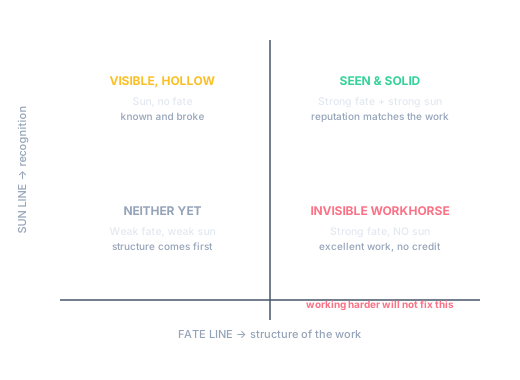
Charisma without scaffolding: sun line, no fate line
The inverse hand is just as common and just as misunderstood.
A clear Surya Rekha with a weak, broken or absent Bhagya Rekha.
This person is *seen*. They are magnetic, quotable, remembered. They walk into a room and it registers. People assume they are doing well.
And their bank balance is chaos.
Recognition without structure produces a very specific life: brilliant projects that do not compound, a reputation larger than the income, admiration from people who would not hire them, and a persistent private sense of being a fraud — because the visibility has run ahead of the substance.
The instinct here is also wrong. This person tries to become more visible, because visibility is what has always worked for them. It is the one lever they know how to pull.
The correction: you do not need more attention. You need a track. Structure that others inherit, you must build deliberately — a deadline set by someone else, a partner who finishes what you start, a business with recurring revenue rather than recurring applause. Read the fate line guide; that is the line you are missing, and it is the one that pays.
Where the sun line begins — and what kind of recognition it brings
The origin of the Surya Rekha tells you *how* recognition arrives, and this is the most practically useful part of the reading.
Rising from the Chandra Parvat (the Moon mount, outer heel). Recognition that comes through other people — the public, an audience, clients, a network. This is the performer's, teacher's, media professional's and public-facing entrepreneur's origin. The reputation is granted by a crowd. Paired with a fate line from the same mount, it is one of the strongest public-career configurations in Hast Rekha.
Rising from the Bhagya Rekha (the fate line itself). Recognition earned by the work. The reputation grows directly out of what was actually produced. Slow, solid, and durable — this is the reputation that survives a bad year.
Rising from the Jeevan Rekha (the life line). Recognition through sustained personal effort — the self-made reputation, built by grinding, usually late-arriving and thoroughly deserved.
Rising from the Mastishk Rekha (the head line). Recognition arriving through the mind — through an idea, a book, an argument, an intellectual contribution. Almost always late. Read alongside the head line guide.
Beginning high, close to the fingers. Late recognition — often in the fifties and beyond. Common, and profoundly reassuring to people who have concluded they were passed over permanently. They were not. The line simply starts high.
Stop guessing at your own hand
You are reading this because you have a suspicion you cannot prove: that you are better than your position, and that something in the way you operate is preventing that from being seen.
A palmist charges ₹500 to ₹2,000 to look at your hand, and in the offline market a large number of them will simply flatter you — because a flattered client returns, and a challenged one does not.
The AI Hast Rekha Calculator reads it from one photograph, and it has one honest advantage over both a palmist and your own hopeful eye: it is not trying to please you.
- No birth time. No birth date. No birth place. Your palm is enough.
- 6 lines, 7 mounts, 8 life scores — your Surya Rekha read against the fate line, the Surya Parvat and the thumb, not in isolation
- Classical Samudrika rules, personalised remedies, downloadable PDF report
- Your palm image is never stored on our servers — it stays in your browser session and is removed after analysis
- ₹51. No subscription, no upsell, no ritual to buy afterwards
Multiple sun lines, breaks and islands
Several sun lines running toward the ring finger is a mark people are usually pleased to find, and the classical reading is more sober: scattered recognition. Talent in several directions, reputation in none of them consolidated. The person is known for four things and famous for nothing.
This is the hand of the multi-talented professional who cannot answer the question *what do you actually do?* — and it is a real commercial handicap. The classical guidance is unambiguous: choose one. A single deep sun line outperforms five fine ones in every reading, because reputation compounds only when it accumulates in one place.
A break in the Surya Rekha indicates a reputational interruption — a period where standing was lost or reset. A job that ended badly. A venture that failed publicly. Where the line resumes clearly, the reputation was rebuilt. Note carefully what this does not mean: it does not predict scandal, disgrace or a future fall. It records a rupture; it does not schedule one.
An island on the sun line indicates a phase where reputation was clouded or divided — being known for two contradictory things, or a stretch where your name meant something uncertain.
A star on the Surya Parvat is classically one of the finest marks in the hand: sudden, significant elevation of standing. And we will add the honest caveat the tradition assumes and the internet omits — a star on a flat, undeveloped Surya Parvat amplifies very little. The mount must carry something for the mark to lift it.
The wealth myth — the sun line is not a money line
Search this topic and you will be told, with great confidence, that a strong sun line means wealth, luxury, and a life of ease.
It does not.
The Surya Rekha carries reputation. Reputation and money are correlated — often strongly — but they are not the same quantity, and the difference is where people get hurt.
Consider who actually has clear, deep sun lines: performers, teachers, activists, artists, public intellectuals, respected professionals in unglamorous fields. A great many of them are known and not rich. Their line is doing exactly what the tradition says it does. It was never a wealth line.
And consider the opposite: a very large share of genuinely wealthy people are completely anonymous. The person who owns four commercial properties and is recognised by nobody has a strong fate line and, frequently, no sun line at all. Money followed structure, not visibility.
So when a reader tells you a sun line means riches, they are doing what the entire industry does — collapsing every favourable mark into the one promise that sells.
Nothing on your hand predicts a sum of money. Not the sun line, not the fish sign, not the M. If a page tells you otherwise, close it.
What to actually do about a missing sun line
An honest reading has to convert into action.
Strong fate line, no sun line. Your work is excellent and it is not landing. Three corrections, in order of how much they will annoy you:
- Attach your name to the output. Not in a vulgar way — simply stop letting the work travel anonymously. The single most common habit of this hand is doing the work and letting someone else carry it into the room.
- Publish. Write the thing down. A memo, a post, a talk, a paper. Reputation cannot compound on work that leaves no trace.
- Say it out loud once. In the review, in the meeting, to the person who decides. Once, plainly. This hand will find that harder than three months of overtime — which is precisely why it has not happened yet.
Sun line, weak fate line. Stop performing. Build one thing that runs without your presence. Recognition you already have; durability is what is missing.
Multiple sun lines. Choose one. This year.
Classical support for Surya works through the Sun: dignity, integrity, taking public responsibility, and — the classical prescription that is far more literal than people expect — standing where you can be seen. Do not hide.
And on gemstones: never wear Manik (ruby) or any Surya stone on the strength of a palm mark. Remedial stones are prescribed from the birth chart, not the hand. Check suitability against your actual chart with the gemstone suitability calculator before spending a rupee.
The Surya Parvat: the mount decides what the line can carry
A sun line terminates on the Surya Parvat — the mount below the ring finger — and the condition of that mount decides what the line is actually capable of delivering. Read the line without the mount and you will get the reading backwards.
A well-developed Surya Parvat — raised, firm, clearly defined. Genuine creative force, natural charisma, an instinct for form and beauty, and an appetite for recognition that is *earned* rather than demanded. A strong sun line rising into a mount like this is the classical configuration for durable reputation. The person has something worth seeing, and it is seen.
A flat Surya Parvat with a clear sun line. Visibility without substance beneath it. The person is noticed and there is less there than the noticing suggests. This is an uncomfortable reading and we will give it anyway, because it is the most fixable problem in this entire chapter: build the thing first. Reputation running ahead of capability is the most fragile position in any career, and it collapses at exactly the moment it is tested.
An over-developed, spongy Surya Parvat. Appetite for recognition exceeding the willingness to earn it. Classically read as vanity — the hunger for applause detached from the work that would justify it. The tradition is blunt about this and so are we: it is a leak, and it is visible to everyone except the person who has it.
A flat mount and no sun line at all. Recognition is simply not part of this person's story, and — here is the part nobody says — that is genuinely fine. A great many contented, prosperous, well-lived lives are entirely unwitnessed by strangers. Not every hand needs an audience, and the assumption that it should is a modern disease, not a classical one.
So before you conclude anything from your sun line, press the mount beneath it. The line describes the channel. The mount decides what is flowing through it.
Get your Surya Rekha read against the whole hand
A sun line on its own is a fragment. It only means something when read against the Bhagya Rekha it is supposed to be partnered with, the Surya Parvat it terminates on, and the thumb that decides whether you will act on any of it.
The AI Hast Rekha Calculator detects the Surya Rekha from a single palm photo — origin, depth, breaks, islands, multiplicity — reads it against all seven mounts and the other five lines, and applies classical Samudrika Shastra rules. You get 8 life scores including career and leadership, a full classical interpretation, personalised remedies and a downloadable PDF report.
₹51. One photo. No birth time, no birth date, no birth place.
It will not tell you that you are going to be famous. Nothing honest will.
It will tell you whether the work you are doing is structured to be seen — and if it is not, that is a fixable problem, and you have probably been fixing the wrong one for years.
Read my palm → · Or start with the complete Hast Rekha guide.
The sun line and Surya mount — the source of its reach
The sun line rises toward the Surya mount, and a full mount extends the line's reach into genuine public recognition. A flat Surya mount leaves even a clear sun line reading as quieter, more localised acknowledgment.
See the seven mounts of the palm before reading the line's reach.
Can the sun line appear or fade over a lifetime
Yes. As a secondary line, it can strengthen dramatically after a genuine public achievement, or remain faint through a quieter, more private career. Neither state is permanent, much like the fate line it usually rises alongside.
The sun line has no bearing on Manglik dosha
A missing or faint sun line is sometimes wrongly connected to Manglik dosha online. The two are unrelated — Manglik status depends solely on Mars's house placement in the birth chart.
The genuine check is the free manglik dosh calculator.
Both hands compared on the sun line
The non-dominant hand's sun line shows inborn potential for recognition; the dominant hand shows how much of that potential has actually been realised publicly. A significant gap often marks unclaimed visibility.
See which hand to read for the full comparison method.
Marks on the sun line — machli, trishul and star
A machli near the sun line adds favourable, well-received recognition; a trishul amplifies its reach into multiple domains at once. A star marks a sudden, intense burst of public attention.
Classical sources behind the Surya Rekha
On classical support: the Trikaal Library holds one palmistry text, Varahamihira's Brihat Samhita (Ch.67, Purusha Lakshana), and it has no verse that reads the sun line, so this page cites none rather than stretch a verse over a question it does not answer. Trikaal Vaani's reading: we take the Surya Rekha as a line of recognition — whether the work is seen — and not of talent or money, and that is our reading of the hand, not a classical verdict. The library's verses give no lifespan, no disease, no dates and no promise of fame or income, and neither does this page.
The full framework is in the Hast Rekha guide.
Telling a genuine sun line from an incidental crease
A real sun line runs with reasonably consistent depth toward the ring finger; incidental creases tend to be shorter and less directional. A poor-quality photo makes this distinction significantly harder.
The full photo standard is in is palm reading accurate.
How AI reading measures the sun line
The engine checks presence, depth, starting point and any marks against the Surya mount it rises toward — the same checklist a careful human reader applies. Photo quality, not the method, is what actually limits accuracy here.
See how AI palm reading works, or read your own palm for ₹51.
Common myths about the sun line, restated plainly
"No sun line means no success" — false; many deeply successful, private people show little to no sun line at all. "A sun line guarantees fame" — false; it shows potential for recognition, not a promise of it. "Multiple sun lines mean double the luck" — false; it usually shows recognition from more than one source, not doubled fortune — the same honesty runs through is palm reading accurate.
The gender-based hand myth and the sun line
The sun line means the same thing regardless of which hand belongs to a man or a woman. What actually matters is dominant versus non-dominant hand, covered fully in which hand to read.
The sun line and career fit
A clear sun line favours careers with visible, public moments — media, performance, competitive fields, public-facing leadership. The fate line still decides overall direction; the sun line adds whether that direction gets noticed.
Frequently asked questions about the sun line
Can the sun line predict fame specifically? No — it shows potential for recognition, not a guaranteed level of it. Does a broken sun line mean lost success? It marks a disrupted period of recognition, not permanent loss. Is a very deep sun line rare? Uncommon, and it reads as unusually strong, consistent recognition throughout life, per is palm reading accurate.
Bringing the sun line into the whole system
The sun line works alongside the fate line, the head line, and the Surya mount it rises from — never read alone. Whether any of this holds up is addressed honestly in is palm reading accurate.
The full method is in the Hast Rekha guide, and you can begin your own reading for ₹51.
Multiple sun lines — reading them correctly
More than one clear sun line usually reflects recognition arriving from more than one direction — a day job and a creative pursuit, for instance — rather than doubled fame. Faint additional lines suggest minor, less consistent sources of visibility, similar to how a doubled life line is read.
When the sun line typically becomes visible
Because it is a secondary line shaped by lived achievement, the sun line is often faint or absent in younger hands and becomes clearer once genuine public recognition has actually occurred, following the fate line's own pace of development.
What if you crave recognition but have no sun line
A faint or absent sun line does not mean recognition is unavailable — it means it has not yet crystallised, or that success in this life is running through quieter, more private channels. Neither is a lesser path — the same point made throughout is palm reading accurate.
The sun line and money — the honest distinction again
The sun line shows recognition, not income directly, though the two often travel together in practice. Actual wealth reads as convergence — a strong Budh mount, a clear fate line, and a disciplined thumb, never one line alone, as detailed in the seven mounts discussion of wealth convergence.
The most common mistake reading the sun line
The most common error is equating any sun line at all with guaranteed fame, without checking its depth or the mount it rises toward. The second is ignoring the fate line entirely when reading recognition.
The sun line and introversion — no contradiction
A genuinely introverted person can carry a clear sun line — recognition does not require seeking the spotlight personally. Quiet, respected expertise in a narrow field is recognition just as much as public fame is.
A final honest summary on the sun line
The sun line describes potential for recognition, never a guarantee, a date, or a specific level of fame. Read against the fate line and the Surya mount, it becomes genuinely useful context for a career question.
The full method sits in the Hast Rekha guide; start your own reading for ₹51.
Apna Personalized Analysis Lein
Yeh article general framework hai. Aapke specific chart ke according detailed analysis ke liye:
शब्दावली · Glossary
- Surya Rekha
- The sun line, which runs vertically toward the ring finger and describes whether your work is recognised, not how talented or wealthy you are.
- Surya Parvat
- The mount below the ring finger where the sun line ends. Its fullness decides how much the line can actually deliver.
- Bhagya Rekha
- The fate line, which describes the work itself. It is read beside the sun line, which describes the reputation the work earns.
- Chandra Parvat
- The mount on the outer heel of the palm. A sun line rising from it is read as recognition that comes through other people.
- Island
- A small oval break within a line. On the sun line it marks a phase when reputation was clouded or divided.
Frequently Asked Questions
What does the sun line mean in palmistry?
The Surya Rekha indicates recognition, reputation and public visibility — whether your work is seen. It does not measure talent and it does not measure money. Those are separate quantities and confusing them misleads most readings.
I have no sun line. What does that mean?
If your fate line is strong, it is the classical signature of the invisible workhorse — excellent work that goes uncredited. The instinct is to work harder, which changes nothing. The missing quantity is visibility, not output.
Does a strong sun line mean I will be rich?
No. The sun line carries reputation, not wealth. Many people with deep sun lines are known and not rich — teachers, artists, respected professionals. Many wealthy people are completely anonymous and have no sun line at all.
What do multiple sun lines mean?
Scattered recognition — talent in several directions, reputation consolidated in none. The person ends up recognised for many things and famous for none. The classical guidance is to choose one, because reputation compounds only when it accumulates in one place.
What does a break in the sun line mean?
A reputational interruption that already happened — a job that ended badly, a venture that failed publicly. If the line picks up clearly afterwards, standing was restored. It does not predict a future scandal or disgrace.
Where should the sun line start?
There is no should. From the Moon mount means recognition through the public. From the fate line means recognition earned by the work. From the head line means recognition through an idea, usually late. A high start simply means late recognition — not none.
What does a star on the Sun mount mean?
Classically one of the finest marks — sudden, significant elevation of standing. With the caveat the tradition assumes and the internet omits: on a flat, undeveloped Surya Parvat it amplifies very little. The mount must carry something for the mark to lift it.
See also · यह भी देखें
Part of the hubHast Rekha Gyan — 5 Myths Everyone RepeatsGroup: The major lines of the palm
Broken Fate Line? Why It Is Often Good News
palmistryFish Sign on Palm? It's Probably an Island
palmistryHead Line — Not How Smart, But Which Smart
palmistryHeart Line — Why Relationships Keep Repeating
palmistryShort Life Line? It Does Not Mean Early Death
palmistryM Sign on Palm — Not Rare, But Telling
palmistryTrishul on Palm — It Multiplies, Not Promises
Categories: palmistry · spirituality