Fish Sign on Palm? It's Probably an Island
Trikaal Sandesh — Direct Answer
The fish sign (machli / Matsya chinha) is an eye-shaped mark formed by two curved lines crossing, most significant on the Chandra Parvat or near the wrist. Classical Samudrika Shastra reads it as a mark of prosperity, protection and merit. It is genuinely auspicious — but it is rarer than the internet suggests, and it promises no specific sum of money.
Deep Dive Analysis
What the machli sign is, precisely
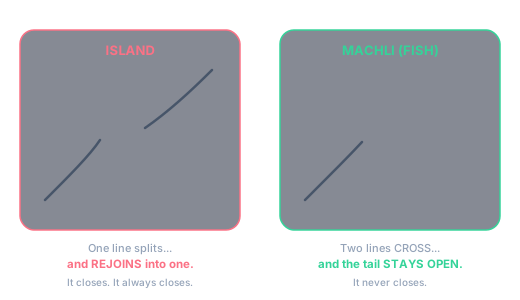
The Matsya chinha — the fish sign — is formed when two curved lines cross and overlap, creating a closed, eye-shaped or leaf-shaped figure with a tapering tail. Seen clearly, it looks exactly like a small fish.
This matters because most people who believe they have a fish sign do not. They have an island — an oval split in a line where the strands separate and rejoin — and an island is a *completely different mark with the opposite meaning*.
The distinction:
- A fish is formed by two lines *crossing* and overlapping to create a closed shape with a pointed tail. It sits as a distinct figure.
- An island is a *single line* splitting into two strands and rejoining. It has no tail. It sits *within* a line.
A fish is auspicious. An island indicates divided, drained energy in the line that carries it. Confusing the two is the single most common error in amateur palm reading, and it means a great many people are celebrating a mark that actually asks them to be careful.
This is exactly the kind of thing photograph-based analysis is good at — the geometry is either there or it is not.
Where it appears — and why location changes everything
In Samudrika Shastra a sign has no fixed meaning of its own. It amplifies the quality of the mount or line that carries it. The fish is no exception.
On the Chandra Parvat (Moon mount, outer heel of the palm) — the classical placement, and the most celebrated. The Moon governs imagination, intuition, public appeal, travel and water. A fish here is read as prosperity arriving *through other people* — the public, clients, an audience, a network — and often through work done away from the birthplace. Foreign settlement is a recurring classical association.
Near the wrist, on or above the Manibandha Rekha (bracelet lines) — read as ancestral merit and protection. Fortune with roots.
On the Guru Parvat (Jupiter, below the index finger) — merit expressed through authority, teaching, respect.
On the Shukra Parvat (Venus, base of the thumb) — comfort, warmth, domestic prosperity, a life with physical ease in it.
Pointing toward the fingers is generally read as more favourable than pointing toward the wrist — the tradition reads direction as flow.
Same fish, four completely different readings. Anyone giving you one meaning for the fish sign without asking *where* it sits has not read the shastra.
What it genuinely indicates
Stripped of the hype, the classical reading of a well-formed Matsya chinha is consistent across sources:
Merit (punya). The tradition frames the fish as a mark of accumulated good karma — support that arrives without being engineered. In practical terms: things work out for this person more often than probability suggests. Doors open. People help.
Protection. The fish is read as a shielding mark. Difficulties arrive and are survived with less damage than expected.
Prosperity — but of a particular kind. Not a lottery. The classical texts associate the fish with *sustained sufficiency* and, in strong placements, genuine wealth. But it is wealth that flows rather than wealth that is seized. It arrives through relationships, reputation and merit, not through grinding force.
Spiritual inclination. Repeatedly associated with dharmic temperament — a person who does not need to be told to behave decently.
That is what the shastra says. Now the part the shastra does *not* say.
The honest part: what the machli sign does not promise
It does not make you a crorepati.
We are stating this plainly because the entire Indian internet is currently telling you otherwise. Search the fish sign and you will find thousands of videos promising that this mark guarantees wealth, foreign settlement, a luxury car, a business empire.
There is no classical source that says this. The texts speak of merit, protection and prosperity as *qualities* — not as a delivery schedule for specific assets.
And there is a practical test you can apply yourself: a great many people with fish signs are not wealthy. If the sign guaranteed wealth, this would not be true. It is true. Therefore it does not guarantee wealth.
What an honest reading gives you instead: a fish sign indicates that support and opportunity flow toward you more readily than average, and that difficulty tends to be survivable. That is a real advantage. It is not a promise, and it is not a substitute for doing the work.
We refuse to sell you the other version. If that costs us traffic, so be it.
Fish sign with the fate line, sun line and mounts
A sign is only as strong as the hand that carries it.
Fish on the Chandra Parvat + a fate line rising from the same mount — this is the strongest wealth-through-people configuration in the classical repertoire. Career powered by the public, network or clients, with merit flowing in. It is the recurring hand of successful entrepreneurs, media figures and people who make their fortune abroad. Read our fate line guide for the fate line half of this.
Fish + a strong Surya Rekha (sun line) — merit that becomes visible. Reputation, recognition, a name that travels.
Fish + a weak, broken fate line and a flexible thumb — the merit is real and the execution is not. This person is repeatedly offered opportunity and repeatedly fails to convert it. The fish is not the problem. The thumb is.
Fish + a strong Budh Parvat — commercial merit. The trader's version.
The fish tells you what flows toward you. The rest of the hand tells you whether you can hold it.
Stop guessing at your own hand
You are reading this because you looked at your palm and could not tell what you were looking at. That is not a failing — the marks are small, the light is never right, and you are the one person in the world who most wants a particular answer.
A palmist charges ₹500 to ₹2,000 to settle it, and in the offline market a great many of them will tell you what you want to hear, because the follow-up puja is where their margin sits.
The AI Hast Rekha Calculator settles it from one photograph — and it has one honest advantage over both a palmist and your own hopeful eye: it is not rooting for you.
- No birth time. No birth date. No birth place. Your palm is enough — which is the whole point if your birth time was never reliable.
- 6 lines, 7 mounts, 8 life scores — read against the full hand, not one mark in isolation
- Classical Samudrika rules, personalised remedies, downloadable PDF report
- Your palm image is never stored on our servers — it stays in your browser session and is removed after analysis
- ₹51. No subscription, no upsell, no follow-up ritual to buy
Skeptic's corner and what to actually do
Is the fish sign real? The mark is real — it is a geometric configuration you can photograph. The *interpretation* is a tradition, codified in the Samudrika corpus, the Hasta Sanjeevani and Varahamihira's Brihat Samhita. It is a structured observational system, not a laboratory science, and we will not pretend it is one.
Is it being oversold? Massively. The fish sign is the single most exaggerated mark in modern Indian palmistry content, because 'you will be rich' is the most profitable sentence in the industry.
If you have a fish sign, the useful response is not to sit back and wait for wealth. The classical reading is that support *flows* — which means it must be met. Merit that nobody acts on produces nothing. Do the work; the sign says it is more likely to land.
If you do not have one — and most people do not — you have lost nothing, because the sign was never a guarantee. Read your fate line, sun line and thumb. That is where the actual story of your working life is written.
Price: ₹51 for the full reading. Privacy: your palm image is never stored on our servers.
The AI Hast Rekha Calculator distinguishes a genuine Matsya chinha from an island — the mistake almost everyone makes — locates it on the correct mount, and reads it against the full hand. One photo. No birth time. Read the complete guide for all the signs.
The island: the mark that is quietly telling you the opposite
If you take one thing from this page, take this — because it is the single most consequential error in Indian palmistry, and almost nobody corrects it.
An island is not a fish. It is closer to its opposite.
An island is a single line splitting into two strands and rejoining. It has no tail, no separate identity, no crossing lines. It sits *inside* a line as a swelling or an eye. And what it indicates in Samudrika Shastra is divided, diluted, drained energy in the line that carries it.
- Island on the Bhagya Rekha (fate line): a career phase of confusion and blocked progress — two roles pulling in different directions, a partnership that drained rather than fed, a stretch of effort going nowhere. It resolves when the strands rejoin.
- Island on the Jeevan Rekha (life line): a period where physical energy is split and depleted. Chronic tiredness, over-extension, running on empty.
- Island on the Hriday Rekha (heart line): a phase of emotional division — attachment pulling two ways.
Now consider what happens when someone sees an island on their fate line, decides it is a machli, and celebrates it. They have taken a mark that is asking them to simplify and consolidate, and read it as permission to wait for wealth.
That is not a small mistake. It is an actively harmful one, and it is happening at scale across YouTube and every astrology portal in the country.
How to tell them apart — the test you can run right now
Take your dominant hand into daylight. No flash, no phone torch. Tilt it slowly.
Ask three questions:
1. How many lines built this shape? A fish is formed by two lines crossing and overlapping. An island is one line splitting. Follow the shape back to its source. If everything traces back to a single line, it is an island. This alone settles most cases.
2. Is there a tail? A genuine Matsya chinha has a tapering tail — the crossing lines extend beyond the closed body of the fish. An island has no tail. It is a closed loop and nothing more.
**3. Is it *on* a line, or *beside* it?** An island lives inside a line — it is a swelling *of* that line. A fish sits as a distinct figure, usually on a mount, and frequently near the wrist or on the Chandra Parvat rather than embedded in a major line.
If after all three tests you are still unsure — and most people are, because the marks are small and the light is never right — that is precisely the problem an image-based reading solves. The geometry is either present or it is not. The engine has no wish to find a fish on your palm.
That is the honest advantage of a machine over a hopeful mirror: it is not rooting for you.
What everyone else on the internet is telling you — and why it is wrong
Search this topic in Hindi and you will find the same claims repeated across every major portal, almost word for word:
'Fish on the Guru Parvat — the person becomes extremely wealthy.' 'Fish near the wrist with its mouth toward the fingers — sudden wealth, Rajyoga.' 'Fish on the life line — the person lives a very long life.'
Let us take these apart.
'Extremely wealthy.' No classical source promises a specific financial outcome from a single mark. The Samudrika texts speak of *merit, protection and prosperity* as qualities of temperament and fortune — not as a delivery schedule for assets. The leap from 'auspicious' to 'crorepati' was made by content writers, not by the shastra.
'Sudden wealth, Rajyoga.' Rajyoga is a term from Jyotish — it describes specific planetary combinations in a birth chart. It is not a palmistry term and it cannot be diagnosed from a hand. Borrowing it to describe a palm mark is category confusion dressed up as authority.
'Long life.' This is the worst of them. No mark on the hand predicts lifespan. We said this about the life line and we will say it again here: a palm cannot tell you how long you will live, and any source claiming otherwise has crossed from tradition into fortune-telling theatre.
We are not going to compete with those articles by writing a better version of the same lie. We are going to tell you what the mark actually means and let you decide.
So what does the fish honestly give you?
Strip away the wealth promises and something more useful remains.
A genuine Matsya chinha, well-formed and correctly placed, indicates that support flows toward you more readily than average. Opportunity arrives. People help. Difficulties, when they come, tend to be survivable rather than ruinous.
That is a real and meaningful advantage — but notice its shape. It describes a tailwind, not a destination. A tailwind is worthless to someone standing still.
This is why the classical framing matters. The fish is a mark of punya — accumulated merit — and merit in the Vedic understanding is not a bank balance. It is a *disposition of circumstances in your favour*. It must be met with action to become anything at all.
The practical reading, then:
- If you have a fish and your life has not produced wealth, the fish is not broken. The meeting is missing.
- If you have a fish alongside a strong fate line and a stiff thumb, you are in an unusually strong position and you should be pressing harder than you are.
- If you have a fish alongside a weak fate line and a flexible thumb, you are the person who is repeatedly offered opportunity and repeatedly fails to convert it. The mark is not the problem. The execution is.
That is a reading you can act on. 'You will be rich' is not.
Check what you actually have — before you celebrate it
Here is the uncomfortable arithmetic of this topic.
Islands are common. Genuine fish signs are not. Which means that of all the people currently celebrating a machli on their palm, a large share are looking at an island — and an island asks for the opposite response.
A palmist will charge you ₹500 to ₹2,000 to settle this, and in the offline market a significant number of them will tell you what you want to hear, because the follow-up puja is where the money is.
The AI Hast Rekha Calculator settles it from one photograph:
- Distinguishes a genuine Matsya chinha from an island — strict geometry, two crossing lines and a tail, or it is not a fish
- Locates it on the correct mount — Chandra, Guru, Shukra, Budh, wrist — because placement changes the entire reading
- Reads it against the whole hand — the fate line that decides whether merit converts, the thumb that decides whether you act
- 8 life scores, classical Samudrika interpretation, personalised remedies, downloadable PDF
₹51. One photo. No birth time, no birth date, no birth place. Your image is never stored on our servers — it stays in your browser session and is removed after analysis.
The engine is not rooting for you to have a fish. That is exactly why you should trust what it says.
Check your palm now → · Or read the complete Hast Rekha guide first.
Which mount carries the machli most auspiciously
On the Chandra mount, a machli reads as favour tied to intuition and travel. On Guru, it reads as favour in leadership. The core meaning — auspicious, protective favour — stays constant; the mount decides what area of life it touches.
See the seven mounts of the palm before reading emphasis.
Machli at the end of the fate line
A machli at the tip of the fate line is read as unexpected career fortune arriving alongside sustained effort — luck meeting preparation rather than luck alone. It does not replace the fate line's own direction, only adds to its ending.
Machli near the sun line
A machli close to the sun line adds a favourable boost to recognition — work that gets noticed with unusual ease. Without a sun line present at all, a nearby machli carries considerably less weight.
Can the machli sign appear or fade over a lifetime
Yes. Because it typically forms alongside secondary lines that themselves shift, a faint machli can sharpen after a genuinely fortunate turn, or fade if that period has clearly passed. It is not a fixed birth mark.
This is consistent with how every other secondary sign on the hand behaves, including the fate line it often forms alongside.
The thumb and the machli sign
The machli shows favourable potential; the thumb shows whether that potential gets actively used. A firm thumb alongside a machli tends to mark someone who converts good fortune into follow-through rather than letting it pass by — the same principle covered in the seven mounts.
Both hands compared for the machli sign
A machli present on both hands is read as considerably stronger than the same mark on one hand only — inborn favour that has also been lived out. One-hand-only marks are still genuine, simply less emphatic.
See which hand to read for the full comparison method.
The machli sign has no bearing on Manglik dosha
A machli, however clearly formed, has no connection to Manglik dosha, which is determined solely by Mars's house placement in the birth chart, not by any mark on the palm.
The real check is the free manglik dosh calculator.
Multiple machli marks — rare, but not impossible
A single clear machli is already uncommon; two or more genuine, fully closed machli marks on one hand are rare enough to warrant extra scrutiny before trusting the claim. The same caution that applies to any rare sign applies here.
See rare auspicious signs on the palm for the full verification standard.
Classical sources behind the machli sign
On classical support: the Trikaal Library holds one palmistry text, Varahamihira's Brihat Samhita (Ch.67, Purusha Lakshana). It names a hand marked with a pair of fish as that of one who gives constantly in charity (Sl.44)[1], and lists fish-tail-shaped marks with learning, alongside conch, umbrella, palanquin, elephant, horse and lotus-like marks for a king (Sl.45)[2]. Trikaal Vaani's reading: this is the classical root of reading a true fish sign as auspicious — generosity and merit rather than a sum of money — while the island that is often mistaken for it carries no such verse. Popular tradition also links the fish to Vishnu's Matsya avatar, protection and auspicious beginnings, but that is a symbolic association, not a verse; and since the verses promise no wealth, this page does not either.
The full framework is in the Hast Rekha guide.
How AI reading verifies the machli sign
The engine checks for a fully closed, oval outline rather than flagging any curved crease as a machli — the closed shape is what actually distinguishes it. Photo quality, not the method, is what limits accuracy here.
See how AI palm reading works, or get your own hand read for ₹51.
Wealth claims built on the machli sign — the honest limit
No single mark, including a genuine machli, guarantees wealth. Financial outcomes read as convergence — a strong Budh mount, a clear fate and sun line, and a disciplined thumb, together, never one mark alone.
Anyone promising riches off a single machli is selling a story, not a reading grounded in the Hast Rekha guide.
Common myths about the machli sign, restated plainly
"A machli guarantees a foreign move" — false; it is a symbolic association with water and travel, not a specific prediction. "No machli means no luck" — false; most successful hands show no machli at all. "A bigger machli means more fortune" — false; size shows clarity, not magnitude of luck.
None of these claims survives contact with the classical texts, or with the honesty check in is palm reading accurate.
Career fit for a hand carrying a machli
A machli is generally read as favourable for careers requiring long-term stability and public trust — education, administration, counselling — adding steadiness to whatever direction the fate line already shows.
The fate line still decides direction; the machli simply steadies it.
Bringing the machli sign into the whole system
The machli takes its real meaning from the line or mount it sits on — the life line, the fate line, the heart line, or a mount. Nearby marks such as the M sign or trishul reinforce the same foundation from a different angle.
Whether any of this holds up is addressed honestly in is palm reading accurate. The full method is in the Hast Rekha guide, and you can check your own hand for ₹51.
The gender-based hand myth and the machli sign
The machli means the same thing regardless of which hand happens to belong to a man or a woman — gender-based palmistry rules have no classical basis. What actually changes the reading is dominant versus non-dominant hand.
The honest treatment of folk claims like this is in is palm reading accurate.
When the machli sign typically becomes visible
Because the machli often forms alongside secondary lines that develop with age, it is uncommon in younger hands and becomes somewhat more likely to appear or sharpen from the late twenties onward.
A hand showing none in youth is not evidence it will never appear, the same as the fate line itself.
The most common mistake reading the machli
The most common error is calling any closed oval shape a machli without checking which mount or line it actually sits on, which is what determines its real meaning. The second is confusing it with an island, which is open rather than fully closed.
Confirm the closed shape first, then check location, in that order — the same discipline used for the M sign.
A final honest word on the machli sign
The machli is a genuine, favourable mark, but it is neither rare enough to be exceptional nor powerful enough to override the rest of the hand. Read against its mount and neighbouring lines, it adds real, specific texture to a reading.
Check your own hand and see what is genuinely there, for ₹51.
Apna Personalized Analysis Lein
Yeh article general framework hai. Aapke specific chart ke according detailed analysis ke liye:
शब्दावली · Glossary
- Machli (Matsya chinha)
- The fish sign, an eye-shaped mark formed by two curved lines crossing, read as auspicious when genuine.
- Island
- A small oval break within a line that looks like a fish but is read as divided energy — the opposite meaning.
- Chandra Parvat
- The mount on the outer edge of the palm opposite the thumb, where the fish sign is most significant.
- Bhagya Rekha
- The fate line, near whose end the fish sign is read with special interest.
- Surya Rekha
- The sun line; a fish sign beside it is read together with questions of recognition.
ग्रंथ सन्दर्भ · Classical Sources
The classical source behind every rule in this article — Granth, Adhyaya and Shlok number.
तिस्रो रेखा मणिबन्धनोत्थिताः करतलौपगा नृपतेः । मीनयुगांकितपाणिः नित्यं सत्रप्रदो भवति ।
— Brihat Samhita, Adhyaya 67 — Purusha Lakshana Adhyaya · Shlok 44Three lines rising from the wrist into the palm mark a king; a hand marked with a pair of fish marks one who constantly gives in charity.
मणिबंध से उठकर हथेली तक जाती तीन रेखाएँ नृपति का लक्षण हैं; मछली-युग्म चिह्न वाला हाथ सदा दान देने वाले का होता है।
वज्राकारा धनिनां विद्याभाजां च मीनपुच्छनिभाः । शंख आतपत्रशिविकागजाश्वपद्मौपमा नृपतेः ।
— Brihat Samhita, Adhyaya 67 — Purusha Lakshana Adhyaya · Shlok 45Vajra-shaped marks belong to the wealthy and fish-tail-shaped marks to the learned; conch, umbrella, palanquin, elephant, horse and lotus-like marks belong to a king.
वज्र जैसे चिह्न धनवान के, मीन-पुच्छ जैसे चिह्न विद्वान के; और शंख, छत्र, शिविका, हाथी, घोड़े तथा कमल जैसे चिह्न राजा के लक्षण हैं।
Each reference checked against the Trikaal Vaani Granth library or a reputable open source · Interpretation: Rohiit Gupta, Chief Vedic Architect
Frequently Asked Questions
What does the fish sign (machli) on the palm mean?
The Matsya chinha is read in Samudrika Shastra as a mark of merit, protection and prosperity — support that arrives without being engineered. It is genuinely auspicious, but it promises no specific sum of money.
How do I know if it is a fish sign or an island?
A fish is formed by two lines crossing to make a closed shape with a pointed tail, sitting as a distinct figure. An island is a single line splitting into two strands and rejoining, with no tail. They mean opposite things, and confusing them is the most common error in amateur palm reading.
Where is the fish sign most auspicious?
On the Chandra Parvat (Moon mount) — read as prosperity arriving through other people, the public, or work done far from the birthplace. Near the wrist it indicates ancestral merit and protection.
Does the fish sign guarantee wealth?
No. No classical source makes that claim. Many people with fish signs are not wealthy — which by itself disproves the guarantee. It indicates that opportunity and support flow more readily than average. It does not replace doing the work.
I do not have a fish sign. Should I worry?
No. Most people do not have one, and it was never a guarantee of anything. Read your fate line, sun line and thumb instead — that is where the story of your working life actually sits.
Is the fish sign rare?
A genuine, well-formed Matsya chinha is uncommon — considerably less common than the internet suggests, largely because most people are looking at islands and mistaking them for fish.
Can AI detect a fish sign from a palm photo?
Yes, if the photo is clear. The geometry is either present or it is not, and distinguishing a fish from an island is exactly the kind of task image analysis handles well. Daylight, flat palm, camera straight above.
See also · यह भी देखें
Part of the hubHast Rekha Gyan — 5 Myths Everyone RepeatsGroup: Signs and symbols on the palm: M, machli, trishul and more
Broken Fate Line? Why It Is Often Good News
palmistryIsland, Cross, Grille — The Honest Truth
palmistryShort Life Line? It Does Not Mean Early Death
palmistryM Sign on Palm — Not Rare, But Telling
palmistryThe Seven Mounts — What the Lines Can Actually Do
palmistryStar, Triangle, Square: Only One Is Luck
palmistryTrishul on Palm — It Multiplies, Not Promises
Categories: palmistry · spirituality