Trishul on Palm — It Multiplies, Not Promises
Trikaal Sandesh — Direct Answer
The trishul (trident) is a three-pronged mark that amplifies the quality of whatever mount or line carries it. On the Guru Parvat it is one of the most favourable marks in Samudrika Shastra — authority, respect and dharmic strength. Its meaning changes entirely with placement, and it promises nothing by itself.
Deep Dive Analysis
What a trishul actually is — and what it is not
The trishul chinha is a three-pronged mark: a stem with three tines rising from it, resembling the trident of Shiva. In Samudrika Shastra it is counted among the strongest auspicious marks — but only when it is genuinely a trishul.
Most of what people identify as a trident is not one.
- A true trishul has a clear stem and three distinct prongs rising from a common point. It is a discrete figure sitting on a mount.
- A fork is a line splitting into two or three branches at its *end*. That is a line terminus, not a trishul, and it is read as the ending of that line — a completely different matter.
- A grille is a crosshatch of intersecting fine lines. It looks busy and important. It means dispersed, blocked or wasted energy on that mount — close to the *opposite* of a trishul.
The distinction matters enormously, because a grille on the Guru Parvat and a trishul on the Guru Parvat are read in almost opposite directions. Confusing them means a person walks away believing they carry a mark of authority when the hand is actually flagging scattered ambition.
Geometry decides this, not enthusiasm — which is precisely why a photograph read against classical rules beats a hopeful glance in the mirror.
The trishul is an amplifier, not a promise
This is the core principle and almost every online article gets it wrong.
A trishul has no independent meaning. It does not mean wealth. It does not mean fame. It does not mean anything at all until you know what it is sitting on.
Its function in Samudrika Shastra is to intensify and stabilise the quality of the mount or line beneath it. It is a multiplier applied to an existing value. And a multiplier applied to a weak value gives you a weak result.
This has a consequence people do not expect: a trishul on a flat, undeveloped mount is not a great sign. It amplifies a quality that is barely present. The classical reading is potential without substrate — a promise the hand cannot currently keep.
A trishul on a well-developed mount, however, is one of the finest marks in the tradition. The quality is already there; the trident locks it in and strengthens it.
So the first question is never 'what does a trishul mean'. It is: which mount is it on, and how strong is that mount?
Trishul by placement — the four readings that matter
On the Guru Parvat (Jupiter — below the index finger). The most celebrated placement, and deservedly so. Guru governs authority, ambition, ethics, teaching, the desire to be respected. A trishul here indicates natural, stable, dharmic authority — a person others follow without being forced to. Traditional palmistry associates it with leadership that carries moral weight rather than mere power. On a well-formed Guru mount, this is arguably the single best mark in Hast Rekha.
On the Shani Parvat (Saturn — below the middle finger). Saturn governs discipline, endurance, solitude, the capacity for long unglamorous work. A trishul here amplifies staying power — the person finishes what nobody else would tolerate finishing. It is not a glamorous mark. It is a formidable one. Paired with a strong fate line, it produces careers built on sheer duration.
On the Surya Parvat (Sun — below the ring finger). Amplifies recognition, creativity and reputation. Work that becomes visible; a name that travels.
On the Budh Parvat (Mercury — below the little finger). Amplifies speech, negotiation and commerce. The persuader's mark. In business hands this is significant.
Four placements. Four entirely different lives. Same symbol.
Trishul on the mounts of Shukra, Chandra and Mangal
The remaining placements are less discussed and worth stating.
On the Shukra Parvat (Venus — base of the thumb). Amplifies vitality, warmth, physical presence and the capacity for pleasure and care. On a full Venus mount this is a warm, magnetic, physically confident person. Read together with the life line, which borders this mount.
On the Chandra Parvat (Moon — outer heel). Amplifies imagination, intuition and public appeal. Classically linked to creative work, public-facing careers, and journeys — including settlement far from the birthplace.
On the Mangal zones (Mars). Amplifies courage and resilience under pressure. On Upper Mangal it is endurance in conflict; on Lower Mangal it is physical drive and aggression. A powerful mark on a soldier's or founder's hand — and a difficult one on a hand with poor emotional control, since it amplifies whatever the Mars energy is already doing.
This is why placement is everything. The trishul does not care whether the quality it amplifies is comfortable for you. It simply makes it stronger.
Skeptic's corner: is the trishul just pattern-matching?
An honest challenge, and it deserves an honest answer.
Human beings are extraordinarily good at seeing meaningful shapes in random texture. Show someone a palm and tell them tridents are auspicious, and they will find one. This is a real cognitive bias and it affects palm reading enormously.
Our position: the geometry must be strict, or the reading is worthless. A trishul requires a clear stem and three distinct prongs from a common origin. If you have to squint, you do not have one. If you are counting a random crosshatch as a trident because you would like to have one, you are reading your own hopes, not your hand.
This is one of the honest advantages of image analysis over an enthusiastic self-reading: the engine has no wish to find a trishul on your palm. It either detects the configuration or it does not.
And the broader honesty: Samudrika Shastra is a structured observational tradition, not a laboratory science. We do not claim proof of prediction. We claim a disciplined, honest reading of what is on your hand.
Stop guessing at your own hand
You are reading this because you looked at your palm and could not tell what you were looking at. That is not a failing — the marks are small, the light is never right, and you are the one person in the world who most wants a particular answer.
A palmist charges ₹500 to ₹2,000 to settle it, and in the offline market a great many of them will tell you what you want to hear, because the follow-up puja is where their margin sits.
The AI Hast Rekha Calculator settles it from one photograph — and it has one honest advantage over both a palmist and your own hopeful eye: it is not rooting for you.
- No birth time. No birth date. No birth place. Your palm is enough — which is the whole point if your birth time was never reliable.
- 6 lines, 7 mounts, 8 life scores — read against the full hand, not one mark in isolation
- Classical Samudrika rules, personalised remedies, downloadable PDF report
- Your palm image is never stored on our servers — it stays in your browser session and is removed after analysis
- ₹51. No subscription, no upsell, no follow-up ritual to buy
What to do with a trishul — and what not to expect
If you have a genuine trishul on a strong Guru Parvat: you have natural authority and people are already responding to it. The classical guidance is to *use it deliberately* — this configuration wastes badly in people who avoid leading. Take the responsibility you are avoiding.
On a strong Shani Parvat: your advantage is duration, not speed. Stop competing on brilliance. Compete on outlasting.
On a weak or flat mount: the potential is there and the substrate is not. Build the quality first — the classical remedies for a weak mount are behavioural before they are ritual. Strengthen Guru through study, teaching and ethical conduct; strengthen Shani through routine, service and patience. Before wearing any gemstone, check suitability against your actual birth chart with the gemstone suitability calculator. Never wear a stone on someone else's enthusiasm.
What a trishul will never do: deliver a specific outcome, a specific sum, or a specific date. Nothing on your hand does that. Any reading that promises it is fear-and-greed selling, and it is exactly what this platform was built against.
The AI Hast Rekha Calculator detects the trishul, verifies the geometry against classical rules, identifies which mount carries it, and — crucially — measures how strong that mount actually is. ₹51. One photo. No birth time. Your image is never stored on our servers.
The grille: the mark people mistake for a trishul — and it means the reverse
This is the error that matters most on this page, and it is the mirror image of the fish-versus-island confusion.
A grille is not a trishul. It is close to its opposite.
A grille is a crosshatch — fine lines intersecting each other in a mesh across a mount. It looks busy. It looks *significant*. People see the density and assume the mount is powerful.
What a grille actually indicates in Samudrika Shastra is dispersed, blocked, wasted energy on that mount. The quality is present but it is leaking in every direction at once. It is scattered force.
- Grille on the Guru Parvat: ambition that never lands. The desire for authority without the focus to hold it. Restless, frustrated leadership hunger.
- Grille on the Shukra Parvat: physical energy dissipating. Appetite without direction.
- Grille on the Shani Parvat: discipline turning into rigidity and isolation rather than endurance.
Now picture the consequence. Someone sees a dense crosshatch on their Jupiter mount, decides it is a trident, and concludes that they carry a mark of great authority. In reality their hand is flagging scattered ambition — the precise thing they need to address.
A trishul says *this quality is concentrated and locked in*. A grille says *this quality is spilling everywhere*. Same mount. Opposite instruction.
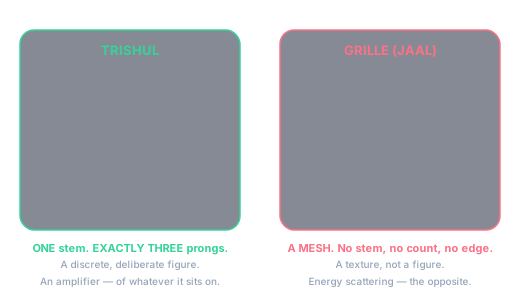
The three-question test you can run on your own hand
Take your dominant hand into daylight. No flash. Tilt slowly and look at the mount in question.
1. Is there a single stem? A true trishul has one stem with three prongs rising from a common point. Follow the lines back. If they do not converge on one origin, you do not have a trident.
2. Are the prongs distinct — exactly three? Not two (that is a fork). Not five or six (that is a grille or a random cluster). Three. The tradition is specific and the specificity is the point.
3. Is it a discrete figure, or a texture? A trishul sits as a separate mark on the mount. A grille is a *texture* — a mesh that covers an area. If you cannot draw a boundary around the shape, it is texture, not a symbol.
And the honest caveat: humans are extraordinarily good at seeing meaningful shapes in random texture. Tell someone tridents are auspicious and they will find one on their palm within thirty seconds. This is a real cognitive bias, and in palmistry it is epidemic.
If you have to squint, tilt, and want it — you do not have a trishul. The whole value of the mark lies in its being unambiguous.
Why a trishul on a weak mount is bad news, not good news
This follows directly from the amplifier principle, and almost nobody says it out loud.
If a trishul multiplies whatever quality the mount already carries, then a trishul on a flat, undeveloped mount multiplies *almost nothing*. But the situation is worse than merely neutral, and the classical reading is unsparing about why.
A trishul on a weak mount is read as potential without substrate — a promise the hand cannot currently keep. And in a life, that has a very particular texture:
- Trishul on a flat Guru Parvat: the person feels destined to lead and has not built the capacity to. They know they should be in charge. They are not. The gap between the felt destiny and the actual position produces bitterness — the most corrosive outcome in the entire chapter.
- Trishul on a hollow Shani Parvat: the person believes they are capable of the long unglamorous work and repeatedly discovers, mid-project, that they are not.
- Trishul on a weak Budh Parvat: the persuasive instinct is there and the substance behind it is not. The talker with nothing to sell.
This is why we will not congratulate you on a trishul without first measuring the mount. That is not a reading — it is flattery with a Sanskrit word attached.
The good news is the direct corollary: build the mount, and the trishul finally means what it promised. Which is the next section.
What the amplifier principle means for competitors' claims
Search this topic and you will find the same sentences everywhere: *'A trident on the Jupiter mount means guaranteed success.' 'The trishul makes the native famous and wealthy.' 'This mark grants leadership over the world.'*
Every one of these makes the same category error: treating an amplifier as a source.
A trishul has no independent content. It cannot *grant* leadership, because it does not carry leadership — the Guru Parvat carries leadership, and the trident only strengthens what is already there. A multiplier applied to zero returns zero. This is not our opinion; it is the internal logic of the tradition, and any reading that violates it has stopped being Samudrika Shastra.
They also lift Jyotish vocabulary — Rajyoga, specific planetary yogas — and apply it to palm marks. Rajyoga describes planetary combinations in a birth chart. It cannot be diagnosed from a hand. Borrowing the word is not scholarship; it is authority-cosplay.
We are not going to write a more persuasive version of that. We are going to tell you that placement and mount strength decide everything, that a trident on a flat mount is a warning rather than a blessing, and that no mark on your hand guarantees an outcome.
If that is less exciting than what you were hoping to read, we accept the cost.
Building the mount — the only thing that makes a trishul pay
An honest reading has to end in something you can do.
Weak Guru Parvat with a trishul. Guru is strengthened, in the classical framing, through study, teaching, ethical conduct and the deliberate acceptance of responsibility. Not through a gemstone bought on impulse. The prescription is unglamorous: take the role you are avoiding, teach what you know, keep your word when it costs you. The mount builds. It genuinely does.
Weak Shani Parvat with a trishul. Shani is strengthened through routine, service, patience and showing up when it is boring — the four least fashionable behaviours available. This is precisely why most people with this configuration never realise it.
Weak Budh Parvat with a trishul. Build substance before persuasion. The mount strengthens when the talker acquires something real to say.
On gemstones: never wear a stone because a palm mark suggested it. Remedial stones are prescribed from the birth chart, not the hand, and the wrong stone does real damage. Check suitability against your actual chart with the gemstone suitability calculator before spending a rupee.
And what a trishul will never do: deliver a specific outcome, a specific sum, or a specific date. Nothing on your hand does that.
A palmist will charge ₹500–₹2,000 to look at your mount and, in a distressingly large number of cases, tell you what you want to hear — because the follow-up ritual is where their margin lives.
The AI Hast Rekha Calculator checks the strict geometry (stem plus exactly three prongs from a common origin), distinguishes a trishul from a grille, identifies which mount carries it, and — the step nobody else takes — measures how strong that mount actually is. ₹51. One photo. No birth time. Your palm image is never stored on our servers.
The engine is not hoping you have a trident. That is exactly why you can trust it when it says you do.
Trishul at the end of the fate line
A trishul at the tip of the fate line is read as career success extending in three directions at once — one of the most favourable combinations in the tradition, since the three prongs suggest energy that spread successfully rather than scattering.
Trishul near the sun line
A trishul close to the sun line amplifies recognition into something multi-dimensional — reputation that reaches several audiences at once rather than one narrow field.
Can a trishul appear or fade over time
Yes. Because it typically forms on secondary lines that themselves change, a trishul can sharpen after a defining achievement or fade as that period passes. It is not fixed at birth like the three major lines, or the life line specifically.
The thumb and the trishul sign
The trishul shows amplified potential; the thumb shows whether that potential gets used decisively. A firm thumb beside a trishul on the fate line tends to mark someone who converts the amplification into sustained results.
Both hands compared for the trishul
A trishul on both hands reads as considerably stronger than the same mark on one hand only — inborn amplification that has also been lived out. See which hand to read for the full comparison method.
The trishul has no bearing on Manglik dosha
Despite sharing an association with strength and protection, the trishul has no connection to Manglik dosha, which depends entirely on Mars's house placement in the birth chart.
The real check is the free manglik dosh calculator.
Multiple trishuls — rare, and worth extra scrutiny
A single clear trishul is already uncommon; two or more genuine ones on one hand are rare enough to warrant careful verification before trusting the claim. See rare auspicious signs on the palm for the general standard applied to rarity claims.
Classical sources behind the trishul sign
On classical support: the Trikaal Library holds one palmistry text, Varahamihira's Brihat Samhita (Ch.67, Purusha Lakshana), and it does not name the trishul, so this page cites none rather than stretch a verse over a mark the text does not mention. Trikaal Vaani's reading: the trishul's role as an amplifier comes from where it sits, and nothing here is a promise of lifespan, disease, dates or outcome.
The full framework is in the Hast Rekha guide.
Telling a genuine trishul from an accidental line crossing
A real trishul needs three branches clearly meeting at a single point, not two unrelated lines happening to cross near each other. A blurry or angled photo makes this distinction significantly harder.
The full photo standard is in is palm reading accurate.
How AI reading verifies the trishul sign
The engine checks for three genuinely distinct branches converging at one point, rather than flagging any complex crossing as a trishul. Photo quality, not the method, is what actually limits detection here.
See how AI palm reading works, or get your own hand read for ₹51.
Wealth claims built on the trishul — the honest limit
A trishul does not guarantee wealth by itself. Financial outcomes read as convergence — a strong Budh mount, a clear fate and sun line, and a disciplined thumb, together, never one mark alone.
Anyone promising riches off a single trishul is selling a story, not a reading grounded in the Hast Rekha guide.
Common myths about the trishul, restated plainly
"A trishul guarantees Shiva's direct blessing" — this overstates what an amplifier mark can honestly claim. "No trishul means bad luck" — false; most successful hands carry no trishul at all. "Bigger trishul means bigger fortune" — false; size shows clarity, not magnitude.
The M sign and the trishul — both auspicious, both different
The M sign forms from four lines converging and shows instinctive judgement; the trishul is a separate three-branch mark that amplifies whichever line or mount it sits on. Both can appear together, each contributing its own distinct meaning.
Career fit for a hand carrying a trishul
A trishul on the Budh mount favours careers spanning multiple domains — consulting, diversified business, multi-skilled trades. On Guru, it favours leadership roles with wide-reaching influence.
The fate line still decides overall direction; the trishul adds reach to it.
Bringing the trishul sign into the whole system
The trishul takes its meaning entirely from what it amplifies — the life line, the fate line, the heart line, or a mount. Nearby marks such as machli or the M sign reinforce the same foundation differently.
Whether any of this holds up is addressed honestly in is palm reading accurate. The full method is in the Hast Rekha guide, and you can check your own hand for ₹51.
The gender-based hand myth and the trishul
The trishul means the same thing regardless of which hand belongs to a man or a woman — the folk rule assigning meaning by gender has no classical basis, addressed directly in is palm reading accurate. What actually matters is dominant versus non-dominant hand, covered in which hand to read.
When the trishul sign typically becomes visible
Because it usually forms on secondary lines that develop with age, the trishul is uncommon in younger hands and becomes more likely to appear from the late twenties onward, following the fate line's own maturation.
A final honest word on the trishul sign
The trishul is a genuine amplifier, not an independent promise — it strengthens whatever line or mount already carries it, and its absence carries no negative meaning. Check your own hand for ₹51, or read the Hast Rekha guide first.
Apna Personalized Analysis Lein
Yeh article general framework hai. Aapke specific chart ke according detailed analysis ke liye:
शब्दावली · Glossary
- Trishul chinha
- A three-pronged mark on the palm, a stem with three tines, read as an amplifier of whatever mount or line carries it.
- Guru Parvat
- The mount below the index finger, governing authority and the desire to be respected. It is the most celebrated placement for a trishul.
- Shukra Parvat
- The mount at the base of the thumb. A trishul here amplifies vitality, warmth and the capacity for care.
- Chandra Parvat
- The mount on the outer heel of the palm, another placement where the meaning of a trishul changes.
- Grille
- A criss-cross of fine lines that people mistake for a trishul. It is read as the reverse of the trishul.
Frequently Asked Questions
What does a trishul sign on the palm mean?
The trident amplifies the quality of the mount or line that carries it. On the Guru Parvat it indicates natural, dharmic authority. It has no independent meaning of its own — placement decides everything.
Where is the trishul most auspicious?
On a well-formed Guru Parvat (below the index finger). Traditional palmistry reads it as leadership carrying moral weight — authority others follow willingly. On a flat Guru mount, the same mark is far weaker.
How do I tell a real trishul from a grille?
A trishul has a clear stem and three distinct prongs from a common origin. A grille is a crosshatch of intersecting fine lines and means dispersed or blocked energy — close to the opposite meaning. If you have to squint, you do not have a trishul.
Does a trishul guarantee success?
No. It is a multiplier, not a promise. Applied to a strong mount it is one of the finest marks in Hast Rekha. Applied to a weak mount it indicates potential without substrate. Nothing on the hand delivers a guaranteed outcome.
What does a trishul on the Saturn mount mean?
It amplifies staying power — the ability to finish long, unglamorous work that others abandon. Not a glamorous mark, but a formidable one, especially alongside a strong fate line.
I have no trishul. Is that a problem?
No. Most hands do not carry one. The trishul amplifies existing qualities; its absence simply means those qualities are read from the mounts and lines directly.
Can AI detect a trishul from a palm photo?
Yes, and it has an advantage here: the engine has no wish to find a trident on your palm. It checks the strict geometry — stem plus three prongs from a common origin — rather than reading your hopes.
See also · यह भी देखें
Part of the hubHast Rekha Gyan — 5 Myths Everyone RepeatsGroup: Signs and symbols on the palm: M, machli, trishul and more
Broken Fate Line? Why It Is Often Good News
palmistryFish Sign on Palm? It's Probably an Island
palmistryIsland, Cross, Grille — The Honest Truth
palmistryShort Life Line? It Does Not Mean Early Death
palmistryM Sign on Palm — Not Rare, But Telling
palmistrySwastik, Shankh, Chakra on Palm — Real?
palmistryStar, Triangle, Square: Only One Is Luck
Categories: palmistry · spirituality