Is Palm Reading Accurate? The Honest Answer
Trikaal Sandesh — Direct Answer
Palmistry is a structured observational tradition, not a predictive science. It can defensibly describe constitution, temperament and disposition from hand structure, but it cannot predict events, dates, disease or death. AI reads a palm by detecting lines and mounts from a photo and applying classical Samudrika Shastra rules — accurately when the photo is good, poorly when it is not.
Deep Dive Analysis
We sell palm readings. Here is the case against them.
You have asked a fair question and you deserve a straight answer, not a defensive one.
So we are going to do something that will cost us money: we are going to make the strongest possible case against palmistry before we make any case for it. If what remains still stands, it will be worth something. If it does not, you should not pay us ₹51.
The case against, stated properly:
1. There is no known mechanism. Nobody has demonstrated a causal pathway by which a crease in the skin of your hand could encode a career, a marriage or a temperament. Palmistry has no equivalent of gravity, no proposed physics. It asserts a correlation and does not explain it.
2. The Barnum effect is real and it is powerful. *You have great potential you are not fully using. You appear confident but you have private doubts.* Almost everyone accepts statements like these as personally accurate, because almost everyone is like that. A reading built from such statements will feel astonishingly precise and will contain no information whatsoever.
3. Cold reading is a genuine skill. A practised palmist watches your face, your clothes, your hands, your reaction to each sentence, and adjusts. The client experiences this as insight. It is observation, feedback and inference — and it works on almost everyone.
4. Confirmation bias does the rest. You will remember the three things the reader got right and forget the eleven they got wrong. Everyone does. This is not stupidity; it is how memory works.
That is the case, and it is a strong one. We are not going to pretend otherwise.
Now here is what survives it.
What palmistry can honestly claim — and what it cannot
Almost every defence of palmistry fails because it defends too much. So let us divide the claims carefully.
Claims we do not make, and will not make:
- That a palm can predict an event. It cannot.
- That a palm carries a date. It does not. You cannot map forty years of adult life onto a centimetre of skin.
- That a palm can diagnose disease or predict lifespan. It cannot, and this claim causes real harm.
- That a palm names a partner, a divorce, a sum of money, or a catastrophe.
Every one of these is standard in the Indian palmistry market. Every one is indefensible, and we have spent this entire hub saying so — on the life line, on the marriage line, on the fear-selling marks.
The claim we do make:
That hand structure correlates with constitution, temperament and disposition — and that a disciplined reading of that structure, against a codified classical system, tells you something true about how you are built.
Is that provable in a laboratory? No, and we will not pretend it is. Is it a weaker claim than the industry makes? Enormously — and that is precisely the point. It is weak enough to be honest.
Samudrika Shastra is a structured observational tradition — thousands of years of recorded correlation between hand structure and temperament, codified in the Samudrika corpus, the Hasta Sanjeevani, the Ravan Samhita and the body-lakshana chapters of Varahamihira's Brihat Samhita. It is not physics. It is closer to a very old, very carefully maintained field guide.
The one thing an AI reading does that a palmist cannot
Now the part of the skeptic's case we can actually answer — and it is the strongest argument for what we have built.
Cold reading requires a reader.
A palmist adjusts to your face. They see you flinch at *career trouble* and lean in. They see you brighten at *creative* and expand it. They know what you want and they can feel their way toward it, and a great many of them do so without any conscious intent to deceive.
An engine reading a photograph cannot do any of that.
It does not see your face. It does not know your age, your job, your anxieties, your marital status, or which answer would please you. It does not watch you react and adjust. It receives a photograph, detects geometry, applies rules, and returns the same output it would return to anyone with the same hand.
And this is why we keep repeating one line across this entire hub: it is not rooting for you.
It has no reason to find a Swastik on your Guru Parvat. No reason to call your island a fish. No puja to sell you afterwards, no gemstone, no follow-up sitting where the real money is.
Does that make the underlying tradition true? No. It removes cold reading and commercial incentive from the equation — which are two of the four objections above. The Barnum effect and confirmation bias remain live, and we will not pretend we have solved them.
What you get, honestly, is the tradition applied without the salesman. Whether the tradition itself is worth applying is a judgement we leave entirely to you.
Stop guessing — test it yourself for ₹51
The honest way to settle this is not to argue about it. It is to try it on a hand whose life you already know: your own.
A palmist charges ₹500 to ₹2,000 for a sitting in which cold reading, flattery and commercial incentive are all in play, and none of which you can control for.
The AI Hast Rekha Calculator costs ₹51 and controls for all three, because it cannot see you.
- No birth time. No birth date. No birth place. One photograph of your palm
- 6 lines, 7 mounts, 8 life scores — every mark read against the mount that carries it
- Classical Samudrika rules, personalised remedies, downloadable PDF report
- No puja. No gemstone. No follow-up sitting. There is nothing after the ₹51, because there is nothing to sell you
- Your palm image is never stored on our servers — it stays in your browser session and is removed after analysis
Read it against the life you have actually lived. If it describes you, it describes you. If it does not, you have lost ₹51 and gained a data point — which is more than most of this industry will ever give you.
Can palm lines change? Yes — and it dismantles fatalism
This is the most important fact in palmistry, and the industry is very quiet about it.
The lines on your hand change.
The three major lines — life, head, heart — form before birth and are broadly stable in their overall course. But the secondary structures change measurably across a lifetime, and palmists who read the same hand a decade apart observe this directly:
- Fate lines strengthen, break, restart and reroute
- Sun lines appear where there were none
- Marriage lines deepen and fade
- Fine stress lines multiply under sustained pressure and recede under sustained calm
- The depth and clarity of the major lines shifts with health, focus and habit
Now follow the implication, because it is fatal to the entire fear-selling model.
A mark that can vanish cannot be a fate.
If an island on your fate line could disappear over five years — and it can — then it was never a prophecy. It was a reading of current conditions. If your sun line can appear at forty because you finally started publishing your work — and it can — then its earlier absence was not a verdict.
This is also, incidentally, why remedies exist in the classical tradition at all. If the hand were fixed, remedial action would be logically meaningless. The tradition prescribes remedies because it does not believe the hand is fixed — and that is a far more coherent position than the fatalism sold in its name.
How the AI actually reads your palm
No mystique. Here is the mechanism.
Step 1 — Detection. The vision engine locates the hand in your photograph, normalises orientation and lighting, and identifies the landmark points of the hand structure. It then traces the ridge and crease structures: the major lines, the secondary lines, the mount regions, and the proportions of palm to fingers.
Step 2 — Rule application. Detection alone is meaningless — a set of curves is not a reading. Each detected feature is passed through a rule set derived from classical Samudrika Shastra: depth and continuity of the Jeevan Rekha, origin and slope of the Mastishk Rekha, whether the Hriday Rekha terminates under Guru or Shani, whether the Bhagya Rekha rises from the wrist or from the Chandra Parvat, the relative elevation of the seven mounts, and the strict geometry of any signs present — four symmetrical arms or it is not a Swastik, two crossing lines with a tail or it is not a fish.
Step 3 — Synthesis. Rule outcomes are combined into 8 life scores and composed into a full reading with remedies, delivered as a PDF.
The honest limits, stated plainly:
- It reads only what is visible. A dark, blurred or angled photograph produces weak detection and therefore a weaker reading. It does not invent lines that are not there
- It cannot press your mounts. Elevation photographs well; firmness does not. A full spongy Shukra Parvat and a full firm one mean opposite things, and a photograph struggles with that distinction. A skilled palmist with your hand in theirs has a genuine advantage here, and we will not pretend otherwise
- It cannot read skin texture or palm flexibility with any confidence
That is roughly the substantial majority of the shastra done well, and a minority done less well than a human expert. That is the trade, and you should know it before you pay.
The best palm photo — five rules and four mistakes
Photo quality is the single largest variable in the accuracy of your reading. Not the engine. The photo.
The five rules:
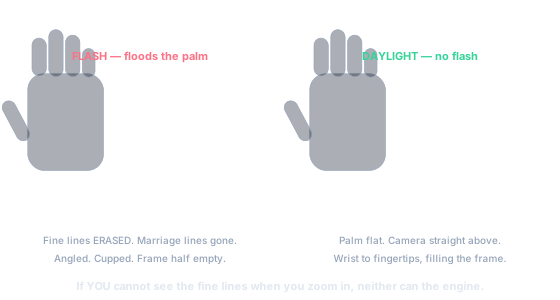
- Daylight. No flash. Flash floods the palm and erases the fine lines completely — including the marriage lines and every small sign. Stand near a window, face the light.
- Palm open and flat. Fingers slightly apart, relaxed. Not tensed, not cupped, not stretched.
- Camera straight above. Shoot perpendicular to the palm. An angled shot distorts mount elevation, and mount elevation is half the reading.
- Fill the frame. Wrist to fingertips, filling the image. A palm occupying a quarter of the photo loses every fine line.
- Check before you upload. Zoom in. If you cannot see the fine lines, neither can the engine. This one step fixes most bad readings.
The four mistakes we see constantly:
- Flash indoors at night. The most common, and the most destructive. It produces a bright, clean, empty palm
- Shooting at an angle because it feels more natural to hold the hand tilted. It distorts everything
- A tense, cupped hand. Cupping compresses the mounts and shortens the apparent lines
- Uploading the wrong hand. Upload your dominant hand for the primary reading — the one you write with, regardless of the right-for-men convention. See the which hand guide
One clear photo. Daylight. Straight down. That is the whole discipline.
What we will never claim
A closing statement of position, so you know exactly what you are buying.
We will never tell you when you will die. No mark on your hand predicts lifespan. A short life line does not mean a short life, and the people who told you otherwise have caused real and needless fear.
We will never diagnose an illness. Palmistry cannot do this and no honest practitioner claims it can. For any health concern, consult a doctor. If you are struggling with your mental health, speak to a qualified professional — a palm reading is not an assessment and not a treatment.
We will never predict your divorce. Your hand does not contain a decree.
We will never promise you money. Not from a fish sign, not from a Swastik, not from a sun line. Nothing on your hand delivers a sum.
We will never sell you a remedy for a fear we manufactured. There is no puja after the ₹51, no gemstone, no thread, no follow-up sitting. That entire business model is the reason this platform exists.
And on gemstones, since they are where most of the money in this industry sits: never wear a stone on the strength of a palm mark. Remedial stones are prescribed from the birth chart, not the hand, and the wrong stone does real harm. Check suitability against your actual chart with the gemstone suitability calculator first.
What we offer is one honest, classical reading of your hand, for ₹51, from a system that cannot see your face and has nothing to sell you afterwards.
If that is not enough, that is a completely reasonable conclusion — and you should keep your money.
Try it against a life you already know
There is only one honest test of a palm reading, and it is not an argument on the internet.
Read it against your own life — the life you have actually lived, whose facts you already know and cannot be flattered about.
The AI Hast Rekha Calculator reads all 6 lines, all 7 mounts, hand shape, finger proportion and every sign from one photograph, applies classical Samudrika Shastra rules, and returns 8 life scores, a full interpretation, personalised remedies and a downloadable PDF report.
₹51. No birth time, no birth date, no birth place. Your palm image is never stored on our servers.
It cannot see your face. It does not know what you want to hear. It has nothing to sell you when it is finished.
That will not make an ancient tradition true. But it will give you the cleanest version of it available anywhere — and then the judgement, correctly, is yours.
Read my palm → · Or start with the complete Hast Rekha guide.
What actual scientific research says, without overclaiming
Research on palmistry's predictive claims is thin and does not support fortune-telling of the kind popular content promises. What does have some genuine research behind it is finger-length ratio and general temperament tendencies — a narrower, separate finding from reading fate off a line.
The honest limits of palmistry, stated plainly
Palmistry cannot name a person, give an exact date, or diagnose an illness. Anyone claiming that level of precision has stepped outside anything the classical texts support. What it can honestly describe is temperament, tendency and general pattern.
So is palmistry actually useful at all
Yes, in its proper place — as a structured tool for self-reflection, particularly valuable when birth time is unreliable. Its real value sits in self-awareness, not prophecy. Anyone selling it as fixed destiny is misusing the tool.
Palmistry versus a birth chart — which is more accurate
Neither is 'more accurate' — they answer different questions. A birth chart is mathematically precise but needs a reliable birth time; palmistry needs none but lacks that mathematical precision.
If birth details are known, the free janam kundali calculator is the better starting point.
Is AI reading better than a skilled human palmist
Neither is simply better — they are different. A genuinely skilled human palmist has one real edge: tilting a hand to the light in person. AI's edge is consistency — no mood, no incentive to upsell, the same rule applied every time.
The fuller comparison is in how AI palm reading works.
How to recognise fear-based palmistry
If a reading names a disease, a death, or a specific disaster date — leave. If it immediately pushes an expensive gemstone or ritual — that is where the real revenue sits, not in the reading itself. Genuine palmistry never demands urgent, fear-driven action.
Should children have their palms read
Technically possible, but a child's lines — especially the fate and sun lines — are not yet fully formed. Treat a child's reading as a light temperament indicator, never a settled prediction.
Your own privacy in a palm reading
A palm photo is sensitive information and should be treated that way by any service you use — used only for the reading, never stored permanently, never repurposed. If a service will not state this plainly, that is itself a warning sign.
The most common customer complaint, and what it actually means
The most common complaint is 'nothing in the reading surprised me' — and this is, counterintuitively, the sign of an accurate reading. Palmistry's job is honest confirmation of self-knowledge, not manufactured shock.
Can a reading make someone anxious or low
Yes, if delivered in fear-based language, and this is exactly why disease, death and disaster claims are never made here. Every weak signal should come paired with a specific, practical next step, not vague dread.
If you are currently feeling low or anxious, any predictive reading, including this one, is worth setting aside for now — talking to someone you trust is the better next step.
Samudrika Shastra and modern psychology — where they meet, where they don't
Both traditions link physical signals to temperament in some form, but the methods and claims differ completely. Where Samudrika Shastra claims predictive power, it parts ways with anything psychology can currently support — and that gap is stated here rather than blurred.
Where to start if you want to learn to read palms yourself
Begin with the Hast Rekha guide for the full six lines, seven mounts and every sign in one place. Each has its own deeper page — life, heart, head, fate, sun and marriage lines — and applying what you read to your own hand is the fastest way to actually learn.
Honest palmistry versus a scam — the final distinction
The real difference is never in how accurate the prediction sounds — it is in intent. Honest palmistry states its limits and never rushes you. A scam always runs on fear, urgency, and the next payment.
Next time a reading tries to frighten you, remember you are allowed to ask: where exactly is this written?
Our own calculators and their honest limits
Beyond palmistry, we run calculators on topics like Manglik dosha and santan yog, each with its limits stated as plainly as here. The free manglik dosh calculator checks a birth chart, never a palm. The free santan yog calculator is equally bounded.
No calculator here delivers fixed destiny — all describe tendency and probability.
How much to trust online reviews and ratings
A five-star rating on a vague, pleasant-sounding reading proves little — positive, non-specific language earns good ratings regardless of accuracy. The real test is whether a reading said anything specific enough that it could have been wrong.
Compare options directly at a palmist near you.
Avoiding gemstone and remedy upsell
If a palm reading moves straight to recommending an expensive gemstone or ritual, that is a signal to pause. Any genuine gemstone recommendation requires checking the full birth chart first, never a palm alone — verify separately with the free gemstone suitability calculator.
Our approach and where it comes from
The rule set behind this platform draws on 16-plus years of practice in the Parashara BPHS tradition. Every rule applied traces to a named source rather than an invented shortcut — laid out in full in the Hast Rekha guide, not hidden behind vague authority.
Frequently asked questions about accuracy
Is my photo kept after the reading? No, it stays within the session only. What if my reading feels wrong? A poor photo is the most common cause — retaking it with better light usually resolves this. Does this replace a full birth chart reading? No, the two work best together; see how AI palm reading works.
What Manglik dosha checking actually requires
Manglik dosha is determined entirely by Mars's house placement in the birth chart — no palm reading, however detailed, can confirm or rule it out. The genuine check is the free manglik dosh calculator, never a palm.
Wealth claims and the honest convergence rule
No single line, mount or sign guarantees wealth on its own — financial outcomes read as convergence across a strong Budh mount, a clear fate and sun line, and a disciplined thumb together. Anyone promising riches off one feature, discussed further in the seven mounts, is selling a story.
Where to go from here
Start broad with the Hast Rekha guide, or go deep on a specific line — life, heart, head, fate, sun or marriage line. For a face-to-face option, see a palmist near you; to start now, read your palm for ₹51.
Apna Personalized Analysis Lein
Yeh article general framework hai. Aapke specific chart ke according detailed analysis ke liye:
Frequently Asked Questions
Is palm reading accurate?
Palmistry is a structured observational tradition, not a predictive science. It can defensibly describe constitution, temperament and disposition from hand structure. It cannot predict events, dates, disease or death — and any reading that claims to is indefensible.
Is palmistry just the Barnum effect and cold reading?
Those are real objections and we take them seriously. Cold reading requires a reader who can watch your face and adjust — an engine reading a photograph cannot do that. It does not see you, does not know what you want to hear, and has nothing to sell you afterwards. That removes two of the four objections. The others remain live.
Can palm lines change over time?
Yes. The three major lines are broadly stable in course, but secondary lines strengthen, break, reroute and fade across a lifetime. This is fatal to fatalism: a mark that can vanish cannot be a fate. It is a reading of current conditions.
How does AI read a palm?
It detects the hand and traces the lines, mounts and proportions from your photograph, then applies classical Samudrika Shastra rules to what it found — strict geometry, not guesswork. It reads only what is visible, and it does not invent lines that are not there.
What is the best palm photo?
Daylight, no flash. Palm open and flat, fingers slightly apart. Camera straight above, not angled. Fill the frame wrist to fingertips. Check before uploading — if you cannot see the fine lines when you zoom in, neither can the engine.
Is a human palmist better than an AI reading?
On firmness, skin texture and palm flexibility — yes, genuinely. A trained hand pressing yours has a real advantage there. On consistency, cold reading and commercial incentive, the engine is better, because it cannot see you and has nothing to sell you afterwards.
Is my palm photo stored anywhere?
No. Palm images are not stored on our servers. They stay in your browser session and are removed after analysis. Only the analysis result is retained.
See also · यह भी देखें
Broken Fate Line? Why It Is Often Good News
palmistryFish Sign on Palm? It's Probably an Island
palmistryHast Rekha Gyan — 5 Myths Everyone Repeats
palmistryIsland, Cross, Grille — The Honest Truth
palmistryShort Life Line? It Does Not Mean Early Death
palmistryM Sign on Palm — Not Rare, But Telling
palmistrySwastik, Shankh, Chakra on Palm — Real?
palmistryWhich Hand to Read? Wrong Question
Categories: palmistry · spirituality