Which Hand to Read? Wrong Question
Trikaal Sandesh — Direct Answer
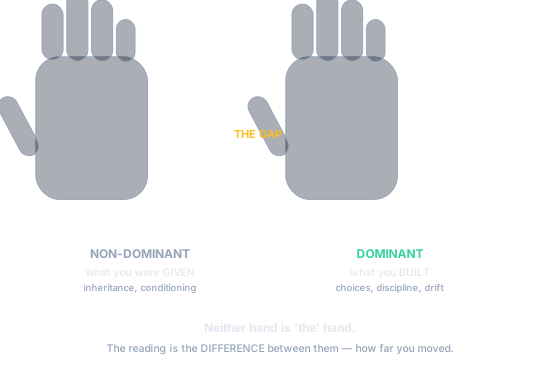
In Samudrika Shastra the non-dominant hand shows inherited constitution and latent potential; the dominant hand shows what has actually been built. Neither is "the" hand to read — the difference between them is the reading. The traditional right-for-men, left-for-women rule is a reading-order convention, not a difference in meaning.
Deep Dive Analysis
You are asking the wrong question
Which hand should I read?
It is the first question everyone asks, and it contains a hidden assumption that quietly ruins the reading: that one hand is the real one and the other is decoration.
Neither hand is the real one. Both are real, and they say different things.
The non-dominant hand shows what you were given. Inherited constitution, family conditioning, the temperament you arrived with, the potential that was placed in you before you had any say in it. This is the hand of your inheritance.
The dominant hand shows what you did with it. The life you actually built. The choices, the discipline, the drift, the reinvention. This is the hand of your authorship.
And here is the part almost nobody performs, including a great many people charging money for it:
The reading is the difference between them.
Not one hand. Not the other. The gap. How far you have moved from where you started — and in which direction. That is the single most revealing measurement available on a human body, and it is available to anyone willing to hold both palms side by side in daylight and actually look.
Most people never have.
Reading the gap — the four cases
Hold both palms open, side by side, in natural light. Compare the same structure on each — the fate line against the fate line, the Guru Parvat against the Guru Parvat. Four patterns emerge.
1. Dominant hand stronger. Deeper fate line, clearer sun line, better-developed mounts on the hand you write with.
This is self-authorship. You were given a certain amount and you built past it. Whatever your starting conditions, you moved. In our reading this is the most encouraging configuration on the human hand, and it is far more common than people expect — most people are so busy comparing themselves to others that they never notice they have outrun themselves.
2. Non-dominant hand stronger. The inheritance was richer than what you have done with it. Potential that was there and has not been spent.
This is an uncomfortable reading and we will give it anyway, because it is the most actionable one on this page: you are capable of more than you are currently doing, and some part of you already knows. The classical framing is unsentimental — latent capability going unused. Not a tragedy. A bill unpaid.
3. The two hands nearly identical. Very little movement. The life you were handed is the life you are living.
This is not automatically bad — some people are handed a good fit and wisely keep it. But it frequently indicates the unexamined life: a track walked without ever being questioned. If the identical hands also show a strong fate line joined to the life line, that reading gets stronger. See the fate line guide.
4. The two hands radically different. Different dominant mounts. Different head line slopes. Different fate line origins.
This is reinvention. Something broke the trajectory — a migration, a rupture, an education, a decision. These people are usually aware of it and can name the moment. Their two hands belong to two different lives, and both were theirs.
The right-for-men, left-for-women rule — what it actually is
You have heard it everywhere: purush ka daya haath, stri ka baya haath. The right hand for men, the left for women.
Here is the honest position, and it will annoy some people.
It is a reading-order convention, not a difference in meaning.
The lines do not mean different things on a woman's hand. The Guru Parvat does not govern one quality in men and another in women. There is no mechanism by which it could, and the classical framing — which is about dominant versus non-dominant — does not support it either.
What the convention actually encodes is a traditional starting point: the hand a reader looks at *first*. It has cultural weight, it appears widely in the Indian texts, and it is genuinely part of the tradition. But it is a protocol, not a physiology.
The operative distinction remains what it has always been: dominant hand versus non-dominant hand. If you are a left-handed man, your left hand is your dominant hand, and pretending otherwise because of a convention will simply give you a worse reading.
So: upload your dominant hand for the primary reading. Add the other for the comparison — which is where the actual information lives.
Hand shape: the layer people skip entirely
Before a single line is read, Samudrika Shastra reads the shape of the hand. Practitioners who jump straight to the lines are working with half the information — and most online palmistry never mentions this at all.
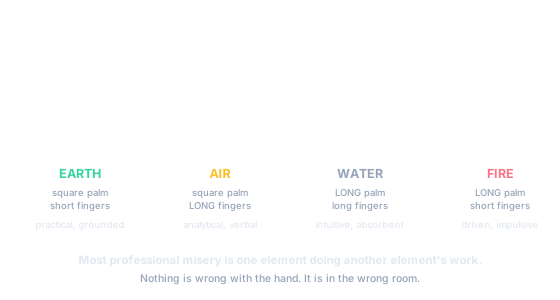
The division works from the proportion of the palm to the fingers, and it maps to the elements.
Earth hand — square palm, short fingers, thick firm skin. Practical, grounded, physically capable, slow to change, resistant to abstraction. Builders, operators, craftsmen, farmers, engineers. What they touch, they understand. What they cannot touch, they distrust.
Air hand — square palm, long fingers, dry skin. Analytical, verbal, restless, quick to abstract, needs mental stimulation the way others need food. Communicators, strategists, teachers, analysts. Bored easily and dangerously.
Water hand — long palm, long flexible fingers, soft skin. Emotional, intuitive, absorbent, easily overwhelmed by other people's states. Artists, healers, counsellors. This hand takes in more than it can process and needs deliberate protection from noise.
Fire hand — long palm, short fingers, firm skin. Driven, impulsive, magnetic, impatient with detail. Founders, leaders, performers. Starts everything, finishes what holds their interest.
And the practical use of this: most professional misery is a hand doing the work of another element. An Air hand in repetitive manual work. A Water hand in a role with no human contact. An Earth hand asked to improvise strategy. Nothing is wrong with any of them. They are simply in the wrong room.
Stop guessing at your own hand
You are holding both palms up and comparing them, and you are not entirely certain what you are seeing. That is expected — the two-hand comparison is the most valuable reading in Hast Rekha and the one almost nobody performs, including most people who charge for it.
A palmist charges ₹500 to ₹2,000, and a great many of them will look at one hand, glance at the other, and improvise.
The AI Hast Rekha Calculator reads it from one photograph — and if you upload both hands, it reads the difference, which is where the actual information lives.
- No birth time. No birth date. No birth place. Your palm is enough
- Hand shape, finger proportion, thumb structure — the layer almost every reading skips
- 6 lines, 7 mounts, 8 life scores, classical Samudrika interpretation, personalised remedies, PDF report
- Your palm image is never stored on our servers — it stays in your browser session and is removed after analysis
- ₹51. No subscription, no upsell, no ritual to buy afterwards
Fingers: length, spacing and set
The fingers refine the reading of the hand shape, and three measurements carry most of the weight.
Length. Long fingers indicate attention to detail and patience with process — this person enjoys the method, not just the outcome. Short fingers indicate speed and impatience — they want the result and find the process an obstacle. Neither is superior; put them on the wrong task and both fail.
Individual fingers. A long index finger (Guru) signals ambition and a need for authority — this person is uncomfortable being led. A long ring finger (Surya) signals creative risk appetite and a taste for being seen. A long little finger (Budh) signals verbal and commercial fluency — the negotiator.
Spacing. Hold your hand relaxed and open. Widely spaced fingers indicate independence, openness, a resistance to control — this person does not check before acting. Tightly held fingers indicate caution, containment, a need for security. This is one of the few readings you can perform on someone across a table without them noticing.
Set. Look at where the fingers meet the palm — do they sit on an even arc, or does one sit noticeably lower? A low-set little finger (Budh) is a genuinely important mark: it classically indicates a period of feeling disadvantaged, unheard or commercially undervalued — often in childhood, and often carried into adult negotiation as a reflex to accept the first offer. People with this mark systematically undercharge for their work, and they can be taught not to.
The thumb: the structure that decides whether anything happens
If we had to read one feature of a hand and nothing else, it would not be a line. It would be the thumb.
In classical Hast Rekha the thumb is the seat of willpower and execution. Some texts hold it reveals more about a person's capacity to *finish* than any line on the palm — and across every page of this hub, the thumb is the structure that keeps deciding whether the reading converts into a life.
Flexibility. Press the thumb gently backward. A stiff thumb that resists indicates iron will, resistance to persuasion, and the ability to grind through years of unrewarded work. It also indicates stubbornness, and an inability to abandon a bad plan. A flexible thumb that bends easily indicates adaptability, generosity, and quick forgiveness — and a tendency to bend when standing firm was the right call.
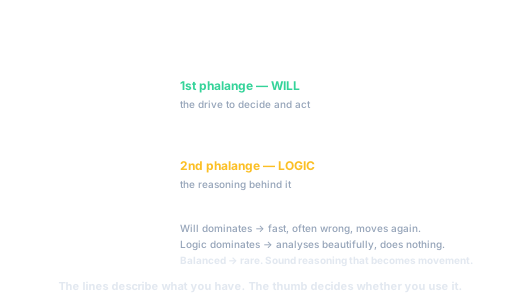
The two phalanges. The first (from the joint to the tip) is will — the drive to decide and act. The second (from the joint to the base) is logic — the reasoning behind the decision.
When the first dominates: decisive people acting on poor reasoning. They move fast and they are often wrong, and they move again.
When the second dominates: excellent reasoning that never converts into action. This person analyses beautifully and does nothing, and they experience their paralysis as prudence.
When they are balanced: the rarest and most effective combination — sound reasoning that reliably becomes movement.
Size and set. A large, well-formed thumb set low on the hand indicates real force of character. A small, weak thumb indicates a person more easily moved by circumstances and by other people.
This single feature is why a hand with a fine life line and a stiff thumb outperforms a hand with a deep life line and a weak one. The lines describe what you have. The thumb decides whether you use it.
Skin, flexibility and the honest limits of a photo
Three final readings that a photograph handles poorly — and we would rather tell you that than pretend otherwise.
Skin texture. Fine, smooth skin indicates sensitivity and refinement — this person registers subtlety and is disturbed by coarseness. Coarse, thick skin indicates robustness, physical tolerance, and a lower sensitivity to atmosphere. This is read by touch, and a photograph approximates it at best.
Palm flexibility. A hand that bends easily backward indicates adaptability and openness. A rigid hand indicates fixed views and a resistance to change. A photograph cannot read this at all.
Firmness of the mounts. As covered in the seven mounts guide, a full spongy Shukra Parvat and a full firm one mean opposite things — indulgence versus warmth. Elevation photographs well. Firmness does not.
So here is our honest limit, stated plainly: an image-based reading is strong on lines, marks, mount elevation, hand shape and finger proportion — which is the substantial majority of the shastra. It is weaker on texture, flexibility and firmness than a trained hand pressing yours in person.
If you have access to a genuinely skilled, non-commercial palmist, use them. Most people in this country do not — what they have access to is a market that finds an auspicious mark, names a disaster, and sells a remedy.
That is the gap we exist in, and we would rather define it accurately than oversell it.
Get both hands read — and read the difference
One hand tells you a fact. Two hands tell you a story.
The AI Hast Rekha Calculator reads hand shape, finger proportion, thumb structure, all 6 lines, all 7 mounts and every sign — and when you upload both hands, it reads the gap between what you were given and what you built.
You get 8 life scores, a full classical Samudrika Shastra interpretation, personalised remedies and a downloadable PDF report.
₹51. One photo — or two. No birth time, no birth date, no birth place. Your palm image is never stored on our servers.
Upload your dominant hand for the primary reading. Add the other if you want the comparison — and the comparison, honestly, is the reading most people have never had and most need.
Read my palm → · Or start with the complete Hast Rekha guide.
Which hand for the life line specifically
The non-dominant hand's life line shows inherited constitution — vitality you started with. The dominant hand shows current reserves, shaped by how that vitality has actually been spent. A wide gap between the two is common and worth noting, not worrying over.
Read both before drawing any conclusion about stamina or resilience.
Which hand for the fate line and career questions
Fate line differences between hands are usually the largest of any line, because career is shaped almost entirely by lived experience rather than birth. A faint fate line on the non-dominant hand with a strong one on the dominant hand is the classic self-made pattern.
Always read career questions from the dominant hand first.
Can your dominant hand change over your lifetime
Physical hand dominance rarely changes. What changes is the hand itself — its lines deepen, fade, or shift as life unfolds. So a reading taken at 25 and again at 45 on the same dominant hand can look meaningfully different.
This is the hand changing, not dominance switching — the same way a life line shifts in depth over decades.
Reading twins — why identical hands are rare
Even identical twins usually show noticeably different palms, because the hand records lived experience rather than genetics alone. This is strong evidence that palmistry is not fortune fixed at birth, but a running account of a life actually lived.
Comparing your palm to a sibling's, twin or not, rarely tells you anything useful — the full reasoning is in the Hast Rekha guide.
The thumb on each hand — capability versus follow-through
The thumb on the non-dominant hand shows inherited temperament — how willpower was wired in. The dominant-hand thumb shows how that willpower is actually being used day to day. A firm dominant thumb with a softer non-dominant one often marks someone who built discipline rather than being born with it.
Read the thumb on both hands before judging follow-through, alongside the mount it sits beside.
Marks and signs — does hand choice matter here too
Yes. A machli or M sign on both hands is read as the strongest version of that mark — inborn and actively used. On one hand only, it is still meaningful, just less emphatic.
Never judge a mark's strength from one hand without checking the other.
Mounts on each hand — potential versus use
A mount's development on the non-dominant hand shows natural aptitude; the same mount on the dominant hand shows how much that aptitude has actually been exercised. A full Guru mount on the non-dominant hand with a flatter one on the dominant hand often marks unused leadership potential.
The full mount map is in the seven mounts of the palm.
What if both hands are almost identical
This happens, and it is not a sign that the method has failed. It usually means life has closely matched inherited temperament — someone who became, largely, who they already were. It is a legitimate, if less common, reading in itself.
Do not force a difference where none genuinely exists.
Common mistake: reading only the hand you write with
Writing hand and dominant hand for palmistry purposes are the same thing for most people, but not always — some write with one hand due to childhood correction while genuinely favouring the other for strength and coordination. When in doubt, the hand you would use to catch a thrown ball is usually the better indicator.
When unsure, read both and note where they agree.
Classical basis for the two-hand method
On classical support: the Trikaal Library holds one palmistry text, Varahamihira's Brihat Samhita (Ch.67, Purusha Lakshana). It does not say which hand to read; it describes the hand itself — long fingers for the long-lived, straight fingers for the fortunate, fine fingers for the intelligent and flat ones for those who work for others (Sl.36)[1], and a deep, sunken palm for loss of the father's wealth while a closed, deep palm marks the prosperous and an upturned open palm the generous (Sl.39)[2]. Trikaal Vaani's reading: the two-hand method (non-dominant hand for what you arrived with, dominant hand for what you built) is our reading convention, not a verse; the verses support only the idea that the shape and posture of the hand carry information, which is why we read both hands.
The full classical framework is in the Hast Rekha guide.
How AI reading handles hand choice
The engine reads whichever hand you photograph and does not assume dominance for you — you tell it which hand you are submitting. Submitting both gives the fuller, comparative reading described throughout this page.
See how AI palm reading works for the full process, and read your palm for ₹51.
Which hand for the heart line and marriage line
The heart line on the non-dominant hand shows inherited emotional temperament; the dominant hand shows how that temperament is actually expressed in relationships. The same logic applies to the marriage line — count and depth can genuinely differ between hands.
A relationship reading built from one hand alone is incomplete.
Timing on either hand — the honest limits
Proportional timing methods (dividing a line by age) work the same way on either hand, but the dominant hand's timing reflects the life actually lived, which is what most people are really asking about. Timing from the non-dominant hand alone tends to describe a path not taken.
For anything close to exact timing, a birth chart's dasha periods remain the sharper instrument — check with the free dasha calculator.
Hand choice has nothing to do with checking Manglik dosha
Neither hand answers a Manglik dosha question — that is determined by Mars's house placement in the birth chart, not by any palm reading. Anyone who claims hand choice affects a Manglik reading is mixing two unrelated systems.
The real check is the free manglik dosh calculator.
Rare marks — does hand choice matter here too
A rare mark such as a swastik or shankh appearing on both hands is read as considerably stronger than the same mark on one hand only — see rare auspicious signs on the palm for how these are verified. One-hand-only rare marks are still genuine, just less emphatic.
Double-check any rare-mark claim against both hands before trusting it.
Left-handed readers — does the rule flip for them
No. Dominance, not the specific hand, is what matters — a left-handed person's dominant hand is simply their left, and the same non-dominant/dominant logic applies exactly as it would for a right-handed person. There is no separate rule for left-handed readers.
The folk convention that assigns hands by gender has no such flexibility, which is one more reason it fails — see is palm reading accurate for more on tested versus folk claims.
Photographing both hands correctly
Photograph each hand separately, flat, in daylight, camera directly overhead — the same standard either hand needs. Submitting one blurry and one clear photo will bias the comparison toward whichever hand was captured better, not whichever hand is actually stronger.
Both photos should meet the same quality bar before you compare results.
What if you only have one usable hand
A single-hand reading is still fully valid — it simply reads as either the inherited or the lived pattern, whichever hand is available, without the comparative layer. Nothing about the reading of that one hand becomes less accurate.
What is lost is only the difference between the two, not the reading itself — a palmist near you can sometimes work around a limited photo better than an app can.
Reading a child's hands — which one, and how much weight
For children, the non-dominant/dominant distinction matters less, because the dominant hand has not yet accumulated much lived difference from the non-dominant one. Treat a child's reading, from either hand, as a light indication of temperament rather than a settled pattern.
The clearer, more reliable comparison becomes available once someone reaches adulthood, once the fate line has had time to actually take shape.
Common myths about hand choice
"Your dominant hand is your true self" — false; it shows current life, not truth versus falsehood. "The non-dominant hand is fixed and unchangeable" — false; it can shift too, just more slowly. "Reading the wrong hand ruins the reading" — false; either hand gives real information, just about a different question.
The honest classical framework for all of this is in the Hast Rekha guide.
Bringing hand choice together across the whole system
The same rule threads through everything on this site: life line, fate line, heart line, head line, sun line, and every mount all read differently, and more completely, when both hands are compared.
The full method sits in the Hast Rekha guide; for a face-to-face option see a palmist near you, or start now for ₹51.
Apna Personalized Analysis Lein
Yeh article general framework hai. Aapke specific chart ke according detailed analysis ke liye:
शब्दावली · Glossary
- Dominant hand
- The hand you write and work with; it shows what you have built from your own choices.
- Non-dominant hand
- The hand you do not write with; it shows inherited constitution and latent potential.
- Karatala
- The inner palm; Brihat Samhita reads its form — sunken, closed or open — for temperament and means.
- Hast Rekha
- The Indian system of reading the lines, mounts and signs of the palm.
ग्रंथ सन्दर्भ · Classical Sources
The classical source behind every rule in this article — Granth, Adhyaya and Shlok number.
हस्तांगुलयो दीर्घाश्चिरायुषामवलिताश्च सुभगानाम् । मेधाविनाम् च सूक्ष्माश्चिपिटाः परकर्मनिरतानाम् ।
— Brihat Samhita, Adhyaya 67 — Purusha Lakshana Adhyaya · Shlok 36Long fingers mark the long-lived; straight, unbent fingers mark the fortunate; fine fingers mark the intelligent; flat ones mark those who work for others.
लंबी उँगलियाँ दीर्घायु की, सीधी उँगलियाँ सौभाग्यशाली की, सूक्ष्म उँगलियाँ बुद्धिमान की, और चपटी उँगलियाँ दूसरों के काम में लगे रहने वाले की होती हैं।
पितृवित्तेन विहीना भवन्ति निम्नेन करतलेन नराः । संवृतनिम्नैः धनिनः प्रोत्तानकराश्च दातारः ।
— Brihat Samhita, Adhyaya 67 — Purusha Lakshana Adhyaya · Shlok 39A deep, sunken palm shows loss of paternal wealth; a closed, deep palm shows wealth; an upturned open palm marks a generous giver.
बहुत धँसी हथेली पैतृक धन की कमी दिखाती है; बंद और गहरी हथेली धनवान की, और ऊपर को खुली हथेली दानी की होती है।
Each reference checked against the Trikaal Vaani Granth library or a reputable open source · Interpretation: Rohiit Gupta, Chief Vedic Architect
Frequently Asked Questions
Which hand should be read in palmistry?
Both. The non-dominant hand shows what you were given — inherited constitution and latent potential. The dominant hand shows what you built with it. The reading is the difference between them, and that gap is the most revealing measurement on the body.
Is the right hand for men and left for women rule real?
It is a reading-order convention, not a difference in meaning. The lines do not signify different things on a woman's hand. The operative distinction is dominant versus non-dominant — a left-handed man should have his left hand read as the primary.
What does it mean if my dominant hand is stronger?
Self-authorship. You were given a certain amount and built past it. It is the most encouraging configuration on the hand — and more common than people expect, because most people are too busy comparing themselves to others to notice they have outrun themselves.
What if my non-dominant hand looks stronger?
The inheritance was richer than what you have done with it — latent capability going unspent. It is an uncomfortable reading and the most actionable one: you are capable of more than you are currently doing, and some part of you already knows.
What are the four hand shapes?
Earth (square palm, short fingers — practical, grounded), Air (square palm, long fingers — analytical, verbal), Water (long palm, long fingers — emotional, intuitive) and Fire (long palm, short fingers — driven, impulsive). Most professional misery is one element doing another's work.
What does the thumb reveal in palmistry?
Willpower and execution — classically more about your capacity to finish than any line on the palm. A stiff thumb indicates iron will and stubbornness; a flexible one indicates adaptability and a tendency to bend when standing firm was correct.
Can a photo read hand shape and fingers accurately?
Yes — lines, marks, mount elevation, hand shape and finger proportion photograph well. Skin texture, palm flexibility and mount firmness do not, and are better assessed by a hand pressed in person. That is a genuine limit and we would rather state it.
See also · यह भी देखें
Part of the hubHast Rekha Gyan — 5 Myths Everyone RepeatsGroup: Which hand should be read — left or right?
AI Palm Reading — What the Machine Actually Sees
palmistryBroken Fate Line? Why It Is Often Good News
palmistryFish Sign on Palm? It's Probably an Island
palmistryIs Palm Reading Accurate? The Honest Answer
palmistryShort Life Line? It Does Not Mean Early Death
palmistryM Sign on Palm — Not Rare, But Telling
palmistryThe Seven Mounts — What the Lines Can Actually Do
Categories: palmistry · spirituality