Swastik, Shankh, Chakra on Palm — Real?
Trikaal Sandesh — Direct Answer
Swastik, Shankh, Chakra, Kamal and Mandir are traditional palm symbols. Trikaal Vaani reads them as punya (merit), protection and dharmic temperament; the Brihat Samhita reads some of the same shapes as marks of rank. They are rarer than the internet claims and promise no specific wealth, which is why they are the most exploited marks in Indian palmistry.
Deep Dive Analysis
The rarity paradox — why these are the fraudster's favourite marks
There is a reason the rare marks get the most breathless coverage, and it has nothing to do with the shastra.
The rarer a mark is claimed to be, the fewer people can check it.
If someone tells you your heart line is chained, you can look. If someone tells you your fate line is broken, you can look. But if a reader leans over your palm, pauses with theatrical gravity, and says *you have a Swastik on your Guru Parvat — this is extremely rare, I have seen it perhaps four times in thirty years* — what exactly are you going to do? Argue?
You will look at the crosshatch of fine lines on your Jupiter mount, you will want it to be a Swastik, and you will believe them. And the reading that follows — and, inevitably, the remedy that follows the reading — will cost you a great deal more than ₹51.
This is not a hypothetical. It is the standard operating procedure of a substantial part of the Indian astrology market, and the rare marks are its primary instrument.
So we are going to do something unusual on a page about rare auspicious signs: we are going to make it harder for you to believe you have one.
What 'auspicious' actually means in the shastra
Before the individual marks, one correction that changes everything.
When we call a mark shubh (auspicious), we are not describing a payout. We read it as punya — accumulated merit — even though the Brihat Samhita itself reads several of these shapes as marks of rank, wealth or lordship.
Punya in the Vedic understanding is not a bank balance and not a lottery ticket. It is a disposition of circumstances in your favour. Doors open more readily. Help arrives without being engineered. Difficulty, when it comes, is survivable rather than ruinous.
Notice the shape of that. It describes a tailwind, not a destination. And a tailwind is worth nothing to someone standing still.
This is the gap that every fraudulent reading exploits. Our reading says *merit*. The reader says *crorepati*. Varahamihira does read some of these shapes as marks of rank, but he states no sum, no property and no date; the leap from a mark to a promised fortune was made by someone with a puja to sell.
So when you read that a Swastik on the Guru Parvat indicates dharmic authority and protection — that is the tradition speaking. When you read that it guarantees a government job, a foreign settlement and a luxury car, that is a content writer speaking, and they have never opened the Samudrika Shastra.
Swastik — the mark of dharmic protection
The Swastik is the most celebrated of the rare marks, and the most frequently invented.
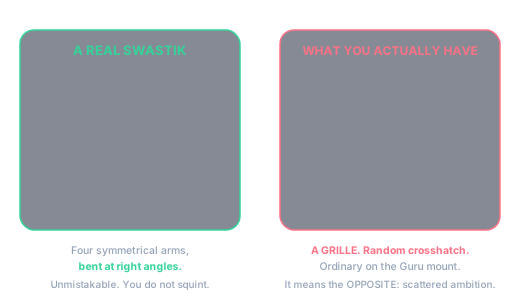
What it genuinely is: a clear, symmetrical, four-armed figure with the arms bent at right angles — the same geometry as the sacred symbol itself. It must be symmetrical and it must be deliberate. It sits most significantly on the Guru Parvat (Jupiter mount, below the index finger).
What it indicates: dharmic strength, protection, and authority carried with moral weight. Traditional palmistry associates it with a person whose position is *deserved* — leadership that serves rather than extracts. It is read as one of the strongest protective marks available.
What it is not: a guarantee of anything material. The Brihat Samhita (Sl.46)[2] does read swastika-shaped lines as a mark of lordship, but it states no sum, no property and no date, and Trikaal Vaani does not turn that into a promise.
And the honest part. Almost every 'Swastik' shown in online palmistry content is a grille — a random crosshatch of intersecting fine lines. The Jupiter mount is one of the most heavily lined regions of the hand, and crosshatching there is entirely ordinary. As covered in the island, cross and grille guide, a grille on Guru means the *opposite* of a Swastik: ambition dispersed, never landing.
So a person can walk out of a reading believing they carry a mark of dharmic authority when their hand is actually flagging scattered, frustrated ambition. That is not a minor error. It is a reversal.
The test: four arms, bent at right angles, symmetrical, forming a discrete and unmistakable figure. If you have to tilt, squint and want it — you have a grille.
Shankh and Chakra — the marks on your fingertips
These two are misunderstood in a specific and interesting way, and getting it right gives you something almost nobody has.
Shankh (conch) and Chakra (wheel/whorl) are not primarily marks on the *palm*. In the classical Indian tradition they are read on the fingertips — they are patterns in the ridge structure of the skin. What Western forensics calls a whorl, the tradition calls a Chakra. What it calls a loop, the tradition reads as a Shankh.
This is genuine, verifiable, and completely unlike the vague shapes people hunt for on their mounts — because your fingertip patterns are fixed, objective, and cannot be argued with.
Chakra (whorl): a closed, circular ridge pattern. Classically associated with individuality, concentration, self-containment, and a resistance to being moved by others. The count matters: the tradition reads the number of chakras across the ten digits, and a high count is associated with a strongly self-directed, uncompromising nature — capable, and difficult to lead.
Shankh (loop/conch): an open, flowing ridge pattern. Associated with adaptability, receptivity, and social ease. The common pattern, and none the worse for it.
The ten-chakra reading — all ten fingertips carrying whorls — is genuinely rare and classically regarded as a mark of exceptional will and singularity of purpose. It is also, unlike a Swastik, something you can verify yourself with a magnifying glass, which is precisely why it is discussed far less often by people selling readings.
Marks that can be checked are bad for business.
Stop guessing at your own hand
You are here because you saw a shape on your palm — or someone told you about one — and you want to know whether it is real.
That question is worth answering honestly, because the rare marks are where the money is. A palmist charges ₹500 to ₹2,000 to look, and finding a rare auspicious mark on your hand is the single most profitable outcome of that sitting — for them. It justifies the puja, the stone, the follow-up, the activation ritual. The incentive to find one is enormous, and a great many practitioners act on it.
The AI Hast Rekha Calculator reads it from one photograph, and it has the one advantage that decides this entire question: it has nothing to sell you afterwards, and no reason to find a Swastik on your palm.
- Strict geometry. A Swastik needs four symmetrical arms bent at right angles. A grille is a mesh. The engine checks the rule, not your hopes
- Every mark read against the mount that carries it — placement decides meaning, always
- No birth time. No birth date. No birth place. Your palm is enough
- 6 lines, 7 mounts, 8 life scores, classical Samudrika interpretation, personalised remedies, PDF report
- Your palm image is never stored on our servers — it stays in your browser session and is removed after analysis
- ₹51. One price. No puja, no stone, no second sitting
Kamal, Mandir and Kalash — the marks of merit
Kamal (lotus). A rounded, layered figure resembling an open lotus, most significant on the Guru Parvat or near the Manibandha Rekha (the bracelet lines at the wrist). In our reading, a mark of purity of intent and spiritual merit — a person whose fortune, when it arrives, arrives clean. The lotus is the most explicitly *dharmic* of these marks: the tradition associates it not with getting, but with deserving.
It is also, in our observation, the mark most frequently confused with an ordinary cluster of curved fine lines. The geometry must be layered and unmistakable.
Mandir (temple). A structure resembling a temple outline — a base with rising sides meeting at a peak. Read as devotion, spiritual inclination, and protection through faith. Classically associated with people whose lives contain a genuine religious or ethical centre, rather than a decorative one.
Kalash (sacred pot). A rounded vessel shape, most significant near the wrist. Read as abundance and completion — the vessel that fills. Of all the rare marks, this is the one most often equated with wealth in modern content, and the Brihat Samhita reads pot-shaped lines as keepers of treasure (Sl.46)[2], and our reading is quieter: sufficiency, a life that does not run empty.
And the pattern you should notice across all three: none of them is, in our reading, a promise of money, status or property. We read them as signs of merit, intent and protection, although the Brihat Samhita reads lotus-like marks as a king's (Sl.45)[1] and pot-shaped lines as keepers of treasure (Sl.46)[2]. Every one of them is a statement about the *quality of a life*, not the *contents of an account*.
The internet has converted all of them into wealth predictions, for the simple reason that merit does not sell and wealth does.
The verification problem — how to protect yourself
Here is the practical value of this page, and it is worth more than any of the marks discussed on it.
A claim you cannot check is a claim you should not pay for.
The rare marks fail this test almost by definition. You cannot verify a Swastik on your own Jupiter mount. You do not know what a real Kamal looks like. You have never seen a Mandir on anyone's palm. Which means when a reader tells you that you have one, you have no independent means of assessment — and you are being asked to buy a remedy on the strength of it.
Four protections:
1. Ask them to show you the geometry. Not the meaning — the *shape*. A real Swastik has four symmetrical arms at right angles. Make them trace it. A great many readers cannot, because it is not there.
2. Notice if every mark points to money. If the Swastik means wealth, the Kamal means wealth, the Kalash means wealth and the fish means wealth, then the symbols have stopped meaning anything. That is not a reading. It is a slot machine with a Sanskrit skin.
3. Notice what happens next. An honest reading ends with a condition and leaves you free. A sale ends with an event and offers to secure it — for a price. If the reading concludes in something you must buy from the person who read you, you did not have a reading.
4. Check your fingertips instead. Your Chakra and Shankh patterns are objective, fixed, and verifiable by anyone with a magnifying glass. Nobody can invent them for you — which is exactly why they are discussed so much less.
If you have none of these — which you probably do not
Let us be direct: most people carry none of these marks, and that is entirely unremarkable.
They are called rare because they are rare. A hand without a Swastik, a Kamal or a Mandir is a completely ordinary hand belonging to a completely ordinary life — and ordinary lives contain most of the happiness ever experienced by anyone.
What you almost certainly *do* have is more useful anyway:
A square somewhere on your hand. The protective mark that only forms over damage — evidence that something went badly and did not destroy you. As covered in the star, triangle and square guide, the tradition regards it as more valuable than most of the marks people actually hope for, and nobody makes videos about it.
A dominant mount. Your planetary type — the standing bias of your temperament, and the single most useful thing on your hand for deciding what work will not make you miserable. See the seven mounts guide.
Lines that record what you have survived. Your islands rejoin. Your breaks resumed. That is not mysticism; it is on your skin.
And the honest closing, which we will state as plainly as we can: no mark on your hand determines your worth, your fortune or your future. Not the Swastik, not the Kamal, not the fish, not the M. The rare marks describe a temperament disposed toward merit. They do not deliver anything, and they never claimed to.
Anyone who tells you your life will change because of a shape on your palm is not reading your hand. They are reading your hope.
Find out what you actually have
The rare marks are the most exploited signs in Indian palmistry precisely because they cannot be checked — and the entire economics of the fear-and-fortune sale depends on you not being able to check.
The AI Hast Rekha Calculator checks.
It reads every mark on your palm from one photograph against strict classical geometry — four symmetrical arms or it is not a Swastik, a layered figure or it is not a Kamal, a mesh is a grille and not a sacred symbol. It identifies which mount carries each mark, and it measures how strong that mount actually is, because a symbol on an undeveloped mount amplifies nothing.
You get 8 life scores, all 6 lines, all 7 mounts, a full classical Samudrika Shastra interpretation, personalised remedies and a downloadable PDF report.
₹51. One photo. No birth time, no birth date, no birth place. Your palm image is never stored on our servers. No puja, no gemstone, no follow-up sitting.
And it will do the one thing no palmist with a remedy to sell will ever do for you: it will tell you when the answer is no.
Read my palm → · Or start with the complete Hast Rekha guide.
Which mount each rare sign is most auspicious on
A Swastik on the Guru mount is read as dharmic protection specifically over leadership and ethics; the same mark on the Shukra mount reads as protection over family stability instead. Location changes what the protection actually covers — see the seven mounts of the palm for the full map.
Never read a rare sign without first checking which mount carries it.
Can these rare marks appear or fade over a lifetime
Yes. Like any secondary mark, a Swastik, Shankh or Lotus can become clearer after a genuinely transformative spiritual or life experience, and can fade if the phase it marked has passed. None of these five marks is fixed at birth.
This is consistent with how every other secondary line and mark, including the fate line, behaves.
The thumb and these rare marks — capacity versus use
A rare auspicious mark shows potential protection or merit; the thumb shows whether that potential gets actively drawn on. A firm thumb alongside a Chakra tends to show someone who acts on that steady, cyclical strength rather than merely carrying it passively.
Read the thumb before assuming a rare mark automatically changes outcomes, alongside the mount it sits on.
Both hands compared for rare marks
A rare sign present on both hands is read as considerably stronger than the same mark on one hand alone — inborn and actively lived, not just inherited. One-hand-only marks are still genuine, simply less emphatic.
The full two-hand method is in which hand to read.
Rare signs have no bearing on Manglik dosha
None of these five marks affects Manglik status, which is determined strictly by Mars's house placement in the birth chart. Claims linking a rare palm sign to Manglik dosha mix two systems that simply do not connect.
The genuine check is the free manglik dosh calculator.
Rare signs and career — a limited, honest claim
These marks describe spiritual and moral standing, not career direction — that remains the fate line's job. A Swastik on a mount does not point toward a profession; it describes the ethical texture someone brings to whatever profession the fate line already indicates.
Treat rare marks as character, not compass.
Distinguishing a genuine rare mark from an ordinary crease
An authentic Swastik, Shankh, Chakra, Kamal or Mandir holds a specific, recognisable geometric shape — this is precisely why they are rare, and precisely why fraudulent readers exploit them. An ordinary crease or scar, however faint, will not hold that same clean shape under a good photo.
The full photo standard is in is palm reading accurate.
How AI reading verifies these five rare marks
The engine checks for the specific, named geometry of each mark rather than flagging any complex line cluster as auspicious — a genuine Chakra or Lotus has to hold its shape clearly. Photo quality is what actually limits detection here, far more than the method itself.
See how AI palm reading works, or get your own hand read for ₹51.
Classical sources naming these five marks
On classical support: the Trikaal Library holds one palmistry text, Varahamihira's Brihat Samhita (Ch.67, Purusha Lakshana), and it names some of these shapes, but as signs of rank rather than of merit. It lists conch and lotus-like marks among those of a king (Sl.45)[1], says pot-, lotus-stalk-, banner- and goad-like lines make keepers of treasure and swastika-shaped lines mark lordship (Sl.46)[2], and says wheel-, sword-, axe- and bow-like lines make a leader of an army (Sl.47)[3]. On the temple (mandir) mark it has one verse: lines shaped like a step-well or temple mark those who perform dharmic works (Sl.49)[4], and the fingertip reading of loops and whorls described on this page does not come from it. Trikaal Vaani's reading: we take these marks as signs of merit and protection and do not turn the verses into a promise of rank, property or money — the verses give no sum, no lifespan, no disease and no dates, and a swastika-like line in a verse is not the same as the clear, symmetrical figure we ask for before calling a mark genuine.
The full classical framework, with every source named, is in the Hast Rekha guide.
Common myths about rare auspicious marks
"Having a Swastik guarantees a trouble-free life" — false; it describes protection, not exemption from difficulty. "A rare mark means you're destined for greatness" — false; it describes character, not scale of achievement. "You can develop one of these marks through ritual" — no verified basis exists for this claim.
All three claims are used to sell far more than the mark itself has ever promised.
Putting rare auspicious marks into the whole system
None of these five marks stands alone — each takes its meaning from the mount or line it sits on, the same way machli, trishul, and star, triangle and square all do. Together they form one continuous hierarchy of merit signs, not five isolated curiosities.
Whether any of it holds up is addressed honestly in is palm reading accurate. The full method sits in the Hast Rekha guide, and you can check your own hand for ₹51.
Rare marks and health — the honest limit
None of these five marks diagnoses illness or predicts a health outcome. They describe spiritual and moral standing, nothing more. Any reading that turns a Swastik or Chakra into a health claim has stepped outside what the classical texts actually say.
For a genuine health concern, see a doctor, not a palm — the same honest limit is set out in is palm reading accurate.
When a rare mark clusters with another sign
A Kamal appearing alongside a machli on the same mount reinforces rather than competes — both point toward merit and protection from the same underlying source. Clustering like this is rare enough to double-check the photo before trusting it.
Do not let one exciting mark distract from confirming the other clearly.
The gender-based hand rule does not apply here either
The folk claim that a mark means more in a man's hand or a woman's hand has no basis for any of these five signs. What actually matters is dominant versus non-dominant hand, covered fully in which hand to read.
Gender-based readings are folk material layered on top of the shastra, not part of it.
When these marks typically become visible
Because rare marks often sharpen after a genuinely significant life or spiritual experience, they are uncommon in younger hands and somewhat more likely to appear or clarify from the thirties onward. A child's hand showing none of these is entirely expected.
Absence at a young age is not evidence the mark will never appear, the same way a young fate line is often faint before it firms up.
What a genuine reader will never claim about rarity
An honest reader never claims to have personally seen dozens of Chakras or Shankhs in a single week — genuine rarity means exactly that, rare. A practice that finds one of these marks on every second visitor is either misreading ordinary creases or exaggerating for effect.
Rarity that evaporates under scrutiny was never rarity — the same test applies to any claim, covered fully in is palm reading accurate.
Photographing faint, delicate marks correctly
These five marks are often finer than machli or trishul, so photo quality matters even more. Daylight, no flash, camera held directly overhead, and a final zoom-in check before uploading are non-negotiable for anything this delicate.
A blurry photo will simply fail to show what is actually there, in either direction — the full photo standard is in is palm reading accurate.
Wealth claims built on rare marks — the same warning as everywhere else
No rare sign, however genuine, guarantees wealth on its own. Financial outcomes read as a convergence of a strong Budh mount, a clear fate and sun line, and a disciplined thumb — never from one auspicious mark in isolation.
Anyone selling a fortune off a single Swastik is selling a story, not a reading grounded in the Hast Rekha guide.
The most common mistake reading rare marks
The most common error is treating any small geometric-looking crease as one of these five named marks, when most such creases are simply ordinary skin lines. The second is skipping the mount entirely and reading the mark as if it worked the same everywhere.
Confirm the exact shape first, then check the location, in that order — the same discipline applies to machli and every other sign.
What it means if you have none of these five marks
Almost everyone has none of these marks, and that carries no negative meaning whatsoever. Merit and character in the classical tradition are read far more from the major lines, the mounts, and the thumb than from any rare geometric sign.
A hand with none of these can still show tremendous strength through the major lines alone.
A final honest word on rarity itself
The rarer a claim, the more scrutiny it deserves before you trust it — this is true of these five marks, and true of palmistry generally. Genuine rarity does not need embellishment to be meaningful; it only needs an honest reader willing to say plainly when it is not there.
Check your own hand and see what is genuinely present, for ₹51, or see how AI palm reading works first.
Apna Personalized Analysis Lein
Yeh article general framework hai. Aapke specific chart ke according detailed analysis ke liye:
शब्दावली · Glossary
- Punya
- Accumulated merit — a disposition of circumstances in your favour, which these marks are read to describe, not a sum of money.
- Swastik
- A clear, symmetrical, four-armed figure with arms bent at right angles. It is read as dharmic protection and is far rarer than online claims suggest.
- Shankh
- The conch, read here as an open loop pattern on the fingertips, linked to adaptability and social ease.
- Chakra
- The wheel, read here as a closed whorl pattern on the fingertips, linked to individuality and a self-directed nature.
- Kamal
- The lotus, a rounded layered figure read as purity of intent and spiritual merit.
- Grille
- A random crosshatch of fine lines, common on the Jupiter mount and often mistaken for a Swastik though it reads as ambition dispersed.
ग्रंथ सन्दर्भ · Classical Sources
The classical source behind every rule in this article — Granth, Adhyaya and Shlok number.
वज्राकारा धनिनां विद्याभाजां च मीनपुच्छनिभाः । शंख आतपत्रशिविकागजाश्वपद्मौपमा नृपतेः ।
— Brihat Samhita, Adhyaya 67 — Purusha Lakshana Adhyaya · Shlok 45Vajra-shaped marks belong to the wealthy and fish-tail-shaped marks to the learned; conch, umbrella, palanquin, elephant, horse and lotus-like marks belong to a king.
वज्र जैसे चिह्न धनवान के, मीन-पुच्छ जैसे चिह्न विद्वान के; और शंख, छत्र, शिविका, हाथी, घोड़े तथा कमल जैसे चिह्न राजा के लक्षण हैं।
कलशमृणालपता अकांकुशौपमाभिः भवन्ति निधिपालाः । दामनिभाभिश्च आढ्याः स्वस्तिकरूपाभिः ऐश्वर्यम् ।
— Brihat Samhita, Adhyaya 67 — Purusha Lakshana Adhyaya · Shlok 46Lines like a pot, lotus-stalk, banner and goad make keepers of treasure, garland-like lines mark the wealthy, and swastika-shaped lines mark lordship.
कलश, मृणाल, पताका और अंकुश जैसी रेखाएँ निधि के रक्षक बनाती हैं, माला जैसी रेखाएँ संपन्न का, और स्वस्तिक के आकार की रेखाएँ ऐश्वर्य का लक्षण हैं।
चक्रासिपरशुतोमरशक्तिधनुःकुन्तसन्निभा रेखाः । कुर्वन्ति चमूनाथं यज्वानमुलूखलाकाराः ।
— Brihat Samhita, Adhyaya 67 — Purusha Lakshana Adhyaya · Shlok 47Lines like a wheel, sword, axe, javelin, spear and bow make a leader of an army; mortar-shaped lines make a performer of yajna.
चक्र, खड्ग, परशु, तोमर, शक्ति, धनुष और भाले जैसी रेखाएँ सेनानायक बनाती हैं; ओखली के आकार की रेखाएँ यज्ञ करने वाले का लक्षण हैं।
वापीदेवकुलाद्यैः धर्मं कुरुवन्ति च त्रिकोणाभिः । अंगुष्ठमूलरेखाः पुत्राः स्युः दारिकाः सूक्ष्माः ।
— Brihat Samhita, Adhyaya 67 — Purusha Lakshana Adhyaya · Shlok 49Lines shaped like a step-well or temple, and triangular lines, mark those who perform dharmic works; lines at the base of the thumb indicate sons, and fine ones daughters.
वापी, देवालय जैसी आकृति वाली और त्रिकोण आकार की रेखाएँ धर्म-कार्य करने वाले का लक्षण हैं; अँगूठे के मूल की रेखाएँ पुत्रों का, और सूक्ष्म रेखाएँ पुत्रियों का संकेत देती हैं।
Each reference checked against the Trikaal Vaani Granth library or a reputable open source · Interpretation: Rohiit Gupta, Chief Vedic Architect
Frequently Asked Questions
What does a Swastik on the palm mean?
A genuine Swastik — four symmetrical arms bent at right angles — on the Guru Parvat indicates dharmic strength, protection, and authority carried with moral weight. It promises no material outcome. Most claimed Swastiks are actually grilles, which mean the opposite: dispersed, frustrated ambition.
How rare are these signs really?
Genuinely rare. Most people carry none of them, and that is entirely unremarkable. Their rarity is exactly what makes them the favourite instrument of fraud — the fewer people who can check a claim, the safer it is to make.
What is the difference between a Shankh and a Chakra?
They are fingertip patterns, not palm marks. A Chakra is a whorl — a closed circular ridge pattern indicating individuality and self-containment. A Shankh is a loop — an open pattern indicating adaptability and social ease. Unlike palm shapes, these are objective and verifiable.
Does a Swastik or Kamal guarantee wealth?
No. We read these marks as punya — accumulated merit, protection, dharmic temperament — and the Brihat Samhita reads some of the same shapes as signs of rank, but neither gives a sum or a guarantee. Merit is a disposition of circumstances in your favour, not a payout. The leap from a mark to crorepati was made by content writers.
How do I know if a palmist is inventing a rare mark?
Ask them to trace the geometry, not explain the meaning. A real Swastik has four symmetrical arms at right angles — make them show you. Also notice whether every mark they find points to money. If so, the symbols have stopped meaning anything.
What does a ten-chakra hand mean?
Whorls on all ten fingertips is genuinely rare and classically associated with exceptional will and singularity of purpose — capable, uncompromising, difficult to lead. Unlike a Swastik, you can verify it yourself with a magnifying glass.
I have none of these marks. Should I be concerned?
No. Most people have none. What you almost certainly do have is more useful: a protective square somewhere, formed over something you survived, and a dominant mount that tells you what work will not make you miserable.
See also · यह भी देखें
Part of the hubHast Rekha Gyan — 5 Myths Everyone RepeatsGroup: Signs and symbols on the palm: M, machli, trishul and more
Fish Sign on Palm? It's Probably an Island
palmistryIsland, Cross, Grille — The Honest Truth
palmistryShort Life Line? It Does Not Mean Early Death
palmistryM Sign on Palm — Not Rare, But Telling
palmistryThe Seven Mounts — What the Lines Can Actually Do
palmistryStar, Triangle, Square: Only One Is Luck
palmistryTrishul on Palm — It Multiplies, Not Promises
Categories: palmistry · spirituality