The Seven Mounts — What the Lines Can Actually Do
Trikaal Sandesh — Direct Answer
The seven mounts (parvat) are the raised pads of the palm, each named for a planet: Guru (Jupiter), Shani (Saturn), Surya (Sun), Budh (Mercury), Shukra (Venus), Chandra (Moon) and Mangal (Mars). In Samudrika Shastra the mounts supply the qualities, and the lines describe what is done with them. A line or sign is meaningless until you know which mount carries it.
Deep Dive Analysis
Lines are verbs. Mounts are nouns.
Almost everything written about palmistry is written about lines. Life line, fate line, heart line — the lines get the videos, the articles and the fear.
And the lines are the less important half of the hand.
Here is the relationship, and once you see it you cannot unsee it: the mounts supply the qualities. The lines describe what is being done with them.
The mounts are nouns — ambition, discipline, warmth, imagination, courage, commerce, recognition. They are what you *have*. The lines are verbs — they describe how those qualities are being spent, structured, wasted or expressed.
A deep, magnificent fate line rising into a flat Shani Parvat is a person executing beautifully in a domain where they have no natural substance. A brilliant sun line on a hollow Surya Parvat is visibility with nothing behind it. A trishul on an undeveloped mount amplifies almost nothing.
This is why every sign page you have read on this site keeps returning to the same question — *which mount is it on, and how strong is that mount?* It is not a stylistic tic. It is the entire discipline.
Read the mounts and the lines finally make sense. Read the lines alone, and you are reading grammar with no vocabulary.
How to actually read a mount — with your finger, not your eye
Here is the reason almost nobody reads mounts properly, including a great many people charging money for it.
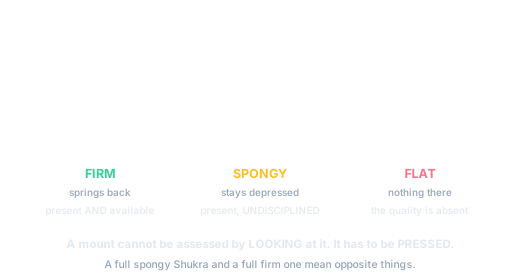
A mount cannot be assessed by looking at it. It has to be pressed.
Open your dominant hand and press each pad with the thumb of the other hand. Four things are being read:
Elevation. Is it raised, level, or hollow? Compare each mount to its neighbours rather than to some imagined ideal — the reading is always relative. One mount standing higher than the rest is the single most informative feature of your hand.
Firmness. This is the measurement everyone skips, and it is the most important. A firm, resilient mount that springs back means the quality is present *and available*. A spongy, soft mount that stays depressed means the quality is present but not disciplined — appetite without control. A hard, unyielding mount means the quality is rigid, held tightly, difficult to express.
So a full, spongy Shukra Parvat is not the same as a full, firm one. The first is indulgence. The second is warmth. Same height. Opposite readings. An article can never tell you this, and a photograph struggles with it — which is an honest limit of every online reading, including ours.
Colour. Pink and healthy: active. Pale: depleted. Very red: overheated, irritable in that quality.
Displacement. Where the mount's apex actually sits — which is the most advanced reading on the hand, and we will come to it.
Guru and Shani: authority and endurance
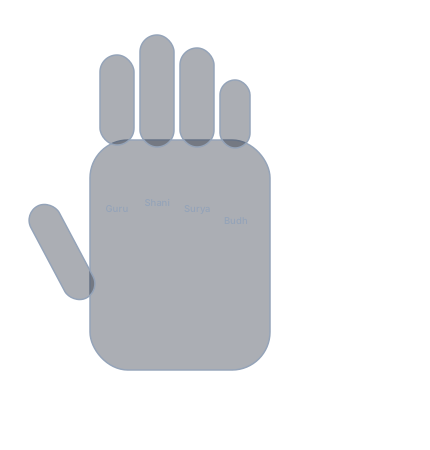
Guru Parvat (Jupiter) — below the index finger.
The mount of ambition, authority, ethics and the desire to be respected. It governs the instinct to lead, to teach, to hold a position of standing.
*Well-developed and firm:* natural authority. People follow this person without being compelled. Confidence that does not need to announce itself.
*Flat:* reluctance to lead, discomfort with visibility, a tendency to defer. Often on the hands of highly capable people who let less capable people run the room — and who cannot explain why they never put themselves forward.
*Over-developed and spongy:* the hunger for status detached from the work that would justify it. Classically read as vanity and domineering pride. It is visible to everyone except the person carrying it.
Shani Parvat (Saturn) — below the middle finger.
The mount of discipline, patience, endurance and solitude. Saturn governs the capacity for long, unglamorous, unrewarded work — the least fashionable virtue available and the one that decides most outcomes.
*Well-developed:* staying power. This person finishes what others abandon. Not brilliant — durable, which beats brilliant over a decade.
*Flat:* difficulty with sustained tedium. Starts well, does not finish. Needs external structure imposed on them, and resents it.
*Over-developed:* severity, isolation, melancholy, a tendency to punish oneself with work. Discipline turned inward until it hardens.
Guru and Shani together decide your relationship with responsibility — whether you want it, and whether you can carry it. They are the two mounts that most determine a career.
Stop guessing at your own hand
You have just pressed seven pads on your palm and are not entirely sure what you felt. That is normal — mount reading is the hardest part of Hast Rekha and the part almost every practitioner does badly, including many who charge for it.
A palmist charges ₹500 to ₹2,000 to assess your hand. Whether they actually press your mounts, or simply glance and improvise, is something you will never be able to verify.
The AI Hast Rekha Calculator reads all seven mounts from one photograph — elevation, relative dominance, displacement, and every sign sitting on them — and applies classical Samudrika Shastra rules to the combination.
- No birth time. No birth date. No birth place. Your palm is enough.
- All 7 mounts + 6 lines + every sign, read as one system — never a mark in isolation
- 8 life scores, classical interpretation, personalised remedies, downloadable PDF
- The honest limit: a photograph reads elevation and shape well, and firmness less well than a hand pressed in person. We would rather tell you that than pretend otherwise
- Your palm image is never stored on our servers — it stays in your browser session and is removed after analysis
- ₹51. No subscription, no upsell, no ritual to buy afterwards
Surya and Budh: recognition and commerce
Surya Parvat (Sun) — below the ring finger.
The mount of creativity, charisma, artistic instinct and recognition. It governs the capacity to make something with form and beauty, and the appetite to be seen for it.
*Well-developed:* real creative force and a magnetism that draws attention without demanding it. Reputation that is earned.
*Flat:* recognition simply is not part of this person's story. And here is the thing nobody says — that is genuinely fine. A great many prosperous, contented, well-lived lives are entirely unwitnessed by strangers. The assumption that every hand needs an audience is a modern disease, not a classical one.
*Over-developed and spongy:* appetite for applause exceeding the willingness to earn it. Vanity, and the fragility that comes with it.
Budh Parvat (Mercury) — below the little finger.
The mount of speech, negotiation, commerce and quick calculation. This is where the marriage lines also sit, which is not an accident — Samudrika Shastra reads marriage as a partnership question, and partnership is Mercury's domain.
*Well-developed:* the trader, the negotiator, the persuader. Fast, articulate, commercially instinctive.
*Flat:* difficulty with negotiation, discomfort with self-advocacy, a tendency to accept the first number offered.
*Over-developed:* cleverness detached from substance. The classical texts are notably wary of a strongly over-developed Mercury mount, and they say why: persuasion without integrity is the most dangerous combination in the hand.
Shukra, Chandra and Mangal: warmth, imagination, courage
**Shukra Parvat (Venus) — the fleshy base of the thumb, enclosed by the life line.**
The reservoir. Vitality, warmth, sensuality, love of comfort and beauty, capacity for physical care. The largest mount on the hand and the most consequential in relationships.
*Full and firm:* physical confidence, genuine warmth, generosity that costs nothing. These people are pleasant to be near and they recover fast.
*Flat and hard:* the person feels deeply and gives with difficulty. Partners experience this as coldness no matter how much love is actually present — and this single mismatch explains an enormous amount of relationship pain that neither party can articulate.
*Full and spongy:* appetite exceeding capacity. Indulgence without stamina to sustain it.
Chandra Parvat (Moon) — the outer heel of the palm.
Imagination, intuition, emotional depth, the pull toward travel, water and the unfamiliar. Careers powered by other people — the public, an audience, clients — rise from this mount, which is why a fate line originating here is so significant.
*Well-developed:* genuine creative and intuitive capacity. Restlessness that produces something.
*Flat:* literal, grounded, uninterested in the abstract. Comfortable at home. Not a defect.
*Over-developed:* imagination running without a brake — the mind convincing itself of things. Anxiety, illusion, an inner life that produces distress rather than material.
Mangal (Mars) — two zones plus the plain between them.
Upper Mangal (above the thumb, below Jupiter): active courage, initiative, physical drive. Lower Mangal (on the percussion side, below Mercury): passive courage — resistance, endurance, the ability to absorb a blow and remain standing.
And between them, the Mangal Kshetra (Plain of Mars) — the hollow centre of the palm. This is read for how you handle conflict. A firm plain means force is available under pressure. A deeply hollow plain means conflict drains rather than energises, and this person avoids confrontation at real cost to themselves.
Displacement: the reading almost nobody performs
This is the most advanced measurement on the hand, and it is where mount reading stops being a checklist and starts being a diagnosis.
A mount has an apex — the highest point of the pad. And that apex is not always where it should be. It leans, and the direction it leans in tells you what the quality is being pulled toward.
Press carefully and find the peak of each mount. Ask: is it centred beneath its finger, or has it drifted toward a neighbour?
Guru leaning toward Shani. Ambition disciplined by patience. Authority earned slowly, through endurance rather than charisma. An excellent combination and a common one in senior professionals.
Shani leaning toward Surya. Discipline seeking recognition. The grinder who wants — and usually deserves — to be seen. Read this alongside the sun line; the frustration in this configuration is often acute.
Surya leaning toward Budh. Creativity turned commercial. The artist who can sell. Rare, and unusually valuable.
Budh leaning toward Surya. Commerce seeking prestige. Business conducted for status as much as for money.
Shukra apex leaning toward the thumb. Warmth held under the control of will — affection that is managed rather than spontaneous.
Chandra leaning toward Shukra. Imagination fused with sensuality. Strongly creative, strongly appetitive.
A displaced mount is not a flaw. It is a fusion — two planetary qualities running together. And it explains the people who do not fit any of the clean archetypes, which is to say, most people.
Your dominant mount is your type
Once you have pressed all seven, one question settles the reading: which mount is highest?
That mount is your planetary type — the standing bias of your temperament, the quality your hand keeps returning to.
Guru-dominant: the leader. Wants position, respect, a platform. Needs responsibility or goes sour.
Shani-dominant: the endurer. Serious, patient, solitary, deeply reliable. Prone to melancholy and to punishing themselves with work.
Surya-dominant: the performer. Creative, magnetic, needs to be seen. Fragile when ignored.
Budh-dominant: the merchant. Quick, articulate, commercially instinctive, restless.
Shukra-dominant: the lover. Warm, physical, generous, comfort-seeking. The most common dominant mount and the least discussed, because it is not glamorous.
Chandra-dominant: the dreamer. Imaginative, intuitive, restless, drawn away from home.
Mangal-dominant: the fighter. Direct, courageous, combative, uncomfortable with subtlety.
And the honest closing: no type is superior. The classical texts do not rank them, and any reader who tells you a Guru hand is better than a Shukra hand has substituted their own snobbery for the shastra.
What the dominant mount gives you is fit. Most professional misery is a person with one type doing the work of another — a Chandra hand in an accounts department, a Shukra hand in a role with no human contact. Knowing your type will not change your life. Knowing it and then ignoring it, however, reliably wastes one.
And on gemstones: never wear a stone because a mount looked weak. Remedial stones are prescribed from the birth chart, not the hand — check suitability with the gemstone suitability calculator first. A weak mount is strengthened by behaviour long before it is strengthened by a ratna.
Get all seven mounts read as one system
A single mount tells you almost nothing. Seven mounts, read against each other, with their relative dominance and their displacement, and with every line and sign placed correctly on them — that is a reading.
The AI Hast Rekha Calculator detects all seven mounts from one palm photo, measures relative elevation and apex position, identifies your dominant mount, and reads every line and sign against the mount that carries it — because a star on Surya and a star on Shani are opposite readings, and a trishul on a flat mount amplifies nothing.
You get 8 life scores, a full classical Samudrika Shastra interpretation, personalised remedies and a downloadable PDF report.
₹51. One photo. No birth time, no birth date, no birth place. Your palm image is never stored on our servers.
And the honest limit, stated again because it matters: a photograph reads elevation and shape well. It reads firmness less well than a trained hand pressing yours in person. If you have access to a genuinely skilled, non-commercial palmist, use them. Most people do not — which is the entire reason this exists.
Read my palm → · Or start with the complete Hast Rekha guide.
Mounts versus lines — which one is the real answer
Beginners fixate on lines because they are easier to see. The mounts underneath actually supply the raw material — a strong fate line with flat mounts is a direction with little fuel behind it. Read mounts first, lines second.
Guru mount in detail — the line between authority and arrogance
A full Guru mount gives natural leadership, ethics, and a genuine desire for respect. Overdeveloped, it tips into arrogance and dismissiveness. Flat, it shows reluctance to lead rather than lack of capability.
Always read this mount alongside the index finger's own length, and the M sign if it happens to sit nearby.
Shani mount in detail — discipline that can curdle into isolation
A well-formed Shani mount gives patience, depth, and the capacity for long unglamorous work. Overdeveloped, it produces severity and self-imposed isolation. Flat, it shows restlessness and a low tolerance for repetitive effort — the same restlessness often shows up in a wavering fate line.
Surya mount in detail — charisma versus performing for attention
A full Surya mount gives creativity, charisma and artistic instinct. Overdeveloped, it becomes a need for constant validation. Flat, it shows real modesty, sometimes at the cost of being noticed for work that deserves it.
The sun line rising through this mount confirms whether the charisma actually converts into recognition.
Budh mount in detail — the trader's hand, examined closely
A strong Budh mount gives quick calculation, negotiation skill and natural ease in commerce. Overdeveloped, it can slide into manipulation. Flat, it shows a more direct, less transactional way of dealing with people, regardless of what the head line shows about thinking style.
Shukra mount in detail — vitality, warmth, and its excess
A full Shukra mount gives genuine physical and emotional energy, sensuality and family warmth. Overdeveloped, it tips into self-indulgence. Flat, it shows a more reserved, less demonstrative temperament — not a lack of feeling, just less display of it.
The life line that encloses this mount means very little without checking the mount's own size first.
Chandra mount in detail — imagination and its emotional undertow
A full Chandra mount gives imagination, intuition and pull toward travel or public-facing work. Overdeveloped, it can produce escapism and mood volatility. Flat, it shows a grounded, less speculative temperament.
Mangal zones in detail — courage, aggression, and the plain between them
Upper Mangal shows courage under pressure; Lower Mangal shows raw physical drive and quick reaction. The Mangal Kshetra between them, when notably flat or notably raised, shows how conflict itself is handled — flat for calm, raised for reactive intensity.
Can mounts change shape over a lifetime
Yes, gradually. Sustained work of a particular kind can visibly develop a mount over years — a career spent negotiating tends to firm up the Budh mount; years of disciplined solitary work can firm up Shani. This shift is slow, measured in years, not weeks — the same pace at which the fate line itself changes.
The thumb and the mounts it sits beside
The thumb sits directly against Shukra and near Mangal, and its firmness modifies both. A firm thumb beside a full Shukra mount channels that vitality with discipline; a very flexible thumb beside the same mount lets it run unchecked.
Never read Shukra's size without checking the thumb right next to it.
Both hands compared, mount by mount
A mount's development on the non-dominant hand shows inborn aptitude; the same mount on the dominant hand shows how much that aptitude has actually been used. A full Guru mount on the non-dominant hand with a flatter one on the dominant hand often marks unused leadership potential.
The full two-hand method is in which hand to read.
Mounts have no bearing on Manglik dosha
Mount development, including the Mangal zones despite the shared name, has no connection to Manglik dosha — that is determined strictly by the planet Mars's house placement in the birth chart.
The real check is the free manglik dosh calculator.
Signs sitting on mounts — how location changes their meaning
A machli on Chandra reads as favour tied to intuition or travel; the same machli on Guru reads as favour tied to leadership. A trishul amplifies whichever mount carries it rather than meaning one fixed thing everywhere.
Never read a sign's meaning before identifying the mount underneath it.
Classical sources behind the seven mounts
On classical support: the Trikaal Library holds one palmistry text, Varahamihira's Brihat Samhita (Ch.67, Purusha Lakshana); it does not list the seven planetary mounts. It does read the base of the thumb — the region of the Shukra mount — saying that lines there indicate sons and fine ones daughters (Sl.49)[1], a rule that later palmists dispute and that we treat as a classical curiosity, not a prediction. The planet-to-mount correspondence (Guru, Shani, Surya, Budh, Shukra, Chandra, Mangal) is Jyotish tradition and is presented here as a teaching framework, not as a verse.
The full framework is in the Hast Rekha guide.
Confirming a mount's height in a photograph, not just by eye
A mount's true elevation is best felt with a finger pressed lightly against it, but a photograph taken with the hand completely relaxed and flat still shows genuine height differences reliably. A tensed or cupped hand can flatten or exaggerate every mount equally.
The full photo standard is in is palm reading accurate.
How AI reading measures mount development
The engine compares the relative height and fullness of each of the seven zones against one another, the same comparative method a trained human reader uses, rather than judging any one mount in isolation.
See how AI palm reading works, or get your own hand read for ₹51.
Wealth and the mounts — the honest convergence rule
No single mount produces wealth on its own. The classical wealth reading always converges several signals — a strong Budh mount for earning, a clear fate and sun line for direction and recognition, and a firm thumb for discipline, together.
Anyone reading wealth from one mount alone is skipping the actual method laid out in the Hast Rekha guide.
Common mistakes reading the seven mounts
The most common error is judging one mount in isolation instead of comparing all seven against each other, since dominance is always relative. The second is skipping the thumb, which modifies how several neighbouring mounts actually get used.
Always compare across the whole hand before naming a 'dominant' mount — the same discipline required in is palm reading accurate.
Mixed and balanced hands — when no mount clearly dominates
A hand where two or three mounts are roughly equally developed is not an unclear reading — it describes a genuinely multidimensional temperament rather than a single defining trait. This is common and should not be forced into a single 'type.'
Frequently asked questions about the mounts
Can a flat mount mean a weakness in that area? Not necessarily — it usually means the trait is present but understated, not absent. Do mounts predict career directly? No, that remains the fate line's job; mounts describe temperament that supports or resists a given direction. Is one mount ever 'bad'? No — every mount describes a trait that is useful in the right context.
Bringing the seven mounts into the whole system
Mounts supply what the life, fate, head and heart lines then describe in use. Every mark discussed on this site — machli, trishul, the M sign — means little without first identifying which mount it sits on.
Whether any of this holds up is addressed honestly in is palm reading accurate. The full method is in the Hast Rekha guide, and you can begin your own reading for ₹51.
Apna Personalized Analysis Lein
Yeh article general framework hai. Aapke specific chart ke according detailed analysis ke liye:
शब्दावली · Glossary
- Parvat (mount)
- A raised pad of the palm, named after a graha, that supplies the quality which the lines act on.
- Guru Parvat
- The mount below the index finger, linked with Jupiter.
- Shani Parvat
- The mount below the middle finger, linked with Saturn.
- Shukra Parvat
- The mount at the base of the thumb, linked with Venus and enclosed by the life line.
- Chandra Parvat
- The mount on the outer edge of the palm opposite the thumb, linked with the Moon.
ग्रंथ सन्दर्भ · Classical Sources
The classical source behind every rule in this article — Granth, Adhyaya and Shlok number.
वापीदेवकुलाद्यैः धर्मं कुरुवन्ति च त्रिकोणाभिः । अंगुष्ठमूलरेखाः पुत्राः स्युः दारिकाः सूक्ष्माः ।
— Brihat Samhita, Adhyaya 67 — Purusha Lakshana Adhyaya · Shlok 49Lines shaped like a step-well or temple, and triangular lines, mark those who perform dharmic works; lines at the base of the thumb indicate sons, and fine ones daughters.
वापी, देवालय जैसी आकृति वाली और त्रिकोण आकार की रेखाएँ धर्म-कार्य करने वाले का लक्षण हैं; अँगूठे के मूल की रेखाएँ पुत्रों का, और सूक्ष्म रेखाएँ पुत्रियों का संकेत देती हैं।
Each reference checked against the Trikaal Vaani Granth library or a reputable open source · Interpretation: Rohiit Gupta, Chief Vedic Architect
Frequently Asked Questions
What are the seven mounts on the palm?
Guru (Jupiter, below the index finger), Shani (Saturn, middle finger), Surya (Sun, ring finger), Budh (Mercury, little finger), Shukra (Venus, base of the thumb), Chandra (Moon, outer heel) and Mangal (Mars, in two zones with the Plain of Mars between them).
Why are the mounts more important than the lines?
The mounts supply the qualities; the lines describe what is done with them. A magnificent fate line on a flat Saturn mount is someone executing well in a domain where they have no natural substance. A sign on an undeveloped mount amplifies almost nothing.
How do you read a palm mount?
By pressing it, not looking at it. Four things are read: elevation (relative to the neighbouring mounts), firmness (a firm mount means the quality is available; a spongy one means it is undisciplined), colour, and displacement — where the apex actually sits.
What does a flat mount of Venus mean?
The person feels deeply and gives with difficulty. Partners experience this as coldness regardless of how much love is actually present. It is one of the most common unspoken sources of relationship pain.
What is mount displacement?
When a mount's apex leans toward a neighbour rather than sitting centred. It indicates a fusion of two planetary qualities — Jupiter leaning toward Saturn is ambition disciplined by patience. It is the most advanced measurement on the hand and almost nobody performs it.
What does my dominant mount mean?
It is your planetary type — the standing bias of your temperament. Guru is the leader, Shani the endurer, Surya the performer, Budh the merchant, Shukra the lover, Chandra the dreamer, Mangal the fighter. No type is superior; the classical texts do not rank them.
Can a photo read mounts accurately?
It reads elevation, dominance and shape well. It reads firmness less well than a trained hand pressing yours in person — that is a genuine limit and we would rather state it than pretend otherwise.
See also · यह भी देखें
Part of the hubHast Rekha Gyan — 5 Myths Everyone RepeatsGroup: The seven mounts (Parvat) and what they reveal
Broken Fate Line? Why It Is Often Good News
palmistryFish Sign on Palm? It's Probably an Island
palmistryShort Life Line? It Does Not Mean Early Death
palmistryM Sign on Palm — Not Rare, But Telling
palmistryStar, Triangle, Square: Only One Is Luck
palmistrySun Line — Why the Best Worker Gets Passed Over
palmistryTrishul on Palm — It Multiplies, Not Promises
Categories: palmistry · spirituality