Star, Triangle, Square: Only One Is Luck
Trikaal Sandesh — Direct Answer
The square, triangle and star are modifier marks in Samudrika Shastra. A square indicates protection and forms over a break or a period of danger. A triangle indicates skill and applied intelligence. A star indicates sudden intensity — which is favourable on some mounts and genuinely disruptive on others.
Deep Dive Analysis
Three marks, three completely different jobs
Every list of lucky palm signs on the internet lumps these three together. Star, triangle, square — all filed under *auspicious*, all promising fortune, all interchangeable.
They are not interchangeable. They do three entirely different jobs, and one of them is not reliably lucky at all.
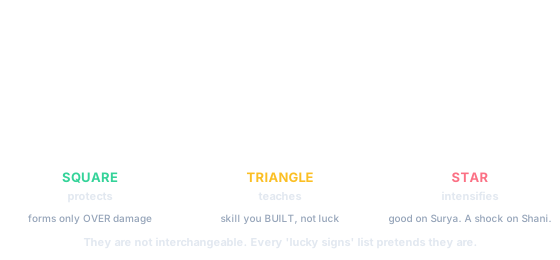
The square protects. It is a rescue mark. And it carries a strange, beautiful implication that almost nobody states: a square only appears where something went wrong. It does not decorate a healthy line. It forms over damage.
The triangle teaches. It indicates skill, applied intelligence, mastery earned through work. It is the mark of capability that was *built*, not granted.
The star intensifies. And intensity is not the same as fortune. A star on one mount indicates sudden elevation. On another it indicates a shock. The internet has quietly deleted the second half of that sentence, because it does not convert.
Understand these three functions and you will read your own hand better than most people charging money to do it.
The square: the scar that healed
Of all the marks in Samudrika Shastra, the square is the one we would most want on our own hand — and it is the one nobody asks about.
A square (chaturbhuj) is a four-sided figure enclosing a section of a line or sitting on a mount. Its classical function is preservation: it indicates that a difficulty occurred and the person came through it intact.
Now read that carefully, because the implication is the whole point.
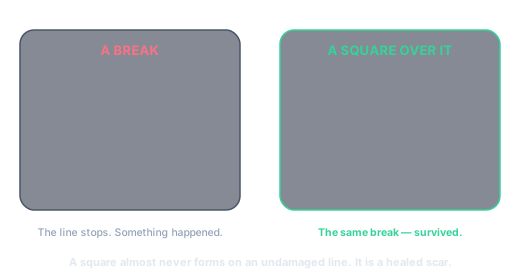
A square almost never appears on an undamaged line. It forms *over* a break, a chain, an island — over the trouble. Which means when you find a square on your hand, you are not looking at good luck. You are looking at evidence of something that went badly and did not destroy you.
It is a healed scar, and the tradition regards it as more valuable than most of the marks people actually hope for.
- **A square over a break in the life line:** a serious disruption to health, environment or circumstance — survived. The constitution held.
- **A square over a break in the fate line:** a career collapse or forced transition that did not end the career. The person rebuilt.
- A square over an island on the heart line: an emotional period that could have broken something permanent, and did not.
There is a quiet dignity in this mark that the fortune-selling industry has no use for, which is exactly why you have never seen a video about it.
The teacher's square, and squares on the mounts
A square sitting on a mount rather than over a line has a different function, and one placement is famous enough to have its own name.
The teacher's square — a square on the Guru Parvat (Jupiter, below the index finger). This is not a protective mark. It is a capability mark, and it is one of the most specific readings in all of Hast Rekha: the ability to make another person understand something.
Not to know a thing. To transmit it. Those are different skills, and most experts have only the first. The teacher's square belongs to the person who can take something complicated out of their own head and install it in someone else's — teachers, trainers, mentors, the manager everyone actually learns from.
If you have it and you are not teaching anything, the classical reading is unambiguous: it is being wasted.
Square on the Shani Parvat (Saturn): protection through discipline and endurance. Difficulty met with patience rather than force.
Square on the Surya Parvat (Sun): protection of reputation. Standing that survives attack — and, read honestly, it implies the attack came.
Square on the Shukra Parvat (Venus): protection in matters of the heart and physical vitality. The bond, or the body, that should have broken and did not.
Every square carries the same double message: you were protected, which means you needed protecting.
The triangle: the mark you have to earn
A triangle (tribhuj) is a three-sided figure formed by three independent lines meeting — and the geometry matters enormously, because most people counting triangles on their palm are looking at random intersections.
A true triangle is formed by three lines crossing to enclose a clean, deliberate shape. It is not the accidental corner where two lines happen to touch a third.
What it indicates is applied intelligence — skill in the quality of the mount that carries it. And notice the word *applied*. The triangle is not a gift. It is not luck. In the classical framing it marks a capability that was developed, and it is one of the few marks in Samudrika Shastra that describes something you did rather than something you were given.
Triangle on the Guru Parvat: diplomatic and organisational skill. The ability to manage people without force.
Triangle on the Shani Parvat: aptitude for the occult, research, and any discipline requiring long solitary study.
Triangle on the Surya Parvat: genuine artistic skill — as distinct from artistic *temperament*, which is far more common and far less useful.
Triangle on the Budh Parvat: commercial and scientific aptitude. The negotiator, the analyst, the trader.
Triangle on the Chandra Parvat: intuitive and imaginative skill that has been *disciplined* into something usable.
Triangle on the head line: exceptional mental capability in the field the head line is already pointing toward. Read the head line guide alongside this.
A triangle on a strong mount is one of the best marks you can carry. A triangle on a flat mount is potential nobody has developed — and, unlike the square, it is not consolation. It is a bill that has not been paid.
Stop guessing at your own hand
You are here because you found something on your palm and want to know if it is one of the good ones. Every list on the internet will tell you yes — because *yes* is what keeps you reading.
A palmist charges ₹500 to ₹2,000 to look at it, and in the offline market a substantial number of them will find an auspicious mark whether or not one is there, because a hopeful client buys the puja that activates it.
The AI Hast Rekha Calculator reads it from one photograph, and it has one honest advantage over both a palmist and your own hopeful eye: it does not want you to have a lucky sign.
- No birth time. No birth date. No birth place. Your palm is enough.
- Strict geometry — a triangle needs three lines enclosing a clean figure, a square needs four sides, a star needs rays from a common point. If it does not meet the rule, it is not the mark
- 6 lines, 7 mounts, 8 life scores — every sign read against the mount that carries it, never in isolation
- Your palm image is never stored on our servers — it stays in your browser session and is removed after analysis
- ₹51. No subscription, no upsell, no ritual to buy afterwards
The star: the mark everyone wants and nobody understands
Here is where we part company with almost every palmistry page in existence.
A star is not automatically lucky.
A star (tara) is formed by several short lines radiating from a common central point — five or six rays crossing. What it indicates in Samudrika Shastra is sudden, concentrated intensity: an event or a force that arrives with power and without warning.
Whether that is fortune or damage depends entirely on where it sits.
Star on the Surya Parvat (Sun mount). The celebrated one, and rightly so: sudden, significant elevation of reputation and standing. Recognition arriving in a rush. This is a genuinely fine mark — on a *developed* Surya Parvat. On a flat one it amplifies very little. See the sun line guide.
Star on the Guru Parvat (Jupiter). Sudden elevation in authority or position. Favourable.
Star on the Budh Parvat (Mercury). Sudden commercial success — or, classically, sudden success through cleverness, which the older texts warn can cut both ways.
Star on the Shani Parvat (Saturn). And here the tradition stops smiling. A star on the Saturn mount is read in traditional palmistry as a shock — a sudden, disruptive, fated event. Not a blessing. That is the traditional reading, and the internet is silent about it, because it is not a sentence that sells a reading.
Star on the Chandra Parvat (Moon). Intensity in imagination — which the classical sources treat with caution, since it amplifies the mind's capacity to convince itself of things.
Star at the end of a line generally indicates a sharp, disruptive interruption to whatever that line governs.
We include the unfavourable placements because a reading that only reports good news is not a reading. It is an advertisement.
Why every 'lucky signs' list you have read is junk
Search *lucky signs on palm* and you will get the same list on forty sites: star, triangle, square, fish, trishul, lotus, conch — all auspicious, all promising wealth, none of them contextualised.
That list is worthless, for three specific reasons.
One: it ignores placement. Every mark in Samudrika Shastra takes its meaning from what it sits on. A star on Surya is elevation. A star on Shani is a shock. The same symbol, opposite readings. A list that names the symbol without the mount is not simplifying the shastra — it is deleting it.
Two: it ignores mount strength. A mark amplifies, protects or applies a quality. If the mount carries nothing, the mark modifies nothing. A star on a flat Surya Parvat is not a promise of fame. It is a firework over an empty field.
Three: it collapses every mark into money. Fish means wealth. Star means wealth. Trishul means wealth. Triangle means wealth. When every symbol produces the same prediction, the symbols have stopped meaning anything — and the reading has become a slot machine with a Sanskrit skin.
We are not going to write a better version of that list. We are going to tell you that the square on your life line — the one nobody made a video about — is quietly the most meaningful mark on your hand, and that it is there because you survived something.
What to actually do with these three marks
If you have a square over a break. You already survived it. The useful response is not gratitude to a mark on your skin — it is recognising your own resilience as data. People with protective squares consistently underestimate how much they have already come through, and they approach the next difficulty as though they have never handled one. You have. The hand is telling you so.
If you have a teacher's square on Guru and you are not teaching. Start. A workshop, a junior colleague, a written explainer, anything. This is the most under-used capability mark in Hast Rekha, and it goes to waste in people who assume that because a thing is obvious to them, it must be obvious to everyone. It is not.
If you have a triangle on a strong mount. You have a developed skill you may be treating as a hobby. Look at which mount it is on and take that skill seriously.
If you have a triangle on a flat mount. The aptitude is real and undeveloped. This is the most actionable mark on the hand — build the mount, and the triangle finally means something.
If you have a star on Shani. Do not panic, and do not let anyone frighten you into buying protection from it. It indicates that sudden, disruptive events feature in this life — which is true of a great many lives, most of which turn out fine. Build reserves. Keep a buffer. Do not over-leverage. That is the entire remedy and it costs nothing.
On gemstones: never wear a stone because a palm mark suggested it. Remedial stones are prescribed from the birth chart, not the hand. Check suitability against your actual chart with the gemstone suitability calculator first.
Get your signs read against the mounts that carry them
None of these three marks means anything on its own. A square is meaningless until you know what it is protecting. A triangle is meaningless until you know which mount it is skilling. A star is meaningless — and occasionally misleading — until you know whether it sits on Surya or on Shani.
The AI Hast Rekha Calculator detects these marks from a single palm photo, checks the strict geometry rather than your hopes, identifies which mount or line carries each one, and measures how strong that mount actually is. You get 8 life scores, a full classical Samudrika interpretation, personalised remedies and a downloadable PDF report.
₹51. One photo. No birth time, no birth date, no birth place. Your palm image is never stored on our servers.
It will not hand you a list of lucky signs. It will tell you what is actually on your hand, where it sits, and what it can honestly do — including the marks that are not good news, because a reading that only reports good news is not a reading.
Read my palm → · Or start with the complete Hast Rekha guide.
The star on the fate line — sudden career turns
A star on the fate line marks a sudden, intense career event — a breakthrough or a sharp disruption, depending on the rest of the hand. Its intensity is real either way; what it does with that intensity depends on the mount and lines around it.
Never read a star in isolation from what surrounds it.
The triangle on the head line — analytical gift
A triangle formed on or near the head line is read as applied analytical skill — the kind that shows up in engineering, strategy, or any work requiring patient problem-solving. It is earned complexity, not luck.
A triangle here rewards training rather than promising raw talent alone.
The square as protection on a weak life line
A square appearing over a thin or broken section of the life line is one of the most reassuring combinations in the tradition — protection precisely where vitality was vulnerable. This is why the square is called the healed scar rather than the wound itself.
The protection is specific to that location, not a blanket guarantee.
Can these three marks appear or fade over time
Yes. Because they typically form on secondary lines and mounts that themselves change, a star, triangle or square can appear after a defining event, or fade as the phase it marked passes. None of the three is fixed at birth.
This is consistent with every other secondary mark on the hand.
The thumb and these three marks — capacity versus execution
A triangle or square shows capacity; the thumb shows whether that capacity gets used. A firm thumb alongside a triangle on the head line usually means analytical skill that actually gets applied; a very flexible thumb with the same triangle suggests insight that stays theoretical.
Read the thumb before drawing conclusions from any of these three marks.
Both hands compared — which carries more weight
On the non-dominant hand, a star, triangle or square shows inborn tendency; on the dominant hand, it shows what has actually happened. The same mark on both hands is read as the strongest, most reliable version of that signal.
See which hand to read for the full comparison method.
These marks and Manglik dosha — unrelated systems
None of these three marks has any bearing on Manglik dosha, which is determined strictly by Mars's house placement in the birth chart. Anyone linking a palm star or square to Manglik status is combining two systems that do not connect.
The actual check is the free manglik dosh calculator.
Classical sources behind star, triangle and square
On classical support: the Trikaal Library holds one palmistry text, Varahamihira's Brihat Samhita (Ch.67, Purusha Lakshana), and of these three shapes it speaks only of the triangle — it says lines shaped like a step-well or temple, and triangular lines, mark those who perform dharmic works (Sl.49)[1]. It has no verse on the star or the square, so this page cites nothing for them. Trikaal Vaani's reading: the triangle as earned, applied skill, the square as a healed scar and the star as intensity that depends on its mount are our reading of the hand, not the content of that verse, which names dharmic works and not skill. The verse gives no lifespan, no disease, no dates and no promise of wealth, and neither does this page.
The full framework is in the Hast Rekha guide.
Telling a real mark from a shadow in a bad photo
Poor lighting or an angled shot can make ordinary skin creases look like a faint triangle or square. A genuine mark holds its shape from a flat, overhead, daylight photo — a shadow artefact does not.
The full photo standard is in is palm reading accurate.
How AI reading verifies these three marks
The engine checks for closed, well-formed geometry rather than counting any crossing lines as a mark — a genuine star, triangle or square holds a recognisable shape; random creases do not. Photo quality is what actually limits accuracy here, not the method.
See how AI palm reading works, or get your own hand read for ₹51.
Wealth claims built on these marks — the honest limit
No single mark, including a star or triangle on a favourable line, guarantees wealth. Wealth in the classical tradition always reads as a convergence — a strong Budh mount, a clear fate and sun line, and a disciplined thumb together, never one geometric mark alone.
Anyone selling a fortune off a single triangle is selling a story, not a reading.
Putting star, triangle and square into the whole system
None of these three marks stands alone — each takes its real meaning from the line or mount beneath it: life line, fate line, head line, or any of the seven mounts. Nearby signs like machli or trishul reinforce the same foundation from a different angle.
Whether any of this holds up is addressed honestly in is palm reading accurate. The full method is in the Hast Rekha guide, and you can start with your own reading for ₹51.
The star on the sun line — sudden recognition
A star on the sun line marks a sudden burst of public recognition rather than the gradual reputation the line usually builds. It is a genuine intensifier, not a separate promise — without a sun line present at all, a nearby star means much less.
Read the star against the line's existing strength first.
The square protecting a broken heart line
A square sitting over a break in the heart line is read as emotional resilience carrying someone through a difficult relational period — protection at exactly the point of strain, the same logic as a square on the life line.
The break still happened; the square describes how it was weathered.
When these marks cluster on one mount
Multiple marks — a star and a triangle, say — clustering on a single mount concentrates that mount's theme rather than diluting it. A cluster on the Guru mount reads as an unusually intense, repeated pattern of leadership tests and gains, not confusion.
Clustering is rare enough that it is worth double-checking against a clear photo before trusting it.
When these marks typically appear
Because stars, triangles and squares usually form on secondary lines and mounts that develop with age, they are uncommon before the late twenties and become more legible through the thirties and forties as the underlying line matures.
A child's hand showing none of these is entirely expected, not a gap.
The gender-based hand myth applied to these marks
The claim that these marks mean something different in a man's hand versus a woman's hand has no basis in the classical texts — the geometry reads the same regardless. What actually changes the reading is dominant versus non-dominant hand, covered fully in which hand to read.
Gender-based palmistry claims are folk material, not shastra.
The most common mistake reading these three marks
The most common error is spotting any crossing of two faint lines and calling it a star — a genuine star needs multiple distinct rays meeting at one point, not two lines happening to overlap. The second is judging fortune from the mark alone, without checking the mount or line beneath it.
Confirm the shape first, then check the location, in that order.
What 'lucky sign' lists online usually get wrong
Most viral lists treat any triangle or star as an automatic windfall, skipping the placement that actually determines meaning entirely. The same triangle on a strong Budh mount and on a weak, flat one tells two very different stories — the lists rarely mention this.
The honest, placement-first method is set out across the Hast Rekha guide.
These marks and career choice
A triangle near the head line fits analytical, methodical careers; a star near the fate or sun line suits fields with visible, public moments — media, performance, competitive fields. Neither mark decides the actual direction, which remains the fate line's job.
Treat these marks as texture on a decision the fate line has already made.
The honest summary on star, triangle and square
None of the three marks changes your fortune on its own. Each amplifies or protects whatever line or mount it sits on, and none of them appears in most hands at all — their absence says nothing negative.
Start your own reading and see what your hand actually carries, for ₹51.
Apna Personalized Analysis Lein
Yeh article general framework hai. Aapke specific chart ke according detailed analysis ke liye:
शब्दावली · Glossary
- Chaturbhuj (square)
- A four-sided figure that encloses part of a line or sits on a mount. It marks protection and usually forms over damage that was survived.
- Tribhuj (triangle)
- A figure formed by three independent lines enclosing a clean shape. It is read as applied skill, not as luck.
- Tara (star)
- Several short lines radiating from one point. It marks sudden, concentrated intensity whose value depends on the mount it sits on.
- Teacher's square
- A square on the Guru Parvat, read as the ability to transmit what you know to another person.
- Guru Parvat
- The mount of Jupiter, below the index finger, where the teacher's square and a star of authority are read.
- Shani Parvat
- The mount of Saturn, below the middle finger, where a star is read as a sudden shock and a square as protection through discipline.
ग्रंथ सन्दर्भ · Classical Sources
The classical source behind every rule in this article — Granth, Adhyaya and Shlok number.
वापीदेवकुलाद्यैः धर्मं कुरुवन्ति च त्रिकोणाभिः । अंगुष्ठमूलरेखाः पुत्राः स्युः दारिकाः सूक्ष्माः ।
— Brihat Samhita, Adhyaya 67 — Purusha Lakshana Adhyaya · Shlok 49Lines shaped like a step-well or temple, and triangular lines, mark those who perform dharmic works; lines at the base of the thumb indicate sons, and fine ones daughters.
वापी, देवालय जैसी आकृति वाली और त्रिकोण आकार की रेखाएँ धर्म-कार्य करने वाले का लक्षण हैं; अँगूठे के मूल की रेखाएँ पुत्रों का, और सूक्ष्म रेखाएँ पुत्रियों का संकेत देती हैं।
Each reference checked against the Trikaal Vaani Granth library or a reputable open source · Interpretation: Rohiit Gupta, Chief Vedic Architect
Frequently Asked Questions
What does a square on the palm mean?
Protection. A square indicates a difficulty that occurred and was survived intact. Crucially, it almost never appears on an undamaged line — it forms over a break or an island. Finding one means you came through something.
Is a star on the palm always lucky?
No, and this is the most important correction on this subject. A star indicates sudden, concentrated intensity. On the Sun or Jupiter mount that is elevation. On the Saturn mount it is read in traditional palmistry as a shock — a disruptive, fated event. Placement decides everything.
What is a teacher's square?
A square on the Guru Parvat (Jupiter mount). It indicates the ability to make another person understand something — not merely to know a thing, but to transmit it. If you have it and are not teaching, it is being wasted.
What does a triangle on the palm mean?
Applied intelligence — skill in the quality of the mount that carries it. Unlike other marks it describes something developed rather than granted. On Jupiter it is organisational skill; on Mercury, commercial aptitude; on the Sun, genuine artistic ability.
What does a square on the life line mean?
A serious disruption to health, environment or circumstance that was survived. The constitution held. It is evidence of resilience already demonstrated, not a warning of trouble ahead.
Are lucky palm sign lists accurate?
No. They name symbols without naming the mount, and every mark in Samudrika Shastra takes its meaning from what it sits on. A star on the Sun mount and a star on Saturn are opposite readings. A list that omits placement has deleted the shastra.
How do I tell a triangle from a random intersection?
A true triangle is formed by three lines crossing to enclose a clean, deliberate figure. An accidental corner where two lines happen to touch a third does not count. If you have to squint and want it, you do not have one.
See also · यह भी देखें
Part of the hubHast Rekha Gyan — 5 Myths Everyone RepeatsGroup: Signs and symbols on the palm: M, machli, trishul and more
Broken Fate Line? Why It Is Often Good News
palmistryFish Sign on Palm? It's Probably an Island
palmistryIsland, Cross, Grille — The Honest Truth
palmistryShort Life Line? It Does Not Mean Early Death
palmistryM Sign on Palm — Not Rare, But Telling
palmistrySwastik, Shankh, Chakra on Palm — Real?
palmistryTrishul on Palm — It Multiplies, Not Promises
Categories: palmistry · spirituality